
 Worksheets
iReady Unit 5 Review
Total questions: 115
Worksheet time: 6hrs 45mins
Evaluate the expression.
49 − 2 x ( 6 + 3 )
33
31
30
29
5÷(8−2)+6×4
9 + [9 x (2 + 4) ÷ 3] - 2
9
34
19
25
2 x (5 + 3 x 2 + 4)
When evaluating this expression, what would be the first expression you would write when solving for step 1?
2 x (5 + 3 x 2 + 4)
2 x (8 x 2 +4)
2 x (5 + 3 x 6)
2 x (5 + 6 + 4)
An______________ is a numerical expression with an equal sign.
Example: 3 + 4 =
Expression
Equation
13 - 2 x 4 =
4
24
5
44

In what step was an error made when solving the numerical expression?
STEP 1
STEP 2
STEP 3
Add 3 and 11, then divide by 2.
( 3 − 11 ) ÷ 2
3 + 11 ÷ 2
11 + 3 ÷ 2
Subtract 7 from 15, then add 6.
15 − 6 + 7
15 −7 + 6
6 + 15 − 7
Increase 23 by 7, then divide by 5.
( 23 × 7 ) + 5
( 23 + 7 ) ÷ 5
7 + 23 − 5
( 23 + 7) −5
Multiply the sum of 45 and 11 by 2.
2 × 45 + 11
45 + 11 × 2
( 45 − 11) × 2
( 45 + 11) × 2
4 times as large as 16.
16 ÷ 4
16 − 4
4 × 16
4 + 16
5 times the difference between 8 and 6.
( 6 − 8) × 5
5 × ( 8 − 6)
5 × 8 − 6
5 + ( 8 − 6)
The quotient of 30 divided by 5 increased by 14.
(30 ÷ 5) − 14
(30 − 5) + 14
30 × 5 + 14
(30 ÷ 5) + 14
8 less than the product of 4 and 6.
4 × 6 −8
( 4 × 6) − 8
8 − (4 × 6)
8 − ( 4 + 6)
2
6
7
12
A mathematical phrase that has at least one operation and no equal sign.
evaluate
expression
order of operations
operation words
Another word for "solve" when working with expressions. Putting the expression in its simplest form.
evaluate
expression
order of operation
operation words
Each child in a group received 5 apples and 2 oranges. There were 3 children in a group. What expression would show the total amount of fruit the children have?
2 + 3 x 5
5 +2 x 3
5 + (2 x 3)
(5 + 2) x 3
10 girls and 20 boys joined a soccer game. The group was divided into 5 teams. What would this expression look like?
10 + (20÷5)
(10 + 20)÷5
10 + (20 × 5)
(10 + 20) × 5

In a coordinate plane, what is the point (0, 0) known as?
A. Origin
B. x-axis
C. x-coordinate
D. y-coordinate
Which ordered pair is described below?
Begin at the origin and move 5 spaces right.
A. (1, 5)
B. (5, 1)
C. (5, 0)
D. (0, 5)

Shelley and Andrew are taking a walk around their neighborhood. The points on the coordinate grid represent locations in their neighborhood. Use the coordinate grid to answer the questions.
Part A.
Andrew walks from the grocery store to another location by traveling 5 units right and 1 unit up. Which location did Andrew travel from and to?
A. from the Grocery Store to the Shoe Store
B. from the Grocery Store to the Movie Theatre
C. from the Grocery Store to the Video Game Store
D. from the Grocery Store to the Park

Part B.
Shelley traveled Home by moving 1 units left and 3 units down. She ended up at Home. Which ordered pair describes where she started?
A. (3,8)
B. (8,8)
C. (4,1)
D. (0,10)

The coordinate plane shows the distance traveled by an Amtrak Train over the course of 8 hours.
How long did it take the Amtrak Train to travel 150 miles?
A. 1 hour
B. 2 hours
C. 3 hours
D. 8 hours

Which point is located at (10, 3) on the coordinate grid?
A. Point F
B. Point G
C. Point H
D. Point J

The coordinate plane represents two ordered pairs. Select all the true statements.
A. Point L is located at (9, 4).
B. Point M is located at (4, 3).
C. The y-coordinate of point L is 9.
D. Point L and M have the same x-coordinate.
E. Both points are the same vertical distance from the origin.
In what order to you plot ordered pairs?
In the ordered pair (5, 8), which number is the x-coordinate?
8
5
neither
both
In the ordered pair (4,9), which number is the y-coordinate?
If you were to plot the point (4, 12) what would be the correct method?
Start at the origin, then go up 4 and then go over 12
Start at 4 and then down 12
Start at the origin, then go over 4 and then go up 12
Start at (0, 0) and then multiply 4 x 12
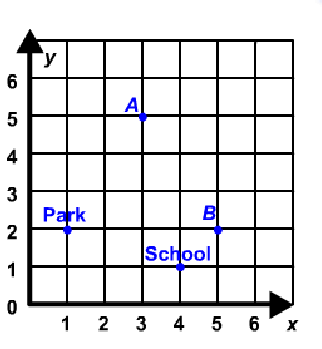

What are the coordinates of point R?

What is the perimeter of ABCD?
9 units
12 units
3 units
6 units

What is the distance between the HOME and the PARK?
7 units
6 units
8 units
9 units
What is the next number in the pattern?
3, 6, 9, 12, 15 ...
19
17
18
16
What is the rule for this pattern?
2, 4, 8, 16, 32 ...
Add 2
Subtract 2
Multiply by 2
Divide by 2

What is the missing term?
6
7
8
10

What is the rule for the Y column?
Add 2
Subtract 2
Multiply by 2
Divide by 2
Will the number 20 appear in the following sequence?
50, 45, 40, 35, 30 ...
Yes
No

What is the rule for going from a term in the X column to a corresponding term in the Y column?
Add 2
Subtract 2
Multiply by 2
Divide by 2

Which of the following would NOT be an ordered pair from the table?
(5, 10)
(15, 30)
(18, 30)
(20, 40)

If you continue the sequence for both X and Y, which of the following would be the next ordered pair?
(25, 45)
(30, 40)
(30, 50)
(25, 50)

What would be the next number in X column?
30
20
25
40

(0,1) (1,3) (2,5) (3,7) ( ? )
A: 1, 3, 5, 7, 9,...
B: 5, 15, 25, 35, 45,...

Describe the correct process of graphing Point A on the graph.
You start at 0 on the Y axis, crawl 1 unit and climb on the X axis 5 units
Starting at the origin you move 1 unit right on the X axis and up 5 units on the y axis
Start at (5,5) and move four spaces to the left
Start at the origin move 5 units up on the Y axis and over 1 unit on the X axis.


Which graph best matches this input/output table?


The chart shows how many hot dogs and pizza slices the lunch room sold each Friday for 3 weeks.
If the pattern continues, how many hot dogs and pizza slices can the cafeteria expect to sell on Friday of Week 5?
Hot Dogs: 23
Pizza Slices: 32
Hot Dogs: 25
Pizza Slices: 35
Hot Dogs: 25
Pizza Slices: 33
Hot Dogs: 27
Pizza Slices: 35
Every bouquet of flowers that Dana makes has 6 daisies and 8 carnations. The ordered pair (36, 48) represents the total number of daisies and carnations Dana used. How many total bouquets did Dana make?
6
8
36
48
Carson walks 4 miles per hour, and Palmer rides his bike 10 miles per hour. Which table shows the relationship between Carson's speed and Palmer's?


The rule t = 5r shows that each ride at the state fair requires 5 tickets. Which ordered pairs can be used to show the pattern on a graph?
(2, 7) (3, 8) (4, 9) (5, 10)
(2, 10) (3, 15) (4, 20) (5, 25)
(2, 5) (3, 5) (4, 5) (5, 5)
(2, 10) (3, 11) (4, 12) (5, 13)

Which rule describes the pattern in the graph?
b = 5a
a = b + 5
a = 5b
b = a + 5

Which number pair extends the pattern on the graph?
(11, 5)
(6, 12)
(6, 11)
(6, 18)
Paul uses a number pattern to graph a point on a grid. He graphs the number pair (3, 5). Which statement about the point is true?
3 is the distance of the point from 0 on the vertical number line.
3 is the distance of the point from 0 on the horizontal number line.
5 is the distance of the point from 0 on the horizontal number line.
5 is the input value from the pattern.

The table uses the rule y = x + 7. Which set of numbers correctly completes the output values in the table?
8, 9, 10
7, 14, 21
8, 10, 12
6, 5, 4

Which rule describes the pattern in the table?
w = v + 3
v = w + 3
v = 3w
w = 3v
The rule b = 7s shows that each shirt, s, needs 7 buttons. How many buttons, b, are needed for 3 shirts?
10
21
40
28

The total cost for renting a tent depends on the size of the tent plus a fee for the tent. The rule is c = 3 + p, where c is the cost and p is the number of people the tent sleeps. Which point on the graph shows the total cost for renting a tent that sleeps 3 people?
Point A
Point B
Point C
Point D

Millie uses the pattern rule I = 6b to generate the first three terms in the pattern. What is the value of the missing number?
24
32
22
16

Which rule describes the pattern in the table?
d = c + 9
d = c + 8
d = 3c
d = 8c
The rule for an input/output table is g = f + 2. What is the output if the input is 10?
8
12
20
18
Ben uses the rule k = j + 10 to show a pattern in the graph. He uses k to represent the output and j to represent the input. If the input is 4, what is the output?
(a)
The rule b = 8m shows that each member, m, of the library may borrow 8 books, b, per visit. Which ordered pair shows the maximum number of books 4 members can check out in a single visit?
(8, 32)
(8, 16)
(4, 12)
(4, 32)

The graph shows the relationship between the number of weeks, w, and the number of soccer games, g, played. Which rule describes the pattern on the graph?
g = w + 3
g = 2w
g = 3w
w = 3g

Which ordered pair extends the pattern on the graph?
(5, 10)
(15, 5)
(6, 15)
(5, 15)
Jasmine uses the rule s = h + 4 to complete a table and make a graph. Which ordered pair would be on the graph?
(4, 22)
(8, 12)
(16, 32)
(2, 4)

Cal uses the rule m = 2n to show a pattern in the graph. He uses m to represent the output and n to represent the input. If the input is 4, what is the output?
8
4
6
2

What is the vocabulary word for the horizontal line at the bottom of the coordinate plane?
X-axis
Y-axis
Origin
Ordered pair

What is the vocabulary word for the vertical line on the left of the coordinate plane?
X-axis
Y-axis
Origin
Coordinate Plane

What is the vocabulary word for the beginning of the coordinate plane, located at the point (0,0)?
x-axis
y-axis
Origin
Ordered Pair
In an ordered pair, the _________ number is called the y-coordinate.
first
second
both
neither
The first number in a number pattern is 7. The rule for the pattern is "Multiply by 2." What are the first five numbers in this pattern?
7, 9, 11, 13, 15....
7, 9, 18, 36, 72....
7, 14, 21, 28, 35....
7, 14, 28, 56, 112....

The table shows how the heights of two trees are changing over time. Which best describes the relationship shown in the table?
Tree X growing 2 feet more each year than tree Y.
Tree Y is growing 1 foot more each year than tree X.
The height of tree X is 3 feet greater than the height of tree Y every year.
The height of tree Y is 2 feet greater than the height of tree X every year.

Mark is slicing oranges. The table shows how the number of slices is related to the number of oranges. Which best describes the relationship shown in the table?
The number of slices is 4 times the number of oranges.
The number of slices is 8 times the number of oranges.
The number of slices is 4 more than the number of oranges.
The number of slices is 6 more than the number of oranges.

Two number patterns are shown in this table.What numbers are missing from the last row of the table?
85 and 76
85 and 79
88 and 76
88 and 79

The table shows five ordered pairs. Which graph shows these ordered pairs?


The first term in Pattern 1 is 6. The rule for the pattern is "multiply by 3."
The first term in Pattern 2 is 25. The rule is "subtract 5."
What are the first three terms in each pattern?
Pattern 1: 6, 18, 54
Pattern 2: 25, 20, 15
Pattern 1: 6, 9, 18
Pattern 2: 25, 30, 35
Pattern 1: 6, 18, 54
Pattern 2: 25, 15, 5
Pattern 1: 6, 18, 36
Pattern 2: 25, 20, 15

Which ordered pair fits into the x/y table?
(55, 44)
(66, 44)
(66, 55)
(77, 66)

Lucy created the table. Which best describes the patterns of x- and y-values shown in the table?
The x-values increase following the rule "multiply by 4," while the y-values increase following the rule "multiply by 2."
The x-values increase following the rule "multiply by 4," while the y-values are twice the x-values.
The x-values increase following the rule "multiply by 2," while the y-values increase following the same rule.
The x-values increase following the rule "multiply by 2," while the y-values are twice the x-values.
Find the rule the pattern is using:
11,9,7,5,3
Subtract 2
Divide 3
Add 3
Subtract 3
Which choice uses the same subtraction rule as the pattern shown?
42,32,22,12,2
29,22,15,8,1
11,9,7,5,3
39,30,21,12,3
47,37,27,17,7
Find the rule the pattern is using:
8,16,32,64
Add 16
Multiply 2
Add 8
Multiply 5
Which choice uses the same addition rule as the pattern shown?
5,12,19,26,33
9,18,27,36,45
6,15,24,33,42
9,16,23,30,37
9,14,19,24,29
Find the rule the pattern is using:
3,9,15,21,27
Multiply 3
Add 4
Add 6
Multiply 10
Which choices uses the same subtraction rule as the pattern shown?
35,25,18,11,4
37,28,19,10,1
36,29,22,15,8
43,34,25,16,7
13,10,7,4,1
What is the SIXTH number in this pattern?
13,16,19,22
28
25
31
22
What is the CORRECTLY written rule for this pattern?
12,21,30,39,48,57
Start at 12. Add 18
Start at 3. Add 9
Start at 21. Subtract 9
Start at 12. Add 9
What is the FOURTH number in this pattern?
47,53,59
71
65
77
64
What is the CORRECTLY written rule for this pattern?
12,21,30,39,48,57
Start at 12. Add 18
Start at 3. Add 9
Start at 21. Subtract 9
Start at 12. Add 9


students who mailed invitations, which equation best shows the
number of invitations that were mailed?
6÷x
34÷z
What is an expression for "the difference of r and 3"?
r÷3
One dozen eggs is 12 eggs. Two dozen eggs is 24 eggs. The rule for this pattern is "Multiply by 12."
How many eggs are in 14 dozen eggs?
144 eggs
168 eggs
26 eggs
96 eggs

The number of legs for 9 grasshoppers is (a) .

Select the true statements
The number of legs will always be an even number.
The rule for the number of legs per grasshopper is "Multiply by 6"
The number of grasshoppers must be odd to follow the rule.
The number of legs will always be less than the number of grasshoppers

Which statement is correct?
The number of legs is a FACTOR of the number of grasshoppers.
The number of legs is a MULTIPLE of the number of grasshoppers.
The number of grasshoppers is a MULTIPLE of the number of legs.
The number of legs is a MULTIPLE of how old the grasshopper is.

The house numbers on a street follow the rule "Subtract 5". What are the next three house numbers if the first house is 25? Choose the correct house numbers and an accurate feature of the pattern.
20, 15, 10- they're all multiples of 5
21, 18, 15- they're all multiples of 3
30, 35, 40- they're all multiples of 5
20, 15, 10- they're all multiples of 10

Avery wrote different patterns for the rule "Subtract 6" to show her mom what she learned in school that day. Which TWO patterns below could Avery have written?
42, 36, 29, 23, 16
45, 39, 33, 27, 21
50, 55, 49, 42, 34
53, 47, 41, 35, 29

Rudy's rule is "Add 2". He started with 4 and wrote these numbers: 4, 6, 8, 9, 10, 12
Which number does NOT belong to Rudy's pattern?
8
9
4
12

Stephanie wants to know how many players are participating in a competition. There are 6 teams. Follow the rule in the chart given to find how many players will be on the 6 teams and an accurate description of a feature of the pattern.
65- the number of players are all multiples of 11
66- digits in the ones place decrease by 1 for each team added
66- the number of teams is a factor of the number of players for each number pair
11- the rule is to multiply by 11

The table shows how many points Joaquin and Jerome scored during 4 basketball games. Which best describes the pattern shown in the table?
It is an additive pattern because the point (0,0) fits the pattern.
It is a multiplicative pattern because Jerome’s points are multiplied by 6 to find Joaquin’s points.
It is a multiplicative pattern because Jerome’s points are doubled to find Joaquin’s points.
It is an additive pattern because 6 is added to Jerome’s points to find Joaquin’s points.
What is an expression for "the quotient of r and 3"?
r÷3

