
 Worksheets
Biology Benchmark Review 22-23
Total questions: 46
Worksheet time: 52mins

A dichotomous key for trees is provided. Hikers found a tree that has large brown cones and single sharp needles. What species of tree have the hikers found? (a)

A student discovers an arachnid with a segmented abdomen, long legs, and a tail with no stinger. The student uses the dichotomous key below to identify it. Which arachnid has the student found?
Whip Scorpion
Wind Scorpion
Daddy long legs
Scorpion
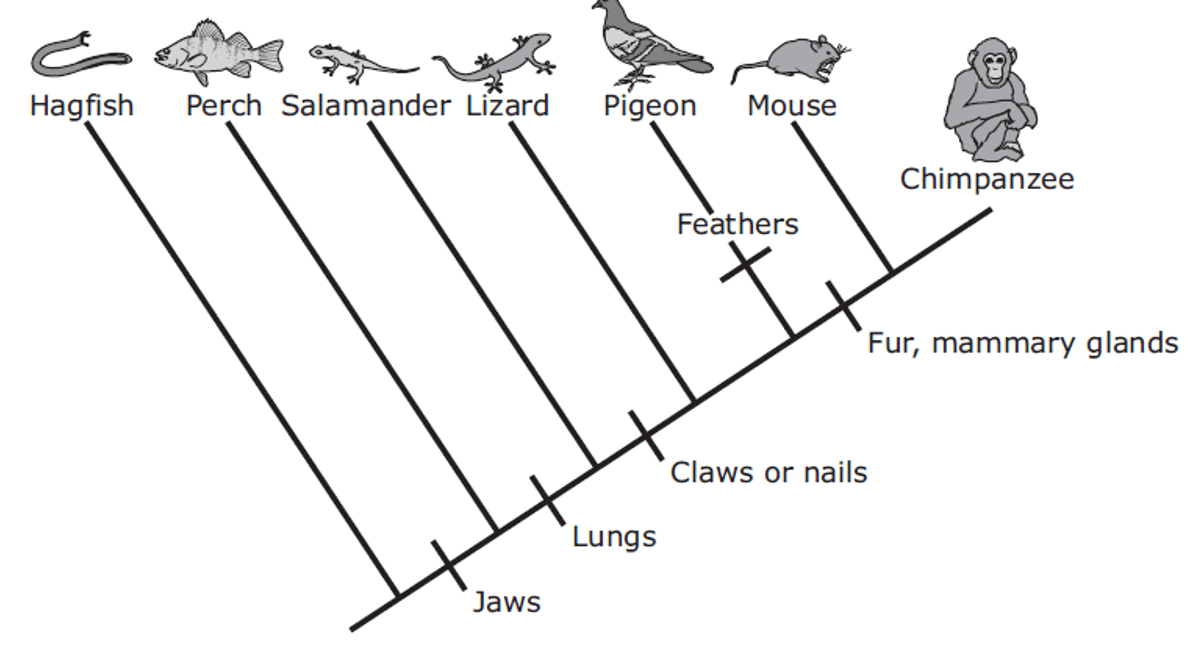
All the animals to the right of the salamander would have the common characteristic of...
Fur
Claws or nails
Lungs
Jaws
An illness caused by a certain virus includes fever, rash, joint pain, red eyes, and headache. The virus is transmitted to people by infected mosquitoes. Symptoms quickly occur within three to twelve days after contracting the virus. There is no vaccine for this virus. Which description best explains the reproductive cycle of this virus?
Lytic, because the virus is transmitted by mosquitoes
Lysogenic, because there is no way to vaccinate against it
Lytic, because of the quick incubation time
Lysogenic, because the virus causes a fever
True or False:
Viruses can be treated with antibiotics.
False
True
Which of the following is carried by a red blood cell throughout the body?
Glucose
Carbon Dioxide
Oxygen
Both Carbon Dioxide AND Oxygen
Which of the following is NOT TRUE about our body's systems?
The digestive system provides the energy that the muscular system needs to move and function
The circulatory system brings the red blood cells to the lungs so that carbon dioxide can be dropped off and oxygen picked up
The skeletal systems sends signals throughout the entire body.
The muscular system helps us walk, move and sit up
What 2 systems: Absorb and deliver the digested nutrients to the cells
Digestive and muscular
Muscular and lymphatic
Digestive and circulatory
Nervous and skeletal
What 2 systems: Allows for movement
Muscular and Skeletal
Endocrine and Skeletal
Nervous and Circulatory
Integumentary and Reproductive


The growth response to touch
Thigmotropism
Geotropism
Phototropism
Hydrotropism

The growth of plants response to gravity
Thigmotropism
Geotropism
Phototropism
Hydrotropism

The movement or growth of a plant in response to light
Thigmotropism
Geotropism
Phototropism
Hydrotropism
Stem cells are
undifferentiated or unspecialized cells in the body.
differentiated or specialized cells in the body.
only found in the inner mass cells of blastocyst
only found in a fetus
TRUE or FALSE: Genes code for traits, such as hair, eye color, and shape of nose.
True
False
If a gene is expressed, what happens?
nothing happens
the protein for that gene is synthesized
all proteins for the DNA strand are created
During what phase of the cell cycle is DNA replicated?
G1 phase
G2 phase
S phase
M phase
How many stages are in mitosis?
1
3
2
4
___ is particle movement from an area of lower concentration to an area of higher concentration.
Active transport
Passive transport
Match what examples go with the correct relationship

Match the examples with the correct interaction.


Which do BOTH prokaryotes and eukaryotes contain?
nucleus
mitochondria
ribosomes
cell wall

is the maintenance of a relatively stable internal environment
is the maintenance of a relatively stable external environment
What do the kingdoms Animalia ,Plantae , Fungi, Protista have in common?
They are all Eukaryotic
They all have a nucleus
They are all Prokaryotic
They all have ribosomes
Enzymes are specific. This means that an enzyme only works with molecules that are....
the right size and shape
broken down already
present in water
too big for the body to handle

Letter E...
active site
products
substrate
enzyme
4. Which biomolecules transport oxygen and other substances and also form part of most organelles?
Lipids
Carbohydrates
Proteins
Nucleic Acids
7. Glycerol and fatty acids are the monomers of _________.
Lipids
Carbohydrates
Proteins
Nucleic Acids
Which of these are the reactants of cellular respiration?
Sunlight and water
Water and carbon dioxide
Carbon dioxide and oxygen
Oxygen and glucose


Nuclear membrane disappears
Chromosomes can now be seen
Centrioles move to opposite sides
Metaphase
Interphase
Telophase
Prophase

Nuclear membrane reforms around the new daughter cells.
Cytoplasm begins to "pinch" in.
Anaphase
Metaphase
Telophase
Interphase



