wayground logo

Free Printable Worksheets

Font size

S
M
L
XL
Worksheets

Grade 10 General Revision 1 Pop Quiz

Total questions: 85

Worksheet time: 3hrs 50mins

Name
Class
Date
1.
Which polynomial is written in standard form?
a)
-3x + 8x2 + 9x3 - 11
b)
9x3 + 8x- 3x - 11
c)
8x+ 9x3 -11 - 3x
d)
-11 - 3x + 8x2 + 9x3
2.
Identify the degree of the monomial:
8a3
a)
8
b)
1
c)
3
d)
11
3.
Classify the polynomial by its number of terms.
 4x² - 2
a)
A
monomial
b)
B
binomial
c)
C
trinomial
d)
D
polynomial
4.
What is the degree of the polynomial
 x2-2x+5
a)
1
b)
2
c)
3
d)
0
5.
4x2 + 8x - 7
is classified as a...
a)
Third Degree Monomial
b)
Second Degree Binomial
c)
Second Degree Trinomial
d)
Third Degree Cubic
6.
Identify the constant term:
4x3 + 2x - 9
a)
4
b)
-2
c)
-9
d)
9
7.
How many terms does this expression have:
-27a3 + 9a2 - 45a
a)
what are terms?
b)
0 terms
c)
-45 terms
d)
3 terms
8.

(2x-1)(x+5)

a)

2x2+9x52x^2+9x-5  

b)

2x+5x1x2x+5x-1x  

c)

2x21x+52x^2-1x+5  

9.

(8m-2)(8m+2)

a)

63m2+263m^2+2  

b)

64m2464m^2-4  

c)

8m228m^2-2  

10.

(m+5)(m2+4m8)\left(m+5\right)\left(m^2+4m-8\right)  

a)

m3+4m28m+5m2+20m40m^3+4m^2-8m+5m^2+20m-40  

b)

m2+40m+m3m^2+40m+m^3  

c)

m3+9m2+12m40m^3+9m^2+12m-40  

11.

(x+3)(x2+4x+7)\left(x+3\right)\left(x^2+4x+7\right)  

a)

x3+7x2+19x+21x^3+7x^2+19x+21  

b)

x2+19x+7x+7x^2+19x+7x+7  

c)

x3+x2+19x+7x^3+x^2+19x+7  

12.
 2x3(x2−2x − 3)
a)
2x6- 4x3 - 6x3
b)
2x5−4x4 − 6x3
c)
-2x5−4x4 − 6x3
d)
-2x6−4x3 − 6x3
13.
(4p − 1)(4p - 1)
a)
16p2 + 1
b)
16p2 − 1
c)
16p2 − 8p + 1
d)
16p2 + 8p + 1
14.

What is the area of this rectangle?

a)

48

b)

8x2+14x+68x^2+14x+6

c)

8x2+x+58x^2+x+5

d)

2x2+6x+82x^2+6x+8

15.

Add the polynomial (-3x + 4) + (8x - 5)

a)

5x - 9

b)

5x - 1

c)

11x - 1

d)

11x - 9

e)

None of these

16.

(2x + 5y - z) + (-6x - 4y + 7z)

a)

-4x +6y + 6z

b)

4x + y + 6z

c)

-4x - y + 6z

d)

-4x + y + 6z

e)

None of these

17.

(4x3-5x2+3x)+(-2x3-x2+6x)

a)

2x3-6x2-9x

b)

2x3+6x2+9x

c)

-2x3-6x2+9x

d)

2x3-6x2+9x

e)

None of these

18.

Add the following polynomials

(x³-6x²+3)+(3x³+4x-1)

a)

4x³-2x²+2

b)

4x³-6x²+4x+2

c)

-2x³+2x+2

d)

4x³-2x²-2

e)

None of these

19.

(3x2+xy-5y2) + (2x2-xy+3y2)

a)

5x2-2xy+8y2

b)

5x2-2y2

c)

5x2+2y2

d)

5x2+2xy-8y2

e)

None of these

20.
x4 - 4x2 - 45
a)
(x2 - 5)(x - 3)(x + 3)
b)
(x2 + 45)(x + 1)(x - 1)
c)
(x2 + 5)(x - 3)(x + 3)
d)
(x2 + 3)(x - 5)(x + 3)
21.

Factor completely.

2x23x142x^2-3x-14  

a)

(x+7)(2x3)\left(x+7\right)\left(2x-3\right)  

b)

(2x+2)(x7)\left(2x+2\right)\left(x-7\right)  

c)

(2x7)(x+2)\left(2x-7\right)\left(x+2\right)  

d)

(x14)(x+1)\left(x-14\right)\left(x+1\right)  

22.
a)
x4(x2 - 5x - 24)
b)
(x - 8)(x + 3)
c)
x4(x - 8)(x + 3)
d)
(x3 - 8)(x3 +3)
23.
Solve x4 - 256 = 0
a)
x = 4, x = - 4
b)
x = 4, x = 4i
c)
x = 4, x -4, x = 4i
d)
x = 4, x -4, x = 4i,         x = -4i
24.

The figure shows a triangle with one of its angle bisectors.

a)

111

b)

18.5

c)

37

d)

74

25.

The figure shows a triangle with one of its angle bisectors.

a)

46

b)

180

c)

11.5

d)

23

26.

The figure shows a triangle with one of its bisectors.

a)

3

b)

6

c)

4

d)

8

27.

The figure shows a triangle with one of its bisectors.

a)

23

b)

96

c)

86

d)

80

28.

The figure shows a triangle with one of its bisectors.

a)

106

b)

84

c)

88

d)

35

29.

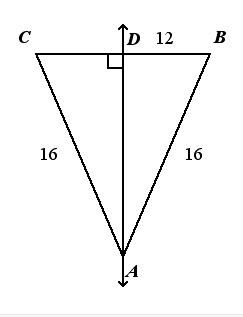
Find BC.

a)

BC = 4

b)

BC = 16

c)

BC = 12

d)

BC = 24

30.

Find BD.

a)

BD = 20

b)

BD = 2

c)

BD = 4

d)

BD = 10

31.
The perpendicular bisector theorem states that if a point is on the perpendicular bisector of a segment, then it is equidistant from the endpoints of the segment.
a)
True
b)
False
32.
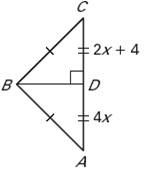
Find the length of AD
a)
2
b)
4
c)
6
d)
8
33.
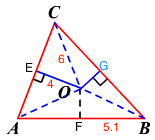
Point O is the circumcenter of the triangle. Find OB
a)
OB = 4
b)
OB = 6
c)
OB = 5.1
d)
Not enough information
34.
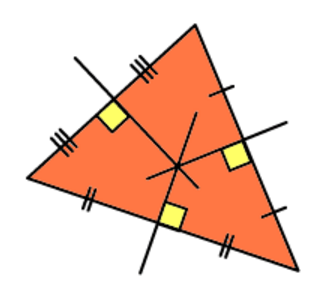
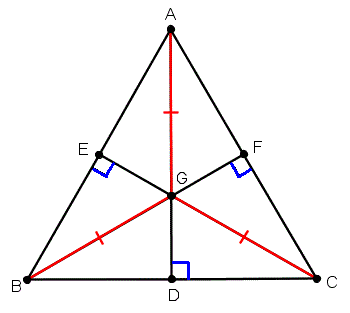
This triangle has...
a)
Altitudes
b)
Perpendicular Bisectors 
c)
Midsegments
d)
Medians
35.
Which of the following describes a perpendicular bisector of a triangle?
a)
A segment that is perpendicular to the side of a triangle at its midpoint.
b)
A segment with endpoints at the vertex and midpoint of the opposite side.
c)
A segment that connects two midpoints of two sides.
d)
A segment that connects the vertex and the opposite side at 90 degrees. 
36.

The CIRCUMCENTER is the intersection of which special segments?

a)

Angle Bisectors

b)

Perpendicular Bisectors

c)

Medians

d)

Altitudes

37.

The circumcenter and orthocenter can be outside the triangle if the triangle is ...

a)

obtuse

b)

acute

c)

iscolese

d)

right

38.

If BC is 18, what is DC?

a)

6

b)

9

c)

12

d)

18

39.
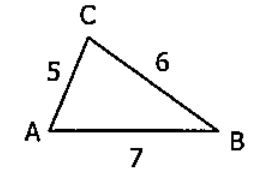
Name the smallest angle in this triangle.
a)
∠A
b)
∠B
c)
∠C
40.
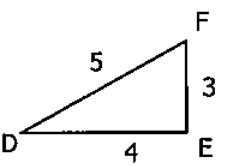
Name the largest angle in this triangle.
a)
∠D
b)
∠E
c)
∠F
41.

If the given side lengths of a triangle are 16 and 10 what can be the third side?

a)

25

b)

22

c)

27

d)

21

42.
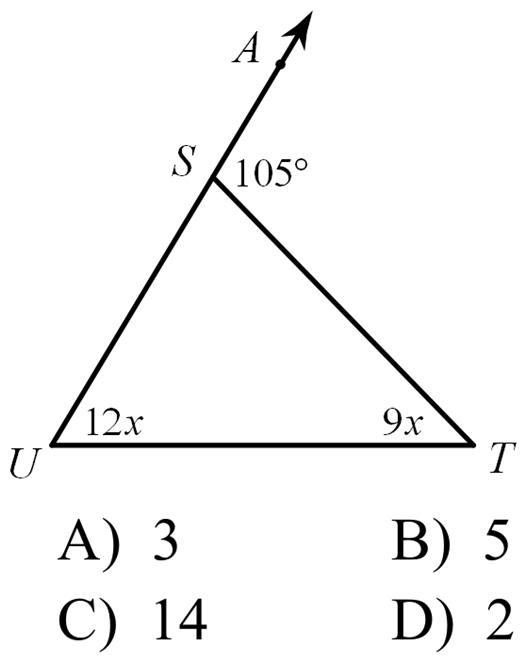
Find the value of x by using the exterior angle theorem.
a)
A
b)
B
c)
C
d)
D
43.
Two sides of a triangle have side lengths of 17 meters and 12 meters.  What is the range of possible lengths for the third side?
a)
12 < x < 17
b)
12 < x < 29
c)
5 < x < 17
d)
5 < x < 29
44.
What is a possible third side to a triangle with side lengths of 5 and 5?
a)
9
b)
10
c)
11
d)
12
45.
Two sides of a triangle have side lengths of 17 meters and 12 meters.  What is the range of possible lengths for the third side?
a)
12 < x < 17
b)
12 < x < 29
c)
5 < x < 17
d)
5 < x < 29
46.

Which of the following statements must be true?

a)

RS > XY

b)

RS < XY

c)

ST < XZ

d)

T >Z\angle T\ >\angle Z

47.

Select all that are TRUE.

a)

AB > AE

b)

BE > CE

c)

BE > CD

d)

CD < DE

e)

CE > BC

48.

What are the possible values for x?

a)

x < 16

b)

4 < x < 16

c)

x < 40

d)

4 < x < 40

49.

Which of the following is the correct ascending arrangement of the measures of the angles of ∆CEA?

a)

∠𝐸, ∠𝐴, ∠𝐶

b)

∠𝐴, ∠𝐶, ∠𝐸

c)

∠𝐸, ∠𝐶, ∠𝐴

d)

cannot be determined

50.

Which statement below defines Addition Property of Equality?

a)

For all real numbers, 𝑝, 𝑞 and 𝑟, if 𝑝 = 𝑞, then 𝑝 + 𝑟 = 𝑞 + 𝑟.

b)

For all real numbers, 𝑝, 𝑞 and 𝑟, if 𝑞 = 𝑟, then 𝑝 + 𝑟 = 𝑞 + 𝑟.

c)

For all real numbers, 𝑝, 𝑞 and 𝑟, if 𝑝 = 𝑞, then 𝑝 + 𝑞 = 𝑞 + 𝑟.

d)

For all real numbers, 𝑝, 𝑞 and 𝑟, if 𝑝 = 𝑟, then 𝑝 + 𝑟 = 𝑞 + 𝑟.

51.

What triangle inequality theorem states that “If one side of a triangle is longer than a second side, then the angle opposite the longer side is larger than the angle opposite the second side”?

a)

Exterior Angle Inequality Theorem

b)

Triangle Inequality Theorem 1 (Ss→Aa)

c)

Triangle Inequality Theorem 2 (Aa→Ss)

d)

Triangle Inequality Theorem 3 (S1 + S2 > S3)

52.

The point A (8, 12) was dilated to become point A' (2, 3). What was the scale factor?

a)

½

b)

¼

c)

4

d)

2

53.

When A(3, 6) is under a dilation of 2 what are the coordinates of A'?

a)

(3, 6)

b)

(1.5, 3)

c)

(6, 12)

d)

(12, 6)

54.

Dilate the figure by a scale factor of 3. What are the coordinates of the image?

A(3,3) B(6,6) C(9,3)

a)

A'(9,9) B'(18,18) C'(27,9)

b)

A'(6,6) B'(9,9) C'(12,6)

c)

A'(0,0) B'(3,3) C'(6,0)

d)

A'(1,1) B'(2,2) C'(3,1)

55.
What scale factor was used to produce the image?
a)
2
b)
-2
c)
1/2
d)
1
56.
Dilate Point B by a scale factor of 1/2
a)
(1.5,-4)
b)
(-1.5,1)
c)
(-1,-1.5)
d)
(-2,-2)
57.

If Triangle ABC is dilated using a scale factor of 1/2, what will be the coordinates of C'?

a)
(-1, -2.5)
b)
(12, 6)
c)
(3, -1.5)
d)
(0, 1.5)
58.

Which condition would prove that these two triangles are similar?

a)

Ratio of two sides and an included angle equal

b)

Three sides proportional

c)

AA

d)

Not Similar

59.
Find side length X.
a)
30
b)
25
c)
15
d)
40
60.
How do these triangles appear to be similar?
a)
AA
b)

Ratio of two sides and an included angle equal

c)

Three sides proportional

d)
Not Similar
61.
Are the triangles similar?
a)
Yes
b)
No
62.
Choose the similarity statement for the triangles.
a)
ΔMNL ∼ ΔOPQ
b)
ΔNOM ∼ ΔPQL
c)
ΔLMN ∼ ΔPQO
d)
ΔMLN ∼ ΔPQO
63.
What is the ratio of the side lengths?
a)
1.25
b)
1.5
c)
2
d)
2.5
64.

Which condition to prove these triangles to be similar?

a)
AA
b)

Ratio of two sides and an included angle equal

c)

Three sides proportional

d)
Not Similar
65.
Find the measure of the missing angle.
a)
47
b)
57
c)
53
d)
133
66.
Find the measure of the missing angle.
a)
90o
b)
100
c)
130o
d)
50o
67.

Given that Triangle ABC is similar to Triangle DEF. Find the angle B.

a)

60⁰

b)

42⁰

c)

79⁰

d)

180⁰

68.

Tell whether the ratios form a proportion.

23 and 1218\frac{2}{3}\ and\ \frac{12}{18}  

a)

Proportional

b)

Not Proportional

69.
Solve for m
a)
1
b)
2
c)
21
d)
1/21
70.

Are the triangles similar? If yes, which postulate proves they are similar?

a)

SSS

b)

ASA

c)

SAS

d)

Not Similar

71.

Are the triangles similar? If so, which postulate proves they are similar?

a)

SSS

b)

SAS

c)

AA

d)

Not Similar

72.

Find the missing side length given that the triangles are similar

(a)  

73.

Find the missing side length given that the triangles are similar.

(a)  

74.

The triangle pairs are similar. Solve for x

(a)  

75.
Two objects that are the same shape but not the same size are _______.
a)
Congruent
b)
Vertical
c)
Similar
d)
Complementary 
76.
Which side length corresponds with EF?
a)
ML
b)
LM
c)
OL
d)
EH
77.
Are the triangles similar?
a)
Yes
b)
No
78.

Are the triangles similar? If so, what similarity shortcut is used?

a)

Similar. SAS

b)

Similar. AA

c)

Similar. SSS

d)

Not Similar

79.

Are the triangles similar? If so, what similarity shortcut is used?

a)

Similar. SSS

b)

Similar. SAS

c)

Similar. AA

d)

Not Similar.

80.
Find the missing length indicated.
a)
28
b)
8
c)
20
d)
14
81.

Find the value of x

a)

5.6

b)

18

c)

35

d)

25

82.

Which proportion could be used to prove that HJKLHJ\parallel KL  ?

a)

KLHJ=KGLG\frac{KL}{HJ}=\frac{KG}{LG}  

b)

KHKG=LGLJ\frac{KH}{KG}=\frac{LG}{LJ}  

c)

HKJL=LGGK\frac{HK}{JL}=\frac{LG}{GK}  

d)

GKHK=GLLJ\frac{GK}{HK}=\frac{GL}{LJ}  

83.
Solve for X
a)
7.5
b)
4.8
c)
13.33
d)
5
84.
Find the length of the unknown segment.
a)
6
b)
3
c)
7
d)
1
85.
Which of the following is NOT true about similar figures?
a)
A) Similar figures always have the same shape.
b)
B) Similar figures always have the same size.
c)
C) Similar figures always have corresponding angles that are equal.
d)
D) Similar figures always have corresponding sides that are proportional.