wayground logo

Free Printable Worksheets

NEW

Font size

S
M
L
XL
Worksheets

Geometry Review

Total questions: 50

Worksheet time: 1hrs 11mins

Name
Class
Date
1.

Describe the transformation:

(x, y) -> (x-2, y+7)

a)

Translation 2 units to the left & 7 units up

b)

Translation 2 units to the left & 7 units down

c)

Translation 2 units to the right & 7 units up

d)

Translation 2 units to the right & 7 units down

2.

Describe the transformation:

(x, y) -> (x, -y)

a)

reflection across the x-axis

b)

reflection across the y-axis

c)

rotation 90 degrees clockwise

d)

rotation 90 degrees counterclockwise

3.

Describe the transformation:

(x, y) -> (-y, x)

a)

reflection across the x-axis

b)

reflection across the y-axis

c)

rotation 90 degrees clockwise

d)

rotation 90 degrees counterclockwise

4.

Describe the transformation:

(x, y) -> (y, -x)

a)

reflection across the x-axis

b)

reflection across the y-axis

c)

rotation 90 degrees clockwise

d)

rotation 90 degrees counterclockwise

5.

Describe the Transformation

a)

Dilation

b)

Reflection

c)

Translation

d)

Rotation

6.

What type of transformation is this?

a)

Translation

b)

Dilation

c)

Reflection

d)

Rotation

7.

What type of transformation changes the size?

a)

Rotation

b)

Reflection

c)

Translation

d)

Dilation

8.

If point H(–6, 2) is translated 4 units up and 3 units right, what are the coordinates of the translated image?

a)

(-2, 5)

b)

(-3, 6)

c)

(-9, -2)

d)

(-9, 6)

9.

Point N(6, –5) is reflected across the

x-axis. What are the coordinates of the image?

a)

(-6, -5)

b)

(-5, 6)

c)

(5, -6)

d)

(6, 5)

10.

Triangle LMN has vertices L(–1, 4), M(–2, 4), and N(–1, –1). What are the coordinates of the image of point M after a dilation with a scale factor of 3?

a)

(-6, 12)

b)

(-6, 4)

c)

(-2, 12)

d)

(12, -6)

11.

If the figure is rotated 90 degrees clockwise, what are the coordinates of R?

a)

(-3, 3)

b)

(3, -3)

c)

(-3, -3)

d)

(3, 3)

12.
Determine where X' would be if you translated X 3 units to the left and 9 units down.
a)
(-4, 4)
b)
(-10, 2)
c)
(-4, -5)
d)
(-1, 5)
13.
Identify the transformation.
a)
Reflection across y axis
b)
Reflection across x-axis
c)
180 Rotation
d)
Translation 2 units down
14.
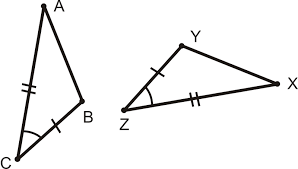
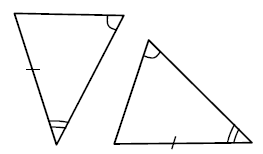
Which triangle congruence theorem can be used to prove the triangles are congruent?
a)
SSS
b)
ASA
c)
AAS
d)
SAS
15.
a)
Congruent by ASA
b)
Congruent by SAS
c)
Congruent by SSS
d)
Not Necessarily Congruent
16.
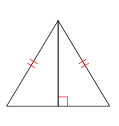
How are the triangles congruent?
a)
HL
b)
SSS
c)
SAS
d)
AAS
17.
What are the five ways to prove triangles congruent?
a)
SSS, ASA, AAS, SAS, HL
b)
SSS, SSA, HL, AAS, SAS
c)
SAS, SSA, HL, AAS, SSS
d)
HL, SAS, SSA, SSS, ASA
18.

If ΔMANΔBOY\Delta MAN\cong\Delta BOY , which of the following statements are true?

a)

MABO\overline{MA}\cong\overline{BO}  

b)

ANBY\overline{AN}\cong\overline{BY}  

c)

BONA\overline{BO}\cong\overline{NA}  

d)

MNBO\overline{MN}\cong\overline{BO}  

19.
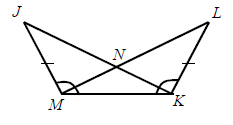
State if the two triangles are congruent.  If they are, state how you know.
a)
A
b)
B
c)
C
d)
D
20.
State if the two triangles are congruent.  If they are, state how you know.
a)
A
b)
B
c)
C
d)
D
21.
What does CPCTC stand for?
a)
Corresponding Parts of Corresponding Triangles are Congruent
b)
Congruent Parts of Corresponding Triangles are Congruent
c)
Corresponding Parts of Congruent Triangles are Congruent
22.
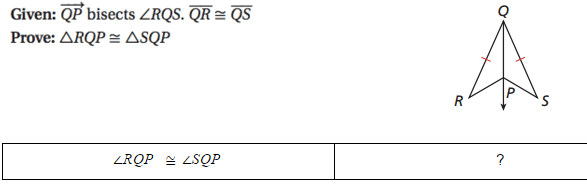
What are the 2 missing pieces of information?
a)
Transitive Property, SAS(Side-Angle-Side)
b)
Reflexive Property, SAS(Side-Angle-Side)
c)
Transitive Property, SSS(Side-Side-Side)
d)
Reflexive Property, SSS(Side-Side-Side)
23.

What is #3 Reason?

a)

Same Line

b)

Perpendicular Lines

c)

Segment Bisector

d)

Reflexive Property

24.

ΔABC Δ?\Delta ABC\ \cong\Delta?  

a)

ΔEFD\Delta EFD  

b)

ΔDFE\Delta DFE  

c)

ΔDEF\Delta DEF  

d)

ΔFED\Delta FED  

25.

Which symbol means congruent?

a)

\approx  

b)

\cong  

c)

==  

d)

\ne  

26.

What type of angles are 1\angle1  and 3\angle3  ?

a)

Complementary Angles

b)

Supplementary Angles

c)

Vertical Angles

27.

Which is not a postulate to prove triangle congruence?

a)

AAA

b)

ASA

c)

SSS

d)

SAS

28.
Angles  e and d are what type of angles?
a)
Vertical Angles
b)
Corresponding Angles
c)
Alternate Interior Angles
d)
Alternate Exterior Angles
29.

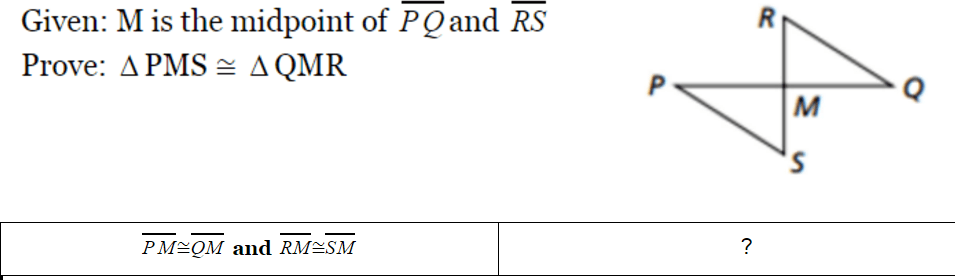
What is the justification?

a)

Definition of congruence

b)

Reflexive Property of Congruence

c)

Segment Addition Postulate

d)

Definition of Midpoint

30.

Are the two triangles congruent? If they are, select the correct congruence postulate. If there is not enough information, select N/A.

a)

ASA

b)

SAS

c)

AAS

d)

N/A

31.

Are the two triangles congruent? If they are, select the correct congruence postulate. If there is not enough information, select N/A.

a)

SSS

b)

AAS

c)

ASA

d)

N/A

32.
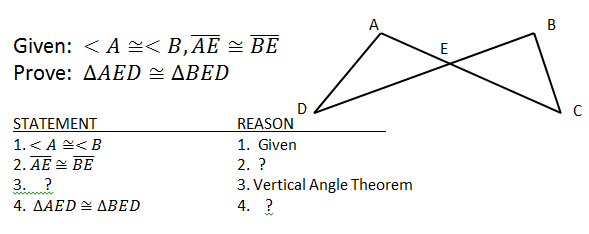
Identify the  missing statement or reason
a)
Given
b)
Vertical Angles Theorem
c)
Definition of Angle Bisector
d)
Alternate Interior Angles Theorem
33.
Identify the  missing statement or reason
a)
Definition of Angle Bisector
b)
Alternate Interior Angles Theorem
c)
Reflexive Property
d)
Definition of Midpoint
34.
What is the "statement" for step 3 of the proof? 
a)
∡EDA≅∡DCB
b)
∡AED≅∡BEC
c)
DE=CE
d)
∡AED≅∡CED
35.
If DA bisects IE, then
a)
ID=ED
b)
IA=EA
c)
<IDA=<EDA
d)
<IAD and <EAD are right angles
36.
Are these triangles congruent? If so, state the rule which you used to determine congruence.
a)
Yes by ASA
b)
Yes by AAS
c)
Yes by SSA
d)
Not congruent
37.

ΔAEB ≅ ΔCED by...

a)

SAS

b)

ASA

c)

AAS

d)

SSS

38.
What is the measure of the missing angle?
a)
76
b)
66
c)
156
d)
154
39.
Solve for x
a)
5
b)
90
c)
25
d)
10
40.
a)

-22.6

b)

248

c)

28

d)

32

41.

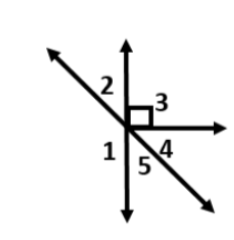
What angle is vertical to angle 2?

a)

∠4

b)

∠1

c)

∠2

d)

∠5

42.
Vertical angles are always
a)
acute
b)
total 180 degrees
c)
congruent (equal measures)
d)
adjacent angles
43.

Practice 1c: Name a pair of linear pair angles

a)

1  and 4\angle1\ \ and\ \angle4

b)

3  and 2\angle3\ \ and\ \angle2

c)

4  and 5\angle4\ \ and\ \angle5

d)

3  and 5\angle3\ \ and\ \angle5

44.
Name the alternate interior angle to angle 3.
a)
4
b)
5
c)
6
d)
8
45.
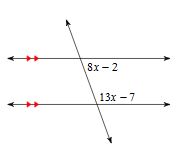
Solve for y.
a)
y = 20
b)
y = 120
c)
y = 60
d)
y = 10
46.
Find y.
a)
50
b)
130
47.

Which could be used to prove the lines are parallel?

a)

Converse of Alternate Interior Angles Theorem

b)

Converse of Same-Side Interior Angles Theorem

c)

Converse of Corresponding Angles Postulate

d)

Cannot be proved parallel

48.

Select the figure that makes lines r and t parallel.

a)
b)
c)
d)
49.
What is the value of x?
a)
60
b)
26
c)
14
d)
10
50.
Solve for x.
a)
7
b)
-4
c)
8
d)
9