
 Worksheets
Kepler's laws
Total questions: 11
Worksheet time: 11mins
Name
Class
Date
1.
Planets orbit the Sun in a shape called a(n)
a)
circle
b)
ellipse
c)
focus
d)
perihelion
2.
An ellipse is drawn around two points called
a)
aphelion
b)
perihelion
c)
foci
d)
axis
3.
When a planet orbits the Sun, one of the foci of the elliptical orbit is
a)
the axis
b)
the perihelion
c)
the center
d)
the Sun
4.
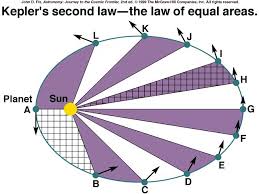
Where is the planet moving faster
a)
Position A to B
b)
Position B to C
c)
Position H to I
d)
Position I to J
5.

What is true about the area between points A, B and the Sun, and the area between points H, I and the Sun?
a)
The area between A, B and the Sun is the largest.
b)
The area between H, I and the Sun is the largest
c)
Both areas are equal in size
d)
There is not enough information to determine the areas
6.
Kepler's 2nd Law deals with
a)
the shape of the planets' orbits
b)
the speed/area the planet travels
c)
the length of time it takes the planet to orbit the sun
7.
A planet moves __________ when it is farthest from the sun.
a)
faster
b)
slower
8.
The farther away a planet is from the sun, the _______ it takes it to orbit the sun once.
a)
longer
b)
shorter
9.
The path a planet travels around the sun is called its
a)
orbit
b)
ellipse
c)
barycenter
d)
precession
10.

The average distance between Jupiter and Earth is 4.204 AU. Calculate Jupiter’s orbital period
a)
4335days
b)
4335 years
c)
18796344 days
d)
18796344 year
11.

Galileo used his telescope to study some of Jupiter’s moons, including Europa (E) and Ganymede (G). Europa is 0.004 AU from the center of Jupiter and has a period of 3.55 Earth days. Ganymede has a period of 7.16 days. What is the distance between Ganymede and the center of Jupiter?
(a)
100 %

