
NEW
Font size
 Worksheets
Ionic and Covalent Bonds
Total questions: 38
Worksheet time: 37mins
Sodium and Bromine will make a _____ bond
Ionic
Hydrogen
Covalent
Exploding
the mutual sharing of one or more pairs of electrons between two atoms.
Covalent
Ionic
This type of bonding can be described as "I give, I get"
Covalent
my mom
Ionic
Friendship
What two types of atoms make a covalent bond?
2 Metal
2 Ionic
1 nonmetal 1 metal
2 Nonmetal
NaCl
metallic
covalent
Ionic
Hydrogen and Chlorine will from a ____ bond
Unique
bestie
Covalent
Ionic
Beryllium and sulfur will form a ____ bond
Covalent
Metallic
Ionic
Unique
In ionic bonds, metals tend to?
Keep their electrons
Gain valence electrons
Lose valence electrons
None of these answers are correct
MgO
Ionic
Metallic
Covalent
What type of bond involves the sharing of electrons between atoms?
Barney
Covalent
Ionic
anything
Why don't noble gases form bonds?
They all have a full octet
Noble gases do form bonds
They only bond when with eachother
none of these answers are correct
Water, H2O
Ionic
Covalent
Water
When metals bond with non-metals they form what type of bonds
Ionic
Covalent
An ionic compound forms between a?
2 nonmetals
metal and nonmetal
2 metals
noble gasses
Why do all bonds form?
to fill the outermost energy level
so an atom can be unstable
so the number of protons and electrons can equal.
so they can gain neutrons.
Valence electrons are found
outermost energy level
innermost energy level
some where in the electron cloud
An atom with 1 valence electron 'needs' a full shell, so it can either gain 7 electrons or lose 1. Which is more likely to occur?
nothing
gain 7
lose 1
What two types of atoms make a covalent bond?
2 nonmetals
2 metals
1 metal and 1 nonmetal`
How many valence electrons does Boron have?
1
2
3
4
When an atom loses an electron, it becomes a
positive ion
negative ion
Atoms are most stable when their outer shell is full or complete.
true
false
How are ionic bonds formed?
transfer of electrons
sharing of electrons
Group numbers on the periodic table help us determine
number of valence electrons
state of the element (solid, liquid, gas)
Water is an example of what?
molecular compound (covalent compound)
ionic compound
Salt is an example of what?
ionic compound
covalent compound
Atoms involved in a covalent bond are not charged, while atoms involved in an ionic bond are charged (negative or positive)
true
false

If an atom has no charge, which of the following must be true?
It has more neutrons than protons or electrons.
There are only neutrons inside the atom.
Its number of protons is equal to its number of electrons.
The neutrons in the atom outnumber the electrons and protons.
What charge will a Neon ion have?
+1
-1
-8
Neon does not form ions.

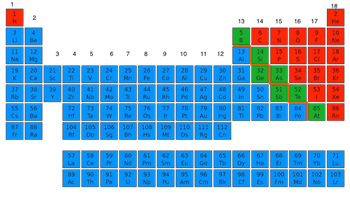
Predict the bond that will form between Ca and F.
Predict the bond that will form between N and Cl.

