
 Worksheets
Newton's Laws Quiz
Total questions: 30
Worksheet time: 37mins
What explains why objects resist changes in their state of motion?
gravity
inertia
force
friction

Isaac Newton developed these 3 laws concerning ______________.
Velocity.
Mass
Acceleration.
Motion

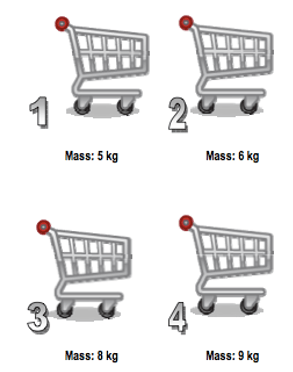

An inflated balloon released from rest moves horizontally.
The law that best explains this event is
Newton's 1st Law
Newton's 2nd Law
Newton's 3rd Law
Law of Gravity
True or False: objects with greater mass require more force to accelerate when compared to objects with less mass.
True
False
A dictionary weighing 15 Newtons is placed on a desk.
What is the force that the desk exerts on the dictionary?
none
15 N
1.5 N
150 N

Suppose that an astronaut throws a baseball in outer space at a location far from significant influences of gravity and air resistance. One would expect that the baseball would ____.
eventually stop since all objects ultimately "lose their steam"
eventually stop as its inertia slowly becomes used up
continue in motion with the same speed and direction
either a, b, or c -- depending on whether the astronaut continues to push it
A skateboard rolls down a hill, reaches the level surface and eventually comes to a stop. The fact that the skateboard ultimately stops is best explained by ____.
an unbalanced force would be required to keep the sled moving forward at constant speed
the presence of an unbalanced force (e.g., friction) can cause a moving object to stop
the presence of inertia causes it to stop
the natural tendency of any object is to ultimately stop
More mass = More inertia
True
False
When Izzy and Zoe pull on the rope with the same amount of force, the forces are _____.
increased
unbalanced
balanced
decreased
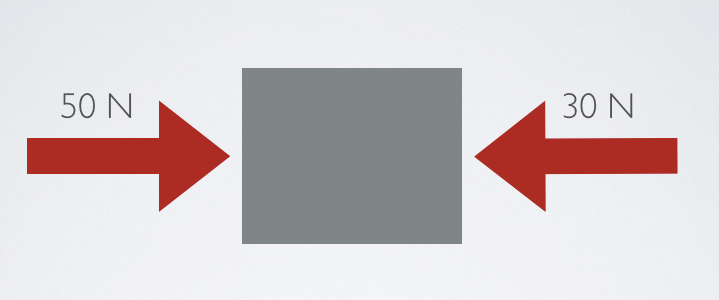
If a cannonball were launched into deep space (no friction or gravitational effects), how much force would be needed to keep the ball moving with a constant velocity?
A force equal to its weight.
No force would be needed.
A force large enough to balance friction.
150-N

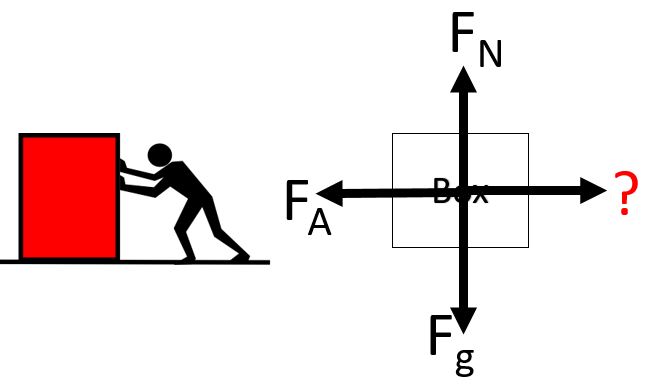
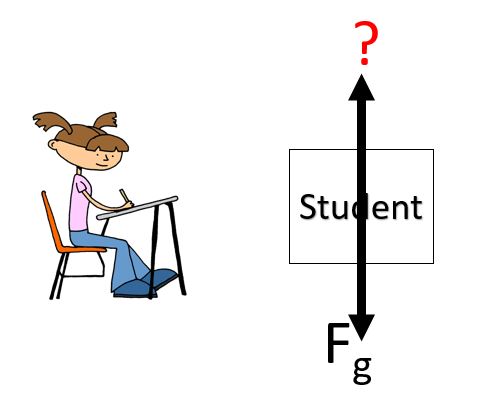
What is the name of the missing force?
applied force
gravity
friction
normal force

What is an Applied Force?
The distance
Mass
A push or pull
Acceleration
The force that keeps objects on top of surfaces instead of letting them sink into the surface is known as:
normal
abnormal
static
inertia
Whenever an object is moving, there is always this force opposing the motion:
inertia
momentum
friction
applied force
The force exerted by ropes and chains is called
tension
normal
elastic
mechanical
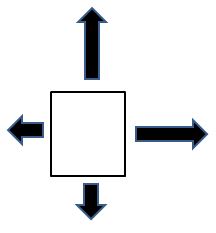
The down-arrow in this diagram is most-likely:
gravity
normal
a push or pull
friction
If this object were moving right, the left-arrow in this diagram is most-likely:
gravity
normal
a push or pull
friction


The car in the picture is moving at a constant velocity. What forces does the car experience?
Gravity
Gravity and Normal
Gravity, Normal, and Friction
Gravity, Normal, Friction, and Applied


