
 Worksheets
Unit 2 Lesson 3: Energy Transfer in Earth's Interior
Total questions: 21
Worksheet time: 20mins
Beneath the Earth's lithosphere, the hotter, weaker, plastic-like zone known as the ___________ allows for motion of Earth's rigid outer shell.
Outer core
Moho
Crust
Asthenosphere
The age of the deepest sediment in an ocean basin _____________ with increasing distance from the oceanic ridge.
increases
decreases
stays the same
Earth is divided into compositional layers based on chemical composition. Which compositional layer is a hot, convecting layer of rock? SC.7.E.6.1
core
crust
mantle
plate
The lithosphere is broken into pieces called _________________. SC.7.E.6.1
atolls
strata
plates
trenches
Scientists and researchers have noticed that the energy waves from earthquakes change speed as the waves move from the upper mantle of the Earth to its crust. Which of the following conclusions about the different layers of Earth does this observation best support? SC.6.E.7.1
The upper mantle and the crust have different ages.
The upper mantle and the crust have different masses.
The upper mantle and the crust have different densities.
The upper mantle and the crust have different suns.
What is a convection current? SC.6.E.7.1
the transfer of energy by direct contact
the transfer of energy by the movement of matter
the transfer of energy through a solid, such as the Earth’s crust
the transfer of energy from a region of higher temperature to a region of lower temperature
Convection currents are believed to flow in Earth’s ______________. SC.6.E.7.1
crust
mantle
inner core
mountains
Scientists know about the Earth Layers due to _________.
volcanic activity
seismic waves
magnetic properties

Scientists think that convection currents that move the plates flow in Earth's
Continental crust
Oceanic crust
mantle
outer core
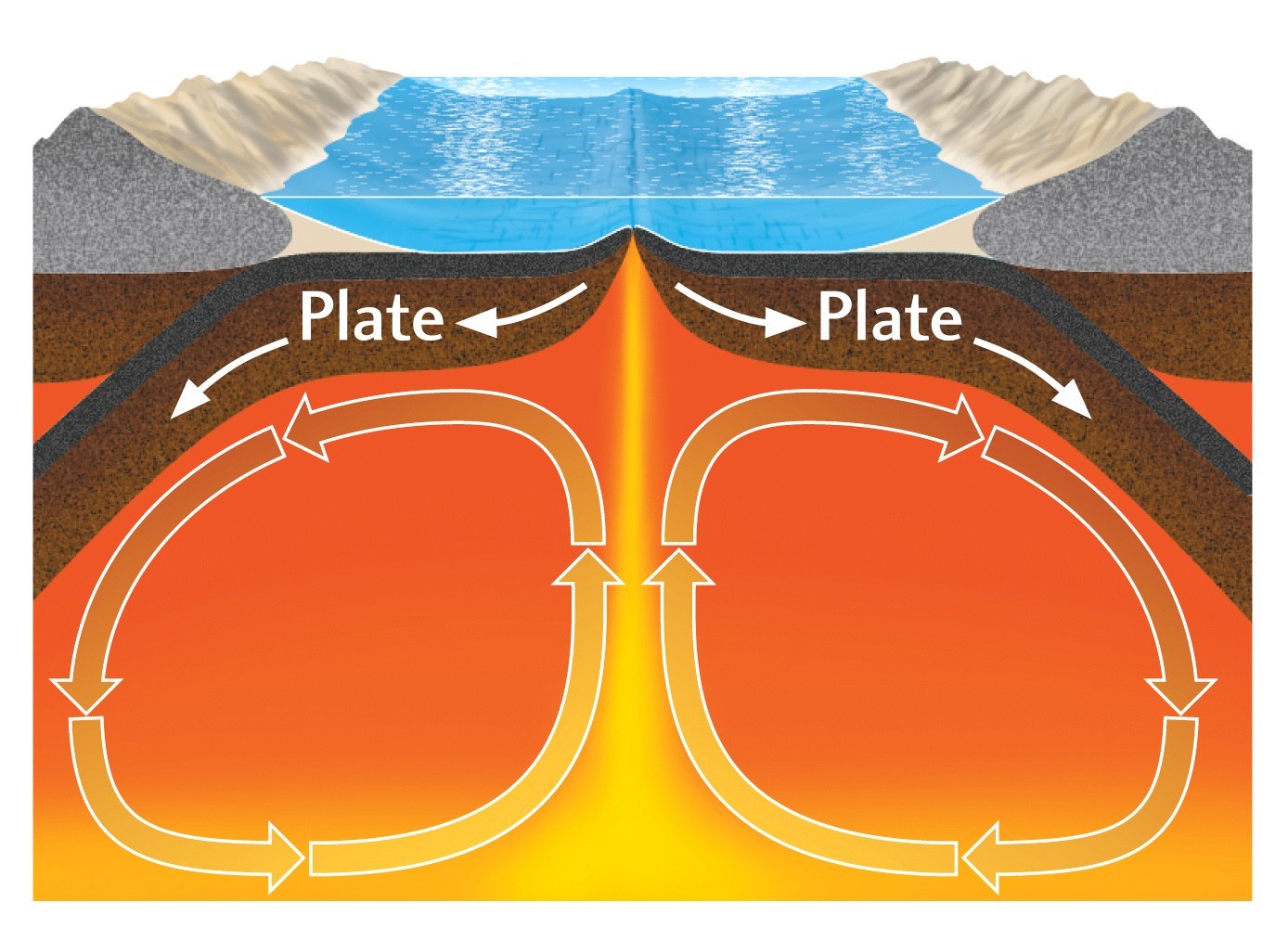
The mantle of Earth is made partly of magma. When magma rises and sinks, this is called ______________.
a conduction current
a hot spot
a volcanic eruption
a convection current
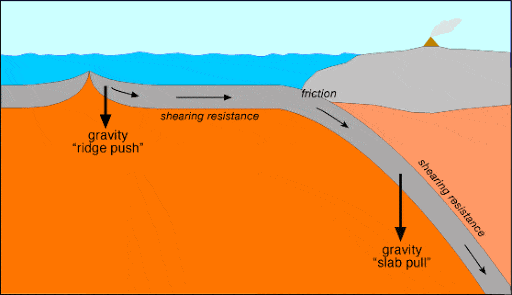
When the force of gravity pulls a lithospheric plate downward and away from a ridge pushing it toward a trench.
Sea Floor Spreading
Subduction
Ridge Push
Slab Pull
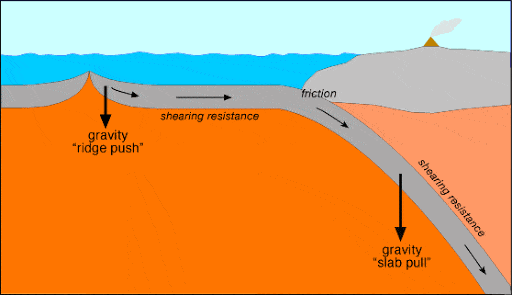
When the force of subduction and gravity moves a lithospheric plate downward into a trench and pulls it away from a ridge.
Sea Floor Spreading
Subduction
Ridge Push
Slab Pull
Which Theory of plate movement occurs as oceanic crust moves away from the mid-ocean ridge and becomes cooler and more dense, sinking into a trench?
convection
ridge push
slab pull
What is slab pull?
cooler, denser crust sinks (is pulled) into the mantle along a trench
when edges become denser and gravity pulls them downward and away from one another
currents just beneath Earth's crust flow very slowly, causing movement in the plates above them
folding and crumpling and sliding upward creating mountains
Identify the three possible driving forces of plate tectonics
conduction
convection
Ridge push
slab pull
Where denser oceanic lithosphere sinks beneath continental lithosphere
slab pull
ridge push
convection
divergent boundary
Where oceanic lithosphere slides downhill due to gravity
slab pull
convection
ridge push
divergent boundary
These develop in the mantle moving the crust and outermost part of the mantle and transferring thermal energy from Earth’s interior to its exterior.
Epochs
Convection currents
Paleomagnetism
Magnetometer

