
 Worksheets
Chemistry: Reactions
Total questions: 33
Worksheet time: 20mins
In an endothermic reaction, heat is ...
taken in
given out
6 CO2+ 6 H2O + Energy → C6H12O6 + 6 O2
endothermic reaction
exothermic reaction

Solid sodium carbonate is added to vinegar in a beaker and stirred.
The water in the watch glass freezes.
Which statement about the reaction explains why the water freezes?
It is a redox reaction.
It is an endothermic reaction.
It is catalysed by sodium carbonate.
It is thermal decomposition.
Why does a higher concentration increase the rate of reaction?
it increases the amount of reactants
it lowers the activation energy
it increases the energy of particle collisions
it increases the frequency of particle collisions
Adding a catalyst ___________ the activation energy.
Raises
Lowers
Doesn't affect
Inreases
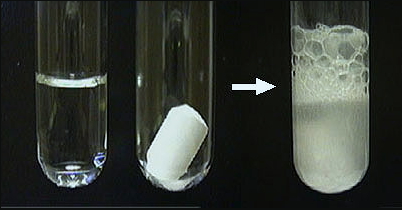
How could we make this reaction happen more quickly?
Decrease the concentration of the acid
crush the chalk to increase the surface area
Put the test tube in an ice bath

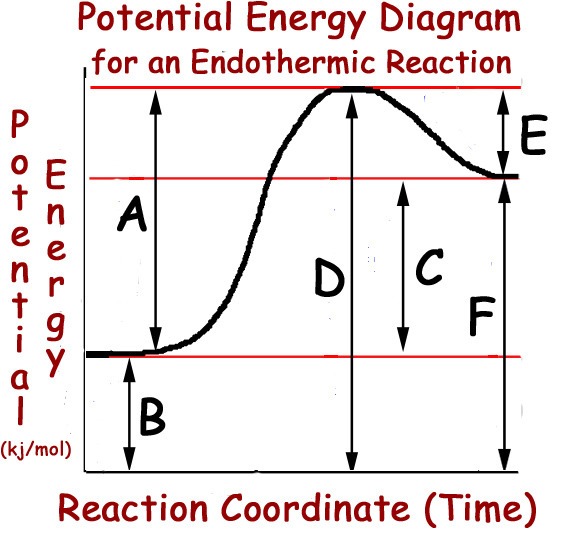
A represents
Potential Energy of Products
Potential Energy of Reactants
Change in Enthalpy
Activation Energy
D represents
Potential Energy of Products
Potential Energy of Reactants
Change in Enthalpy
Activation Energy

Is the following reaction endothermic or exothermic
endothermic
exothermic

Is the following reaction endothermic or exothermic
endothermic
exothermic
4. When a system at equilibrium is subject to change the system tries to minimize the change by?
dissappearing
going to the direction where it will relieve the stress
expand
3. In change in pressure and volume, if the pressure decreases the system will shift to the?
location of more moles
shift to the left
no shift
9. This Law "states that any change to system at equilibrium wil result in an expected shift that countereact the change"
Le Chatelier Principle
Boyles Law
Law of thermodynamics
10. The factors that affect the system at equilibrium are the following exept
Temperature
Change in Matter
Concentration
2SO2(g)+O2(g)⇌2SO3(g)
Removing O2(g) will
shift equilibrium right
shift equilibrium left
increase pressure
have no change
SO2 + O2 <−> SO3
If the equilibrium shifts to the right, the concentration of O2 will ___________.

CoCI42- +6H2O →Co(H2O)62+ + 4CI-.
What would happen when H2O is added?
Position of equilibrium will shift to left (and become more blue)
Position of equilibrium will shift to right (and become more pink)
Keq will increase as H2O is added
Position of equilibrium will shift to left to reduce the added H2O

1N2 + 3H2 →2NH3
When the pressure on the system is increased, the equilibrium position shifts to the right. Why?
To increase the amount of products
To reduce the pressure, as the right side has fewer molecules of gas
Keq will increase when it is shifted to the right
To increase the pressure, as the right side has more molecules of gas
What reaction has the following general formula:
A + CD --> C + AD
Combination
Decomposition
Single Replacement
Double Replacement
Combustion
What reaction has the following general formula:
AB + CD --> CB + AD
Combination
Decomposition
Single Replacement
Double Replacement
Combustion
What reaction has the following general formula:
CxHy + O2 −>CO2 + H2O
Combination
Decomposition
Single Replacement
Double Replacement
Combustion
What type of reaction is the following:
BaCl2+2KI −> 2KCl + BaI2
Combination
Decomposition
Single Replacement
Double Replacement
Combustion
What type of reaction is the following:
Zn + 2HCl −> ZnCl2+H2
Combination
Decomposition
Single Replacement
Double Replacement
Combustion
What type of reaction is the following:
3CuS +2Al −> Al2S3+3Cu
Combination
Decomposition
Single Replacement
Double Replacement
Combustion
What type of reaction is the following:
2C4H10 +13O2 −> 8CO2+10H2O
Combination
Decomposition
Single Replacement
Double Replacement
Combustion
What type of reaction is the following:
Na2S +2HCl −> H2S+2NaCl
Combination
Decomposition
Single Replacement
Double Replacement
Combustion
Identify the following chemical reaction.
Pb + FeSO4 ----> PbSO4 + Fe
Synthesis (or combination)
Decomposition
Single displacement
Double displacement

