
 Worksheets
SHS Physical Science (Physics and Astronomy)
Total questions: 30
Worksheet time: 17mins
hydroelectric power
Which of the following are RENEWABLE energy sources?
Wind
Coal
Geothermal
Hydropower
Petroleum (Oil)
Thermal energy always travels from ______ temperatures to ______ temperatures.
Higher / Lower
Lower / Higher
Higher / Higher
How does heat travel when ice cubes are placed in an orange juice?
From ice to juice
From juice to ice
In ice only
In juice only
What law of thermodynamics explains the principle of heat engines?
Zeroth Law
First Law
Second Law
Third Law
A heat engine uses 100 J of heat to produce 60 J of work. How much is the excess heat?
40 J
160 J
6000 J
5 J
Which is NOT a natural motion based from Aristotle?
Smoke moving upward
Rock falling from cliff
Waterfalls
Cart is pushed
Rock A is dropped while Rock B is thrown horizontally downward. Which of them will reach the ground first?
Rock A
Rock B
Both of them
Cannot be determined
What is the angle of projectile needed to reach the maximum range?
25 degrees
35 degrees
45 degrees
65 degrees
Which of the following angle of projectile will have the highest maximum height?
25 degrees
35 degrees
45 degrees
65 degrees
TRUE or FALSE. During a collision, he greater the mass, the greater the force it exerts
TRUE
FALSE
TRUE or FALSE. The slower the velocity, the farther a projectile travels horizontally
TRUE
FALSE
He is the scientist who proposed the Corpuscular Theory of Light
Huygens
Newton
Planck
Einstein
The angle of incidence is always ______ the angle of reflection
greater than
less than
equal to
cannot be determined
Light travels from GLASS to AIR, how will the refracted light travel?
TOWARDS the Normal
AWAY from the normal
Which type of mirror is used in road mirrors?
Plane Mirror
Convex Mirror
Concave Mirror
A concave lens is a ______ lens
converging
diverging
Which of the following situations exhibits the property of interference?


This scientist proposed the idea that planets move in elliptical orbits
Kepler
Brahe
Copernicus
Galileo
Who was the Greek scientist who first measured the circumference of the Earth?
Anaxagoras
Aristotle
Aristarchus
Eratosthenes
Which of the following were NOT observed by Galileo using his telescope?
Jupiter's Moons
Phases of Venus
Craters of the Moon
Stellar Parallax
This is a terrestrial planet but a SUPERIOR planet
Earth
Mars
Mercury
Venus
Which planet has the highest amount of Carbon Dioxide concentration
Earth
Mars
Mercury
Venus
Which planet can you find the largest volcano?
Earth
Mars
Mercury
Venus
Which celestial body is primarily made up of chunks of ice, dust, and rock particles
Comet
Meteor
Meteorite
Asteroid
Which shows the correct sequence of heavenly bodies located from SPACE to EARTH?
Meteor - Meteoroid - Meteorite
Meteorite - Meteor - Meteoroid
Meteoroid - Meteor - Meteorite
Which of the following is the unique feature of Saturn?
Galilean Moons
Cassini's Division
Sideward Rotation
Great Dark Spot
This scientist proposed the geo-heliocentric model of the universe
Kepler
Brahe
Copernicus
Galileo

In the given figure, which of the following holds TRUE?
The angle of incidence is 10°.
The angle of incidence is 80°.
The angle of reflection is 10°.
The angle of reflection is 90°.
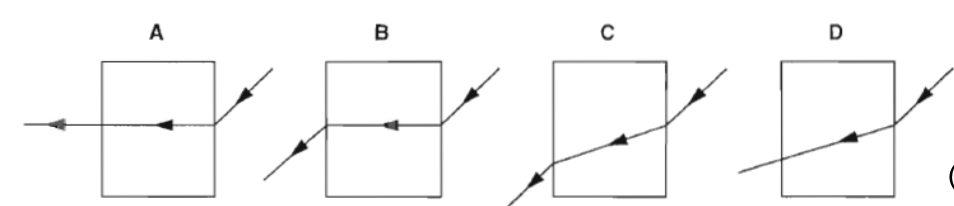
A ray of light travels from air into a glass block.
Which diagram correctly shows the path of the ray through the glass block?
A
B
C
D

