Font size
 Worksheets
Unit 3: Classification
Total questions: 36
Worksheet time: 1hrs 28mins
The term used to describe the scientific study of how living things are classified
Classification
Organization
Domain
Taxonomy
Who was the first person to create a classification system?
Aristotle
Kepler
Fox
Woese
In the 8 Levels of Classification which level is the broadest (biggest) category?
Kingdom
Family
Domain
Species
As each group in the levels of classification is split into smaller groups, the organisms become more ________________.
Different
Populated
Alike
Dissimilar
Which list of characteristics best describes the Archaea Domain?
Heterotrophs-No cell wall- similar to bacteria
From extreme environments- both auto and heterotrophs- unlike any other domain
Kin to animals- has a cell wall- lives in water
Lives in wet environments- heterotrophs only- related to fungi
Which list of characteristics best describes the Bacteria Domain?
Prokaryotic- microscopic- unicellular
Eukaryotic- large celled- multicellular
Eukaryotic- multicellular- related to animals
Eukaryotic- feed on dead animals- has a cell wall
Which list of characteristics best describes the Eukarya Domain?
Prokaryotes, Eubacteria, no nuclear membrane
Prokaryotes, Archaebacteria, no nuclear membrane
Eukaryotic, nuclear membrane, Protists, Fungi, Animalia, Plantae
Prokaryotes, Archaebacteria, nuclear membrane
Which of these kingdoms is NOT a part of the Eukarya (has a nucleus) Domain?
Plant
Bacteria
Fungi
Protists
Cells that have a nucleus are called _____________.
Eukaryotes
Heterotrophs
Prokaryotes
Autotrophs
In the Kingdom Plantae organisms that make their own food are called _________.
Eukaryotes
Autotrophs
Heterotrophs
Prokaryotes
Organisms in the Kingdom Animalia that consume other organisms are called ________.
Autotrophs
Bacteria
Fungi
Heterotrophs
In which Kingdom and Domain is mankind classified?
Prokaryotic/Archaea
Bacteria/Eukarya
Animalia/Eukarya
Eukarya/Protist
List the 8 levels of Classification starting from broadest to most specific
*spelling counts*
(a)
Which option listed is NOT a NEED of a living organism?
Food
Water
Shelter
Clothing
Which of the following IS a characteristic of a living thing?
water
veins
shelter
reproduction
How do multicellular and unicellular organisms differ?
the number of mitochondria in their cells
the amount of total cells the organism has
the shape of their cells
the colorization of their cells
How many parents does an organism that produces asexually need?
5
8
2
1

Carolus Linnaeus developed the system of scientific naming in the 1750s called?
Domain Naming
Scientific Naming
Binomial Nomenclature
Nomenclature Scientificia
Binominal Nomenclature means that organisms has _____ scientific name...
4
8
2
1
An organism's scientific name is composed of its __________ and _________ levels of classification...
Domain and Kingdom
Genus and Family
Genus and Species
Order and Class
A cell is....
the basic unit of structure and function of an organism
an organism's scientific name
a way to classify organisms
the way we organize bacteria
*BONUS*
What does Prokaryote translate to?
(a)
Scientists don’t use the common names of organisms because?
an organism may have more than one common name.
an organism rarely has the same name in different languages.
common names can have more than one meaning
all the above
An organism that breaks down dead organic matter, which it then absorbs as food, is in the kingdom...
Plante
Animalia
Fungi
Protista
The organism Quercus phellos (Willow Oak) is a member of the genus...
Quercus
Plante
phellos
Fungi
BONUS
Why did scientists come up with the naming system that we use today?
(a)
What tool do we use to determine what organisms are?
Protractor
Compass
Taxonomic Key
Calculator
Organisms are classified based on ________.
the number of them that exists in a species
their Greek names
similarities and evolutionary relationships
the year their fossils are discovered
All living things have (a) organization. Use (b) . (c) and (d) . Respond to their environmental (e) and produce offspring.
Who were the two scientists credited with adding the domain Archaea in the 1970s?
Locke and Voltaire
Galileo and Copernicus
Jefferson and Hamilton
Woese and Fox
Match the following organisms with their proper domain.

Fungi

Plante

Animalia

Bacteria

Protist
*BONUS*
What font are scientific names written in?
Bold
Italics
Underline
Times New Roman

Identify leaf F
Cydonia
Magnolia
Aesculus
Fraxinus
Ilex
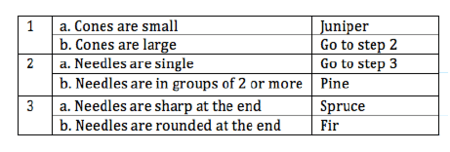
When using a dichotomous key to identify organisms, what do we look at?
physical features
weather patterns
environment
diet
What step do we always start with when using dichotomous keys?
1
2
3
4