
 Worksheets
Ch5.4 Cell Organelles/Structures
Total questions: 38
Worksheet time: 38mins
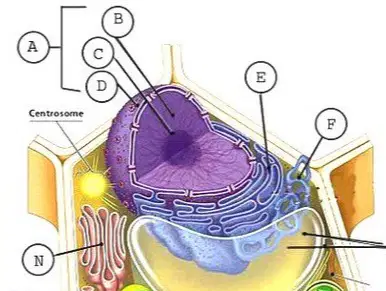
Identify B
chromatin
cilia
microtubules
microfilaments
Which of the following organelles would be absent in a plant ROOT?
Nuclei
Mitochondria
Chloroplasts
Central Vacuole
A cell that requires a lot of energy would contain large amounts of...
Mitochondria
Rough ER
Lysosomes
Ribosomes

Identify the ribosomes.
H
R
P
L

The picture shows a cell without a lot of detail. However, it is still possible to determine the basic structures W-Z. Which correctly best identifies these structures in the cell?
W-chloroplast
X-cell wall
Y-cytoplasm
Z-nucleus
W-cell wall
x-nucleus
Y-cytoplasm
Z-Chloroplast
w-cytoplasm
x-nucleus
Y-cell wall
Z-chloroplast
W-cytoplasm
X-chloroplast
Y-cell wall
Z-nucleus

Identify A
Vacuole
Nucleus
Nucleolus
Cytoplasm


What organelle is #4 pointing to?
Chloroplast
Vesicle
Nucleus
Central vacuole
Chloroplasts and mitochondria have completely different internal structures. Which is true of both.
Chloroplasts have lots of internal membrane folds. Mitochondria have internal membrane stacks.
Mitochondria have lots of internal membrane folds. Chloroplasts have internal membrane stacks.
Chloroplasts are multiple separate stack of membranes (looks like a stack of pancakes and are surrounded by vesicles. Mitochondria are a maze-like membrane system that is either rough our smooth.
Mitochondria are multiple separate stack of membranes (looks like a stack of pancakes and are surrounded by vesicles. Chloroplasts are a maze-like membrane system that is either rough our smooth.
Where do the ribosomes go after they are made in the nucleolus?
Into the space outside of the nucleolus but still inside the nucleus
Cytoplasm only
to the rough endoplasmic reticulum or out into the cytoplasm
to the smooth endoplasmic reticulum only
String-like structures inside the nucleus made up of proteins and deoxyribonucleic acid, better known as DNA.
cytoplasm
ribosomes
mitochondria
chromatin
Tiny holes in the nuclear membrane that allow different cellular materials to come in and go out of the cell.
nucleus
nucleoplasm
nucleolus
nuclear pores

This rod-shaped structure is which organelle?
nucleus
mitochondria
chloroplast
ribosomes

This organelle creates maze like "roads" that are used to move proteins and other material. They also help ribosomes create proteins.
Golgi apparatus
ribosomes
smooth endoplasmic reticulum (SER)
rough endoplasmic reticulum (RER)
This organelle takes proteins made by ribosomes, folds them and packages them in order to move them to the Golgi apparatus for further labeling and repackaging.
Ribosome
Cell Membrane
Nucleus
Rough ER
Do plant cells have cell membranes?
Yes
No
True or False: All plant cells are shaped the same
True
False
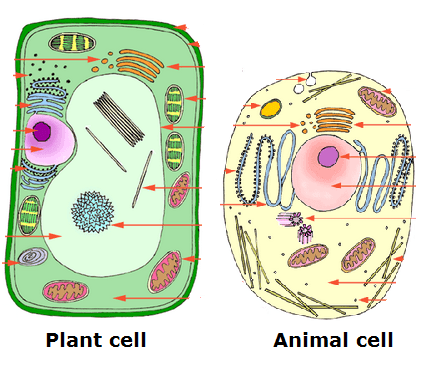
What distinguishes a plant cell from an animal cell? (How do you tell them apart) Hint: There's 3 ways (Check all 3)
Central Vacuole
Mitochondria
Cell Wall
Ribosomes
Chloroplasts
Compartment that works for the transport of substances from one organelle, such as the Golgi Body to other locations within the cell or to the cell membrane for export. "The delivery packages of the cell"
Ribosome
Lysosome
Vesicle
Vacuole
A special organelle that contains chlorophyll a pigment that captures the sun's energy to produce glucose in a process called photosynthesis
Chloroplast
Cell Membrane
Cell Wall
Nuclear Membrane
"Gatekeeper" Separates the cell from the rest of the environment and helps control what passes in and out of the cell. Semi-permeable: allows some materials to pass through but not all. Present in all cells.
Cell Wall
Cytoplasm
Mitochondria
Cell Membrane
No ribosomes attached to it, produces lipids
Lysosome
Smooth ER
Rough ER
Golgi Apparatus

What main substance is produced in this organelle?
glucose
oxygen
DNA
ATP

Function of this organelle?
protein synthesis
modify and produce lipids
modify, package, and ship proteins
storage of water, food or wastes
Which organelles are filled with digestive enzymes that aid in intra-cellular digestion, breaking down wastes and old organelles?
mitochondria
Golgi body
lysosomes
ribosomes

What is number 10 pointing to?
nucleus
ribosome
cell wall
cell membrane
Supports cells structure & drives cell movement. Composed of microfilaments & microtubules.
endoplasmic reticulum
golgi apparatus
cytoskeleton
vacuole

What entire organelle is A pointing to?
Nucleolus
Nucleoid region
Nucleus
ribosome
Evidence for the origin of eukaryotic cells can be seen in mitochondria and chloroplasts. There is strong evidence in both structures to suggest that eukaryotic cells are the product of...
endosymbiosis of different prokaryotes.
deep sea vents.
stem cells.
the nucleus simply splitting off into all the organelles
Mitochondria and Chloroplast _______________ which supports the explanation that these organelles were once long ago their own individual prokaryotes.
have DNA similar to prokaryotic DNA.
Can reproduce asexually on their own.
Neither of these options are true because the above statement is not true.

