
Font size
 Worksheets
Applied biochemistry Enzymes
Total questions: 20
Worksheet time: 13mins
An enzyme speeds up a reaction by
raising the activation energy
lowering the activation energy
releasing energy
absorbing energy.
What happens when enzymes are heated to a high temperature?
Stabilising bonds are disrupted causing the protein to unfold and denature
The membrane becomes more fluid as the phospholipids start to move apart
The enzymes' amino acid sequence changes
The enzymes remain the same

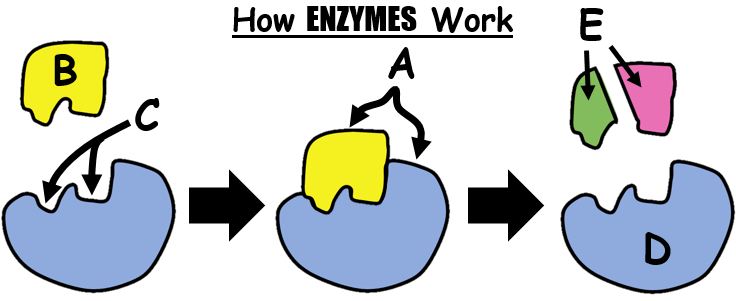
The image highlights the location on the enzyme where the substrate binds to the enzyme. The enzyme changes shape and then perform the reaction. What is this location called where the reaction occurs?
Active Site
Enzyme-Substrate Complex
Nucleic Acid Binding Site
Enzymatic Location
Any substance that is acted upon by an enzyme is called a....
Coenzyme
Substrate
Vitamin
Polypeptide
Which of the following is a way to overcome competitive inhibition of an enzyme?
Increase product concentration
Increase substrate concentration
Decrease enzyme concentration
Decrease environmental temperature
How does a noncompetitive inhibitor decrease reaction rates?
Binds to the active site and prevents substrate from binding so no product is formed
Binds to a site other than the active site, changing enzyme conformation and preventing product from being formed
Binds to substrate-enzyme complex and causes it to be held in the active site for longer
it permanently deactivates the enzyme

Analyze the graph pictured.
What is the estimated optimum pH at which this enzyme functions?
7
2
4
10
Which of the following is true of competitive inhibition?
Vmax doesn't change; Km decreases
Vmax goes down; Km increases
Vmax doesn't change; Km increases
Vmax goes down; Km decreases
According to induced fit model,
binding of substrate will change the substrate's conformation resulting in an exact fit.
the active site is exactly complementary to the substrate
the active site is not an exact fit for the substrate, it changes conformation to provide a tight fit around the substrate
strong bonds will bind the substrate in the active site
Substrate is held in the active site by
metallic bonding
weak non-covalent bonding
strong covalent bonds
velcro

Which line represents the enzyme with the COMPETITIVE inhibitor, if X is the control reaction?
X
Y
Z
What do you call the substrate concentration at which the reaction rate is half of Vmax?
Km (Michaelis constant)
Enzyme affinity
Immoblization
Substrate concentration
Which of the following is not an example of reversible covalent modification
phosphorylation
methylation
acetylation
proteolytic cleavage

The graph begins to plateau because...
All the substrate has been broken down into products
All the active sites are saturated with substrates
All the active sites are saturated with products
The substrate concentration is low
The initial rate of reaction is low because...
All the substrate has been broken down into products
All the active sites are saturated with substrates
All the active sites are saturated with products
The substrate concentration is low
Side chains of amino acids interact with substrate molecules. Mutation that change the amino acid sequence in the peptide that forms an enzyme's active site can result in loss of enzyme activity. Why?
it will disrupt the covalent bonding that normally forms between active site and substrate
the incorrect amino acid side group may not be as reactive as the original
it will reduce the activation energy required for the reaction
it will decrease the Km value for that reaction.
Proteolytic cleavage breaks peptide chains in to two or more fragments by which process?
enzymatic hydrolysis of peptide bonds between amino acids
acid hydrolysis of amide bonds between amino acids
enzymatic hydrolysis of N-glycosidic bonds
enzymatic hydrolysis of weak non-covalent forces present in folded protein
Which statement best describes the mode of action of coenzymes?
bind permanently at the active site to aid in substrate recruitment
form permanent covalent bonds between active site and substrate to increase rate
prevent substrate from binding at the active site
bind loosely at active site and form temporary bonds with substrate molecules

What would be the Vmax and Km for this reaction?
[x intercept = - 0.02 ; y intercept = 0.02]
Vmax = 5
Km = 5
Vmax = 50
Km = 50
Vmax = 500
Km = 500
Vmax = 50
Km = -50

