Wayground logo

Free Printable Worksheets

Font size

S
M
L
XL
Worksheets

2nd 9 Weeks Test #2 Review

Total questions: 96

Worksheet time: 24hrs 0mins

Name
Class
Date
1.
What does a translation do to an image?
a)
Turns it 90* clockwise
b)
Mirrors it
c)
Shrinks it
d)
Slides it
2.

Translate the blue shape to the pink shape...

a)

right 5 down 2

b)

left 5 up 2

c)

right 3 down 1

d)

left 3up 1

3.

Translate the blue shape to the green shape...

a)

left 3 down 3

b)

right 3 up 3

c)

right 2 up 3

d)

left 2 down 3

4.
Determine where X' would be if you translated 3 units to the left and 9 units down.
a)
(-4, 4)
b)
(-10, 2)
c)
(-4, -5)
d)
(-1, 5)
5.
What transformation is happening?
(x, y) ----> (x + 2, y - 3) 
a)

up 2 left 3

b)

right 2 up 3

c)

right 2 down 3

d)

left 3 right 2

6.
Write a rule for the translation.
a)

(x,y) →\rightarrow   (x -1, y  + 2)

b)

(x,y) →\rightarrow  (x -2, y  + 1)

c)

 (x,y) →\rightarrow (x +2, y  - 1)

d)

(x,y) →\rightarrow (x +1, y  -  2)

7.
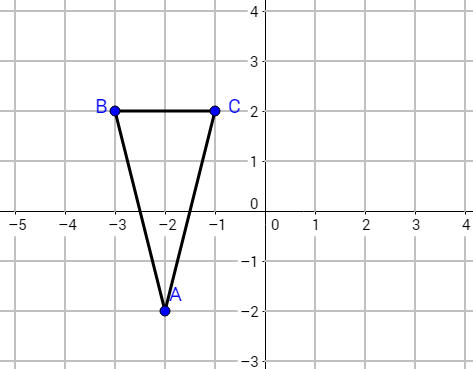
Triangle ABC is going to be translated. Where would  A' position be at, if the translation was be (x,y) --> (x+3, y-2)?
a)
(-1,3)
b)
(5,3)
c)
(5,8)
d)
(3,5)
8.

What is the notation of a figure is translated 2 units right and 5 units up?

a)
(x, y) --> (x - 2, y - 5)
b)
(x, y) --> (x + 2, y + 5)
c)
(x, y) --> (x + 5, y - 2)
d)
(x, y) --> (5x, 2y)
9.

When translating an image, if you move a figure to the right , you will have _____ a number.

a)
x +
b)
x -
c)
y +
d)
y -
10.

When translating an image, if you move a figure down, you will have _____ a number.

a)
y +
b)
y -
c)
x +
d)
x -
11.
Translation are always _______
a)
Congruent
b)
Bigger
c)
Smaller
d)
Rotated
12.
What does this transformation say to do?
(x, y) -----> (x, y +4) 
a)

down 4

b)

up 4

c)

right 4

d)

left 4

13.
Point M (-3, 5) is translated using this rule. 
(x, y) ----> (x - 1, y) 
What are the coordinates of M'?
a)
(-4, 5)
b)
(-2, 5)
c)
(-4, 4)
d)
None of these
14.
What is a reflection?
a)
When you turn an object around a point.
b)
When you slide an object form one place to another.
c)
When you flip or mirror an object across a line.
d)
When you resize an object.
15.
Which answer shows a reflection across the x-axis?
a)
a
b)
b
c)
c
d)
d
16.
Which answer shows a reflection across the y-axis?
a)
a
b)
c
c)
d
d)
b
17.
Triangle GHI is reflected across the x-axis.  What are the coordinates of I'?
a)
(-2, 6)
b)
(2, 6)
c)
(-6, -2)
d)
(6, 2)
18.
What is the rule for the following reflection? 
a)
Reflection across       y = 3
b)
Reflection across        x = −3
c)
Reflection across            x = 3
d)
Reflection across          y = −3
19.
What is the rule for the following reflection? 
a)
Reflection across       y = −1
b)
Reflection across        y = 1
c)
Reflection across            x = −1
d)
Reflection across          x = 1
20.

Is this a reflection over the X-axis or Y-axis

a)

X axis

b)

Y axis

21.

Is the reflection shown a reflection over the x or y axis?

a)

X axis

b)

Y axis

22.

Is the reflection shown a reflection over the x or y axis?

a)

x axis

b)

y axis

23.

Is the reflection shown a reflection over the x or y axis?

a)

x axis

b)

y axis

24.
How many degrees was the figure rotated?
a)
90 degrees counterclockwise 
b)
180 degrees
c)
90 degrees clockwise
25.
If you were to rotate ABCD 180°  about the origin, what would the coordinate of A' be?
a)
(-5, 5)
b)
(-3, -5)
c)
(-5, 3)
d)
(-3, 3)
26.
If you were to rotate ABCD 90° counterclockwise about the origin, what would the coordinate of A' be?
a)
(-5, 5)
b)
(-3, 5)
c)
(-5, 3)
d)
(-3, 3)
27.
If you were to rotate ABCD 180° about the origin, what would the coordinates of B' be?
a)
(0, 0)
b)
(-6, -5)
c)
(-1, 3)
d)
(-6, 2)
28.
What is the angle of rotation for this counterclockwise rotation about the origin?
a)
90°
b)
180°
c)
270°
d)
360°
29.
Rotate the point (-3,-4) around the origin 180 degrees. State the image of the point.
a)
(-4,-3)
b)
(-4,3)
c)
(4,-3)
d)
(3,4)
30.
What is this picture an example of? 
a)
An angle
b)
A cat vertex 
c)
Rotation 
d)
Dilation
31.
The image A'B'C' is a rotation of ABC.
a)
True
b)
False
32.
Triangle C is rotated 180° clockwise with the origin as the center of rotation to create a new figure. Which triangle shows the new location?
a)
A
b)
B
c)
C
d)
D
33.
Triangle A is rotated 270° counterclockwise with the origin as the center of rotation to create a new figure. Which rule describes rotating 270° counterclockwise?
a)
(x,y)→(y, -x) 
b)
(x,y)→(x,y)
c)
(x,y)→(-y,x)
d)
(x,y)→(-x,-y)
34.
Rotate the point (-5,8) around the origin 270 degrees counterclockwise. State the image of the point.
a)
(-8,5)
b)
(8,-5)
c)
(8,5)
d)
(5,-8)
35.
Rotate the point (7,8) around the origin 90 degrees counterclockwise.
State the image of the point.
a)
(-7,-8)
b)
(8,-7)
c)
(-8,7)
d)
(8,7)
36.
How many degrees was the figure rotated?
a)
90 degrees counterclockwise 
b)
180 degrees
c)
270 counterclockwise 
d)
90 degrees clockwise
37.
Rotate the point (-3,-4) around the origin 180 degrees clockwise. State the image of the point.
a)
(-4,-3)
b)
(-4,3)
c)
(4,-3)
d)
(3,4)
38.
The new figure created from a transformation is... 
a)
Congruent 
b)
Preimage 
c)
Image 
d)
Angle 
39.
The name of the figure before the rotation is... 
a)
Congruent 
b)
Preimage 
c)
Image 
d)
The Before
40.
What type of rotation does this represent (from red to blue)?
a)
270⁰ clockwise
b)
360⁰
c)
90⁰ counterclockwise
d)
180⁰
41.

When you rotate 180 degrees the ( x , y ) becomes ?

a)

( y , x )

b)

( -y , x )

c)

( -x , y )

d)

( -x , -y )

42.
Identify the transformation from A to D.
a)
90o Clockwise Rotation
b)
180o Rotation
c)
270o  clockwise Rotation
d)
360o Rotation
43.
Triangle B is rotated 90° counterclockwise with the origin as the center of rotation to create a new figure. Which rule describes this transformation?
a)
(x,y)→(y, -x) 
b)
(x,y)→(x,y)
c)
(x,y)→(-x,-y)
d)
(x,y)→(-y,x)
44.

The point A (8, 12) was dilated to become point A' (2, 3). What was the scale factor?

a)

½

b)

¼

c)

4

d)

2

45.

The point A (8, 12) was dilated to become point A' (2, 3). What was the scale factor?

a)

½

b)

¼

c)

4

d)

2

46.
A dilation is which of the following: 
a)
only an enlargement
b)
only a reduction
c)
Either an enlargement or a reduction
d)
Neither an enlargement or a reduction
47.

State the coordinate of the image of the given point B (4,9) under a dilation with center at the origin with the given scale factor of 2.

a)

B' (2 , 4.5)

b)

B' (-8 ,-18)

c)

B' (8 ,18)

d)

B' (9 ,4)

48.

When A(3, 6) is under a dilation of 2 what are the coordinates of A'?

a)

(3, 6)

b)

(1.5, 3)

c)

(6, 12)

d)

(12, 6)

49.

Dilate the figure by a scale factor of 3. What are the coordinates of the image?

A(3,3) B(6,6) C(9,3)

a)

A'(9,9) B'(18,18) C'(27,9)

b)

A'(6,6) B'(9,9) C'(12,6)

c)

A'(0,0) B'(3,3) C'(6,0)

d)

A'(1,1) B'(2,2) C'(3,1)

50.

The rule (x, y) --> (1/2x, 1/2y) will produce what type of image?

a)

Similar figure that is an enlargement

b)

Similar figure that is a reduction

c)

Congruent figure

d)

None

51.
What scale factor was used to produce the image?
a)
2
b)
-2
c)
1/2
d)
1
52.
Dilate Point B by a scale factor of 1/2
a)
(1.5,-4)
b)
(-1.5,1)
c)
(-1,-1.5)
d)
(-2,-2)
53.
In a dilation what mathematical operation is used with the scale factor?
a)
addition 
b)
subtraction 
c)
multiplication 
d)
division 
54.
When a dilation has a scale factor greater than one, the dilation is an enlargement.
a)
True
b)
False
55.
How many degrees was the figure rotated?
a)
90 degrees counterclockwise 
b)
180 degrees
c)
90 degrees clockwise
56.
The image A'B'C' is a rotation of ABC.
a)
True
b)
False
57.
State the line of reflection.
a)
Reflection across y-axis
b)
Reflection across x-axis
c)
Reflection across x = 1
d)
Reflection across y = 1
58.
Find K' if the figure is reflected across the x-axis
a)
(4, 1))
b)
(-1, -4)
c)
(1, -4)
d)
(1, 4)
59.
Determine how to translate triangle ABC to triangle A'B'C'.
a)
left 2, up 9
b)
right 2, down 9
c)
left 2, down 9
d)
left 2, up 5
60.

This point is translated 3 right and 2 down. Which diagram shows the new position of the point?

a)
b)
c)
d)
61.

The figure before a transformation has occurred is called what?

a)
Pre-image
b)
Image
c)
Translation
d)
Reflection
62.

What is the scale factor for the given dilation?

a)
2
b)
3
c)
1/3
d)
1/2
63.

If Triangle ABC is dilated using a scale factor of 1/2, what will be the coordinates of C'?

a)
(-1, -2.5)
b)
(12, 6)
c)
(3, -1.5)
d)
(0, 1.5)
64.
Triangle ABC will be dilated using the rule (x, y)→(2x, 2y).  What will be the coordinates of C'?
a)
(12, -3)
b)
(12, -6)
c)
(3, -1.5)
d)
(8, -5)
65.

What sequence of transformations will map trapezoid A to its image A'?

a)

Reflection, then translation

b)

Rotation, then translation

c)

Reflection, then rotation

d)

Rotation, then dilation

66.

What sequence of transformations could map ∆ABC onto its image ∆A''B''C''?

a)

a reflection followed by a rotation

b)

a reflection followed by a translation

c)

a translation followed by a rotation

d)

a translation followed by a reflection

67.

Which of the following describes the sequence of transformations shown?

a)

Reflect across the x-axis and then rotate 90 degrees clockwise around the origin

b)

Rotate 90 degrees clockwise around the origin and then translate down.

c)

Reflect across the x-axis and then reflect across the y-axis.

d)

Translate up and then rotate 90 degrees counterclockwise about the origin.

68.

Which transformation is shown?

a)

Translation

b)

Reflection over the x-axis

c)

Reflection over the y-axis

d)

180o rotation

69.

Which transformation is shown?

a)

Translation

b)

Reflection over the x-axis

c)

Reflection over the y-axis

d)

180o rotation

70.

Which transformation is shown?

a)

Translation

b)

Reflection over the x-axis

c)

Reflection over the y-axis

d)

90o counterclockwise rotation

71.
Describe a sequence of transformations that maps figure A onto figure B.
a)
A translation 4 units right followed by a reflection across the x-axis
b)
A reflection across the x-axis followed by a reflection across the y-axis
c)
A reflection across the y-axis followed by a translation 6 units down
d)
A 90° counter-clockwise rotation about the Origin followed by a reflection across the y-axis
72.

Identify the sequences of transformations from the green image to the red image to the blue image.

a)

rotation then translation

b)

translation then rotation

c)

translation then reflection

d)

rotation then reflection

73.

Identify the sequences of transformations from the red image to the blue image to the green image.

a)

translation then translation

b)

rotation then reflection

c)

rotation then rotation

d)

reflection then translation

74.

Which sequence of transformations will result from shape F to its image shape F''?

a)

Reflection over both axes

b)

Reflection, then rotation

c)

Translation, then reflection

d)

Rotation, then translation

75.
What is the sequence of transformations?
a)
Reflect over the y-axis then reflect over the x-axis
b)
Reflect over the x-axis then reflect over the y-axis
c)
Translate 4 units then rotate 90˚ counter-clockwise about the origin
d)
Rotate 90˚ counter-clockwise about the origin then reflect over the x
76.

What combinaton of transformations is shown?

a)

Rotation, then translation

b)

Translation, then reflection

c)

Rotation, then reflection

d)

Translation, then rotation

77.

What combination of transformations is shown?

a)

Reflection, then rotation

b)

Translation, then rotation

c)

Translation, then reflection

d)

Reflection, then translation

78.

What are the final coordinates of B after a rotation of 180 degrees counterclockwise and a reflection over the y-axis

a)

(3, -4)

b)

(3, 4)

c)

(-4, 3)

d)

(4, -3)

79.
Identify the transformation.
a)
Reflection across y-axis
b)
90 Rotation counter clockwise
c)
Translation 5 units left, 1 unit up.
d)
Translation 5 units right, 1 unit down
80.
How many degrees was the figure rotated?
a)
90 degrees counterclockwise 
b)
90 degrees clockwise
81.
Reflect the point (2, -4) over the y-axis.
a)
(-4, 2)
b)
(-2, 4)
c)
(-2, -4)
d)
(2, 4)
82.
Rotate the point (-3,-4) around the origin 180 degrees. State the image of the point.
a)
(-4,-3)
b)
(-4,3)
c)
(4,-3)
d)
(3,4)
83.

Point A is rotated 180 degrees and then flipped over the y-axis. What is A" if A is (2,7)

a)

(2,7)

b)

(-2, -7)

c)

(-2, 7)

d)

(2, -7)

84.
If you were to rotate ABCD 180°  about the origin, what would the coordinate of A' be?
a)
(-5, 5)
b)
(-3, -5)
c)
(-5, 3)
d)
(-3, 3)
85.
All angles in similar figures are congruent.  
a)
True
b)
False
86.
Sides in similar figures must be proportional.  
a)
True
b)
False 
87.
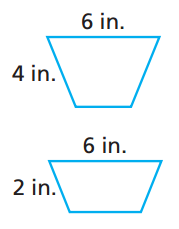
Are the following similar? Why or why not?
a)
Yes. All pairs of corresponding angles are congruent.
b)
No, the corresponding angles are not equal.
c)
No, the ratios of the corresponding sides are not equal.
88.
All corresponding angles in congruent figures are congruent.  
a)
True
b)
False
89.
Tell whether the two figures are congruent.
a)
Yes, same size and same shape
b)
No, same shape but different sizes
c)
No, different size and different shapes
90.
Two objects that are the same shape but not the same size are _______.
a)
Congruent
b)
Vertical
c)
Similar
d)
Complementary 
91.
Are these two shapes congruent or not congruent?
a)
congruent
b)
not congruent
92.
Are these figures similar?
a)
yes
b)
no
c)
i don't know
d)
not enough information
93.
Matching sides are called
a)
Corresponding Sides
b)
Corresponding Angles
c)
The Same
d)
Congruent Sides
94.
Angles in the same position are called
a)
Corresponding Sides
b)
Corresponding Angles
c)
The Same
d)
Congruent Angles
95.
Are the following similar? Why or why not?
a)
Yes
b)
No, the corresponding angles are not equal.
c)
No, the ratios of the corresponding sides are not equal.
96.
Solve the proportion.
____ = ____
a)
p=31.3
b)
p=308
c)
p=924
d)
p=532