
 Worksheets
Optional Practice - Unit 6 Study Guide Part B
Total questions: 84
Worksheet time: 2hrs 37mins
What is the formula for finding the sum of the interior angles of a polygon?
What is the sum of the exterior angles of a polygon?
What is the SUM of the angle measures in a triangle?
What is the sum of the interior angles for a 24-gon?


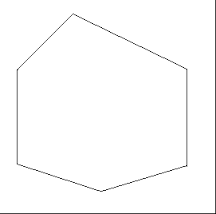


Solve for the missing variable.
255°
90°
60°
105°

Determine the measure of one exterior angle in regular hexagon.
60°

Solve for x.
220
110
250
125

Find the measure of angle y.
y=65°
y=70°
y=60°
y=80°
Opposite sides of parallelograms are _______ and _______.
parallel
congruent
congruent
consecutive
parallel
perpendicular
parallel
supplementary
______ angles of parallelograms are congruent.
Consecutive
Opposite
parallel
diagonal

Solve for x. Each figure is a parallelogram.
0
8
2
1
Consecutive angles of parallelograms are ______.
bisected
congruent
supplementary
complementary
The diagonals of a parallelogram _______ each other.
bisect
equal
are perpendicular to
complement
In parallelogram ABCD, ∠A ≅ ?
∠B
∠C
∠D
In parallelogram ABCD, AB≅?
BC
CD
DA


Find the measurement indicated in each parallelogram.
130°
74°
140°
40°
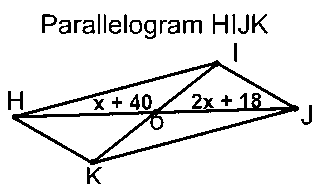


Parallelograms are
Triangles
Trapezoids
Quadrilaterals
Hexagons
Which one is NOT a property or characteristic of a parallelogram
Contains 3 or more sides
Opposite sides are parallel
Opposite sides are equal or congruent
All angles add up to 180 degrees
The opposite sides of a parallelogram are...
perpendicular
unequal
parallel
______ parallelograms are quadrilaterals.
Some
All
No
Most
______ angles of parallelograms are congruent.
Consecutive
Opposite
Parallel
Diagonal

In parallelogram ABCD, ∠DAB ≅ ?
∠DAC
∠DCB
∠ABC
∠ADC

In parallelogram ABCD, AB≅?
BC
CD
DA
BE

Find the measure ot angle ∠WZY .
75
105
24
28

Find the measurement of ∠XYZ .
75
105
28
24
Find the measurement of side WZ.
24
105
75
28


Solve for x.

Find the measure of the angle indicated in the following parallelogram.
105
36
45
135
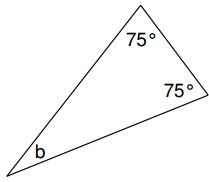

A polygon is a closed plane shape with 3 or more line segments (sides) that meet at the endpoints. What shape is a polygon?


What is the name of a polygon with 10 vertices?
nonagon
quadrilateral
decagon
heptagon

What is the name of a polygon with 7 sides, angles and vertices?
hexagon
octagon
septagon
heptagon

What is the name of a polygon with 5 vertices?
pentagon
heptagon
quadrilateral
hexagon


Determine the property being used to solve the problem.
Opposite SIDES are congruent
Opposite ANGLES are congruent
Consecutive angles are supplementary
Diagonals bisect each other

Solve for a and b.
a=7, b=4
a=14, b=4
a=7, b=8
a=7, b=5

Determine the property being used to solve the problem.
Opposite SIDES are congruent
Opposite ANGLES are congruent
Consecutive angles are supplementary
Diagonals bisect each other

Determine the property being used to solve the problem.
Opposite SIDES are congruent
Opposite ANGLES are congruent
Consecutive angles are supplementary
Diagonals bisect each other

Determine the property being used to solve the problem.
Opposite SIDES are congruent
Opposite ANGLES are congruent
Consecutive angles are supplementary
Diagonals bisect each other

Determine the property being used to solve the problem.
Opposite SIDES are congruent
Opposite ANGLES are congruent
Consecutive angles are supplementary
Diagonals bisect each other

Determine the property being used to solve the problem.
Opposite SIDES are congruent
Opposite ANGLES are congruent
Consecutive angles are supplementary
Diagonals bisect each other

Determine the property being used to solve the problem.
Opposite SIDES are congruent
Opposite ANGLES are congruent
Consecutive angles are supplementary
Diagonals bisect each other


Find m∠U in the parallelogram.
95°
85°
75°
90°

Which reason shows that the quadrilateral is a parallelogram?
Diagonals bisect each other
Both pairs of opposite sides are congruent
Both pairs of opposite angles are congruent
One pair of opposite sides are both congruent and parallel

Which reason shows that the quadrilateral is a parallelogram?
Diagonals bisect each other
Both pairs of opposite sides are congruent
Both pairs of opposite angles are congruent
One pair of opposite sides are both congruent and parallel


Is there enough information to determine that this quadrilateral is a parallelogram?
yes, all opposite sides are congruent
yes, opposite angles are congruent
yes, opposite sides are parallel
yes, consecutive interior angles are supplementary
The opposite sides and opposite angles of a parallelogram are...
congruent
supplementary
perpendicular
not congruent

Is there enough information to determine that this quadrilateral is a parallelogram?
yes, opposite sides are congruent
yes, opposite sides are parallel
no, not all pairs of opposite sides are congruent
no, it is not a quadrilateral

State which method we can use to show that the quadrilateral is a parallelogram.
Both pairs of opposite angles are congruent.
Both pairs of opposite sides are congruent.
The diagonals bisect each other.
Both pairs of opposite sides are parallel.

Polygon ABCD is a Quadrilateral which of the following pieces of information would prove that ABCD is a parallelogram?
DB=AC
DA=BC
DA||BC
DA||BC, DA=BC

Is the quadrilateral a parallelogram?
Yes; one pair of opposite sides are parallel
Yes; one pair of opposite sides are congruent
Yes; one pair of opposite sides are parallel and congruent
No; only one pair of sides are parallel
No; only one pair of sides are congruent
If you can prove that one pair of opposite sides of a parallelogram are the same length and have the same slope, you can prove that it is a parallelogram.
Always
Sometimes
Never

