
 Worksheets
Atoms Review
Total questions: 37
Worksheet time: 27mins
The positive particles of an atom are ___________.
electrons
protons
neutrons
The center of an atom where its neutrons and protons are is called the _____________.
nucleus
electron cloud
center


What is the name of this element?
11
Na
Sodium
20.98977

What is the symbol for this element?
Kr
kr
KR
All of them are right.

How many protons does Potassium (K) have?
19
39
20
58
A neutron has _________ charge or is ________.
negative ... neutral
positive .... neutral
no .... negative
no ... neutral

How many electrons does Phosphorous have?
16
31
15
46
What charge does an ion of oxygen, with 8 protons and 10 electrons, have?
+2
No charge
-1
-2
If there are 19 protons in an ion, but only 18 electrons, what is the overall charge?
-1
0
+1
+2
Which of these atoms (picture above) has 5 electrons?


What element does this Bohr model represent?
Carbon
Boron
Neon
Nitrogen

Name this element.
Neon
Magnesium
Sodium
Manganese
An element will always have the same number of
What is the maximum number of electrons that can be found in the first shell (energy level)?
2
8
18
What is the maximum number of electrons that can be found in the second shell (energy level)?
2
8
18

What is the atomic number of this element?
17
18
35
35.453

Which element is this?
Calcium
Chlorine
Silicon
Potassium

What element is this?
Nitrogen
Chlorine
Argon
Phosphorous

What does the 6 represent?
Atomic mass
atomic number
chemical symbol
element name
Which number is equal to the number of protons?
The atomic number
The mass number


Which Bohr model represents Neon?


What did Rutherford discover about atoms?
An atom is always negatively charged.
An atom is mostly empty space, but has a dense positively charged center(nucleus).
An atom is always positively charged.
All particles will pass straight through gold foil with no change in path.
Who discover the electron?
Dalton
Rutherford
Thomson
Bohr
Who proposed a model with electrons moving in specific layers?
Dalton
Rutherford
Bohr
Thomson
Who was considered as one of the founders of the ancient atomist theory?
Aristotle
Parmenides
Empedocles
Democritus
Where are electrons located in an atom?

This model added on to previous models by showing electrons existed at certain "energy levels". It is often called the Planetary Model.
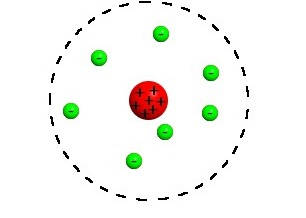
The "Nuclear Model" by Rutherford
The "Plum Pudding Model" of the atom by Thomson
The "Quantum Mechanical Modell" of the atom by Heisenberg


