
 Worksheets
Energy Unit Review
Total questions: 68
Worksheet time: 3hrs 24mins

What 2 things does potential energy depend on?
Position
and
motion
Shape
and
Position
Position
and
color
Color
and
Mass

What 2 things does kinetic energy depend on?
Mass
and
Speed
Shape
and
Position
Mass
and
Color
Speed
and
Position

Which law states that energy cannot be created or destroyed?
Low of Thermal Energy
Law of conservation of energy
Law of Radiant energy
Law of Kinetic energy

What is energy transformation?
When energy is converted from one form of energy to another.
When energy is created from one form of energy.
When energy turns into a robot to fight the aliens.
When energy is both kinetic and potential energy.
It is the rate of doing work
Energy
Power
Force
Acceleration
It is the capacity to do work
Energy
Power
Force
Motion
What is energy?
moving energy
stored energy
renewable energy
The ability to do work.
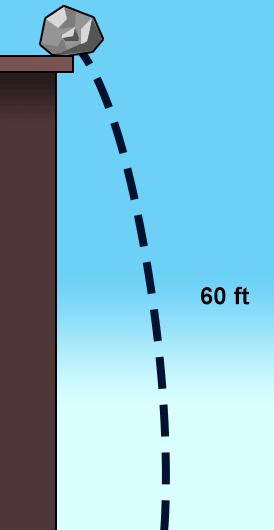
The rock in the picture is pushed over the edge and it begins to fall. Which type of energy conversion is taking place?
mechanical to heat
sound to mechanical
potential to kinetic
kinetic to potential

A ball is projected into the air. Where is potential energy the greatest?


Which point on the roller coaster's path represents the maximum potential energy?


As a roller coaster goes downhill
kinetic energy is converted into potential energy.
potential energy is converted into kinetic energy.
electrical energy is converted into potential energy.
potential energy is converted into electrical energy.
When gasoline is burned in a car engine, ________ energy is converted into _________ energy.
heat, chemical
chemical, potential
mechanical, chemical
chemical, mechanical

Within the alarm clock seen here, energy is transformed. It is time to get up! The alarm clock goes off. What are the energy transformations taking place in your alarm clock?
electrical to magnetic to sound
electrical to mechanical to sound
electrical to mechanical to light
chemical to electrical to mechanical
Maria’s father started a fire in the fireplace. He crumpled some paper, lit a match, and soon the logs in the fireplace were burning. In this case, the stored chemical energy in the logs was changed into
electrical energy.
mechanical motion.
heat and light energy.
electrical and heat energy.

The light bulb converts electrical energy into light and _________.
chemical
electromagnetic
heat
nuclear
Electromagnetic waves vary in
the speed they travel in a vacuum.
wavelength and frequency.
the way they reflect.
the orientation of their electric and magnetic fields.
The full range of frequencies of electromagnetic radiation is called
visible light.
radio waves.
the electromagnetic spectrum.
invisible radiation.
What is the equation for calculating gravitational potential energy
mv
1/2 mv^2
mgh
Ft
What is the equation for calculating kinetic energy?
mv
1/2 mv^2
mgh
Ft
sound
internal energy present in a system due to temperature
energy stored in the bonds of chemical compounds
the movement of energy via compressional waves
energy present in the nucleus of the atom
The energy associated with the motion and position of everyday objects.
thermal energy
nuclear energy
mechanical energy
chemical energy
The potential energy stored in the nucleus of an atom.
thermal energy
nuclear energy
mechanical energy
chemical energy
The total energy of motion in the particles of a substance.
thermal energy
nuclear energy
mechanical energy
chemical energy
A form of potential energy that is stored in chemical bonds between atoms.
thermal energy
nuclear energy
mechanical energy
chemical energy
The energy of electric charges
electrical energy
nuclear energy
electro magnetic radiation
chemical energy
a form of energy that exhibits wavelike behavior as it travels through space
electrical energy
nuclear energy
electro magnetic radiation
chemical energy
How do we see light waves?
as an image in a prism
as rays of sunshine
as colors of the rainbow
as reflections in a mirror
Where is visible light located in the electromagnetic spectrum?
between radio waves and infrared rays
between x-rays and gamma rays
between infrared and ultraviolet rays
between radio waves and microwaves
Which of the following shows the correct order of the electromagnetic spectrum, from shortest wavelength to longest?
gamma ray → x-ray → ultraviolet → visible → infrared → microwave → radio
radio → microwave → infrared → visible → ultraviolet → x-ray → gamma ray
visible → infrared → ultraviolet → x-ray → gamma ray → radio → microwave
microwave →x-ray → gamma ray → ultraviolet → visible → radio → infrared
The color of an object is most dependent on which of the following?
the temperature of the object
the way the object reflects light
the transparency of the object
the volume of the object

The picture shows a duck that appears to have its body detached when viewed underwater. Why does the duck's body look detached?
because the bottom of the pond scatters the light, making the duck's body underwater appear different than the rest of the duck
because the atmosphere absorbs the sunlight, so it reaches the ducks body underwater slower than the rest of the duck
because the pond is a different material than the air, and sunlight gets refracted as it travels in and out of the water
because the duck reflects the light toward its abdomen, making it look different than the rest of the duck
What happens when light is refracted?
It changes direction.
It becomes invisible.
It releases heat.
It moves faster.
A piano creates sound waves of different pitches by striking a small hammer against the strings inside the instrument. When a key is struck, the corresponding hammer strikes a string, causing a vibration that creates a sound wave. How do the sound waves of the higher pitch notes compare to the sound waves of the lower pitch notes?
The sound waves of notes with higher pitches have higher amplitudes.
The sound waves of notes with higher pitches travel at higher speed.
The sound waves of notes with higher pitches have higher wavelengths.
The sound waves of notes with higher pitches have higher frequencies.
Which of the following best describes how light waves pass through transparent materials?
They are refracted.
They are reflected.
They are transmitted.
They are diffused.
Which type of object transmits the most light?
an object that is opaque
an object that is a conductor
an object that is transparent
an object that is translucent
What causes light to slow down?
moving into a lighter medium
moving into a vacuum
moving into a less adhesive medium
moving into a denser medium
Which of the following statement about how sound waves travel is correct?
Sound waves travel the fastest through gases and slowest through liquids.
Sound waves travel faster through gases than through solids.
Sound waves travel fastest through liquids and the slowest through solids.
Sound waves travel faster through solids than through liquids.
Arlen is exploring the ways that colors react to light. He adds red food coloring to four different beakers containing 150 milliliters of water each. He adds three drops of red food coloring to the first beaker, 15 drops to the second beaker, 30 drops to the third beaker, and 50 drops to the fourth beaker. He places all four beakers in the sunlight. After 15 minutes, he measures the temperature of the water in each beaker. What can he expect to find?
The temperature will decrease as the color gets darker, because more radiant energy from the Sun bonds to the food coloring.
The temperature will increase as the color gets darker, because dark colors absorb more heat than light colors.
The temperature will increase as the color gets darker, because the chemical bonds between the food coloring and water create additional energy.
The temperature will decrease as the color gets darker, because the dark colors reflect more light than the light colors.


What would you call this?
Bounce back
Reflection
Diffraction
Refraction

Why does the apple appear red?
It reflects all the colors except red
It diffracts all the colors except red
It absorbs all the colors except red
It refracts all the colors except red

Allows no light through.
Transparent
Translucent
Opal
Opaque


Is a metal cookie sheet a conductor or an insulator?
Conductor
Insulator

Is a potholder a conductor or an insulator?
Conductor
Insulator
STOPS or slows down the transfer of thermal energy:
Conductor
Insulator
The only heat transfer that can occur through empty space. It travels through electromagnetic waves.
Conduction
Convection
Radiation
These materials allow thermal energy to travel through them easily.
Conductors
Insulators

Hands wrapped around a mug of hot cocoa is an example of this type of heat transfer:
Convection
Conduction
Radiation

