wayground logo

Free Printable Worksheets

NEW

Font size

S
M
L
XL
Worksheets

Waves & Astrophysics Review

Total questions: 70

Worksheet time: 49mins

Name
Class
Date
1.
If the frequency gets higher, the wavelength gets 
a)
longer
b)
shorter
2.
If the wavelength gets longer, the frequency gets 
a)
higher
b)
lower
3.
Which EM wave has the lowest frequency?
a)
radio
b)
xray
c)
gamma
d)
infrared
4.
Which EM wave has the longest wavelength?
a)
light
b)
radio
c)
ultraviolet
d)
red
5.
Which color has the lowest frequency?
a)
red
b)
green
c)
blue
d)
violet
6.
Which part of the wave is shown at letter E?
a)
trough
b)
crest
c)
resting point
d)
amplitude
7.
Which part of the wave is shown at letter C?
a)
crest
b)
wavelength
c)
resting point
d)
amplitude
8.
Which part of the wave is shown at letter B?
a)
crest
b)
trough
c)
wavelength resting point
9.
What part of the wave is shown at letter A?
a)
crest
b)
trough
c)
wavelength
d)
frequency
10.
What happens to frequency when the energy increases?
a)
it increases
b)
it decreases
c)
it stays the same
11.

What is the speed of a wave that has a wavelength of 2 m and a frequency of 2.5 Hz?

a)
2.5 m/s
b)
5 m/s
c)
4.5 m/s
d)
6 m/s
12.
Which wave has a longer wavelength?
a)
wave C
b)
wave D
13.
Which wave has a greater frequency?
a)
wave B
b)
wave C
14.
Which wave has the most energy?
a)
top wave
b)
bottom wave
15.
How would a person measure the wavelength on this sound wave?
a)
dense to less dense
b)
trough to crest
c)
compression to compression
d)
beginning of illustration to the end
16.

All waves carry ________ as they travel from one place to another.

a)

matter

b)

space

c)

energy

d)

water

17.
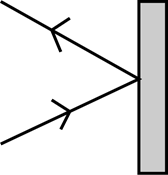
The illustration shows a light ray striking an object.
In the illustration, the light ray striking the object is-
a)
absorbed
b)
stopped
c)
reflected
d)
refracted
18.
A student placed a pencil in a cup of water.  The pencil appears broken because light-
a)
always travels in a straight line
b)
bends when it passes through water
c)
makes the water in the glass evaporate
d)
reflects the pencil on the water's surface
19.
What does it mean to refract?
a)
bounce off
b)
to bend
c)
curve outward
d)
reflect
20.
The _____________ of a wave is how many waves occur in one second.
a)
wavelength
b)
amplitude
c)
frequency
d)
energy
21.
What is the unit of measurement for frequency?
a)
Nanometers
b)
Hertz
c)
Micrometers
d)
Decibels
22.
Which properties of waves make up color?
a)
Wavelength and frequency
b)
Frequency and amplitude
c)
Amplitude and wavelength
d)
Wavelength, frequency, and amplitude
23.
A ___ amplitude light wave will be brighter, and a __ amplitude light wave will be dimmer.
a)
lower; higher
b)
higher; higher
c)
higher; lower
d)
lower; lower
24.
_______ waves need matter to travel but ________ waves do not.
a)
Sound; light
b)
Light; sound
c)
Sound; electrical
d)
Electrical; light
25.
A _______ is a repeating pattern of motion that transfers energy from one place to another.
a)
wavelength
b)
wave
c)
frequency
d)
light
26.

Interference of light is evidence that:

a)

the speed of light is very large

b)

light is a transverse wave

c)

light is electromagnetic in character

d)

light is a wave phenomenon

27.
This image is representing what wave interaction?
a)
Refraction
b)
Diffraction
c)
Reflection
d)
Interference
28.
When a wave moves around a barrier or though an opening it is known as what?
a)
Diffraction
b)
Refraction
c)
Rarefaction
d)
Destruction
29.
In ________ interference, the energy of the combined wave is greater than the energy of each of the two waves.
a)
destructive
b)
rarefaction
c)
resonance
d)
constructive
30.
When the crest of one wave passes through the trough of another wave, ______ takes place.
a)
resonance
b)
diffraction
c)
destructive interference
d)
constructive interference
31.

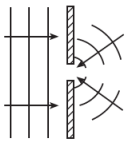
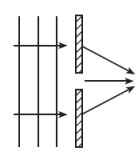
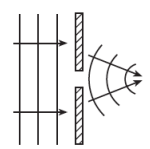
Which diagram best represents the shape and direction of a series of wave fronts after they have passed through a small opening in a barrier?
a)
b)
c)
d)
32.
A change in the direction of a wave when the wave finds an obstacle or an edge.
a)
A. refraction
b)
B. reflection
c)
C. standing wave
d)
D. diffraction
33.

What is a general definition of wave interference?

a)

When a wave bounces off an object

b)

When more than on wave meet and interact in the same medium

c)

When a wave bends around a corner

d)

When a wave creates static

34.

What type of interference is being shown in the picture?

a)

Constructive

b)

Destructive

35.

What type of interference is occurring in the picture?

a)

Constructive

b)

Destructive

36.

As a blackbody, what wavelength of radiation does a low-temperature star (4000 K) give off? Where is the peak of electromagnetic energy it emits?

a)

Infrared radiation

b)

ultraviolet light

c)

gamma rays

d)

visible light

37.

As a blackbody, what wavelength of radiation is emitted by the star SIRIUS A (10,000 K)? Where does the its electromagnetic energy reach its peak?

a)

Infrared radiation

b)

ultraviolet light

c)

gamma rays

d)

visible light

38.

Blackbody curves also tell astronomers about the ___ of an object (like a star).

a)

rotational energy

b)

temperature

c)

distance

d)

composition

39.
The teacher gave Carly a list of four stars of different colors. Carly used the graph shown above to help compare the stars’ luminosity. 
Which star is going to have the highest temperature? 
a)
Yellow
b)
White
c)
Red
d)
Blue
40.

What happens to the color this object is glowing with as it cools down from 5,000 K?

a)

It goes from yellow to white to blue.

b)

It goes from yellow to orange to red.

c)

It goes from infrared to white to blue.

d)

It goes from ultraviolet to infrared to red.

41.
In the diagram given, what happens as we move to the left?
a)
Stars Get Larger
b)
Stars get Colder
c)
Stars get hotter
42.
Which star is the coldest?
a)
Yellow Star
b)
Red Star
c)
Orange Star
d)
Blue Star
43.
Compared to the rest of the stars, our sun is considered...
a)
Extremely Large and Cold
b)
Small with a medium temperature
c)
Medium size with medium temperature
44.
Which category is our Sun located in?
a)
White Dwarfs
b)
Supergiants
c)
Main Sequence
d)
Giants
45.
The category that contains the most stars is...
a)
Main Sequence
b)
Supergiants
c)
Giants
46.
As a whole, Giants are considered hotter than White Dwarfs.
a)
True
b)
False
47.
Blue stars are the _____________.
a)
hottest
b)
coolest
c)
smallest
48.
Which star has the lowest temperature?
a)
A
b)
B
c)
C
d)
D
49.
The continuous spectrum of a star has gaps in it, darker bands where different elements ___
a)
absorb different colors
b)
reflect different colors
c)
transmit different colors
d)
refract different colors
50.
A star can actually emit more green light than any other color but we'll wind up seeing it as ___
a)
white
b)
red
c)
blue
d)
violet
51.
Comparatively, as shown on an HR diagram, massive stars are ___
a)
hotter and more luminous
b)
cooler and more luminous
c)
hotter and less luminous
d)
cooler and less luminous
52.
The stars on the lower left of an HR diagram are hot, blue/white but very faint, and are called ___
a)
white giants
b)
blue giants
c)
white dwarfs
d)
blue dwarfs
53.
Most stars live the majority of their lives ___
a)
as white dwarfs
b)
along the main sequence
c)
as red giants
d)
as red super giants
54.
The color of a star tells us its
a)
magnitude
b)
temperature
c)
size
d)
age
55.
The life cycles of stars are determined by their:
a)
mass (size)
b)
color
c)
distance from Earth
d)
luminosity
56.
Most stars are made of which gases?
a)
Hydrogen only
b)
Hydrogen and Lithium
c)
Hydrogen and Sodium
d)
Hydrogen and Helium
57.
Our sun is currently in what star stage?
a)
Protostar
b)
Nebula
c)
Main Sequence
d)
Red Giant
58.
After the main sequence, a low mass star becomes a
a)
black dwarf
b)
protostar
c)
red giant
d)
supergiant
59.
After the main sequence, a high mass star becomes a
a)
black dwarf
b)
protostar
c)
red giant
d)
supergiant
60.
After a supergiant, a high mass star explodes and forms a
a)
supernova
b)
red giant
c)
black hole
d)
planetary nebula
61.
The final stage of a low mass star is a 
a)
neutron star
b)
nebula
c)
black hole
d)

white dwarf

62.

Astronomer Edwin Hubble discovered (in 1929) that all galaxies are

a)

rushing toward each other.

b)

getting larger by galactic mergers

c)

rushing away from each other.

d)

spiral in shape

63.

Hubble's Law states that most galaxies are receding away from us at a speed that is proportional to their

a)

size.

b)

mass.

c)

quasars.

d)

distance

64.

A galaxy that is moving toward the earth will have which property?

a)

Its absorption lines will be very dim.

b)

Its absorption lines will be blueshifted.

c)

Its absorption lines will be redshifted.

d)

Its absorption lines will be very wide.

65.

You observe three distant galaxies and note their apparent velocities:

  • BFG-01 40,000 km/s
  • BFG-02 80,000 km/s
  • BFG-03 20,000 km/s

Which of the following is true?

a)

BFG-01 is farthest away from Earth.

b)

BFG-02 is closest to Earth.

c)

BFG-03 is closest to Earth.

d)

Nothing can be learned from their apparent velocities.

66.

How is redshift related to distance?

a)

The greater the redshift, the less the distance

b)

The less the redshift, the greater the distance

c)

The greater the redshift, the greater the distance

d)

There is no relationship between redshift and distance

67.

n the diagram, the spectral lines (fingerprint) of hydrogen gas from three galaxies, A, B, and C, are compared to the spectral lines of hydrogen gas observed in a laboratory.

What is the best conclusion that can be made about the movement of galaxies A, B, and C?

a)

Galaxy A is moving away from Earth, but galaxies B and C are moving toward Earth.

b)

Galaxy B is moving away from Earth, but galaxies A and C are moving toward Earth.

c)

Galaxies A, B, and C are all moving toward Earth.

d)

Galaxies A, B, and C are all moving away from Earth.

68.

The more that the spectral lines of a star are shifted to the red end of the spectrum

a)

the larger it is.

b)

the hotter it is

c)

the faster it is moving away from us

69.

The Doppler effect predicts that light from a source moving away from Earth will have

a)

shorter wavelengths.

b)

longer wavelengths.

70.

The theory that the universe is expanding is supported by the

a)

blue shift of light from distant galaxies

b)

red shift of light from distant galaxies