
 Worksheets
Geology Review
Total questions: 70
Worksheet time: 1hrs 10mins


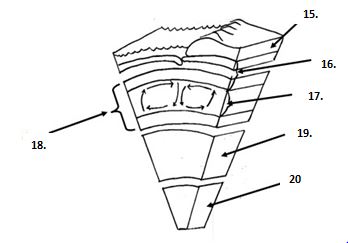
List the layer in order
1.Crust
2.inner core
3.outer core
4.Mantle
1.inner core
2.outer core
3.crust
4.Mantle
1.Mantle
2.outer core
3.inner core
4.crust
1.crust
2.Mantle
3.Outer core
4.inner core
A block of aluminum occupies a volume of 15.0 mL and weighs 45.0 g. What is its density?
3 g/mL
0.3333 g/mL
675 g/mL
I have no idea
A cloud of gas or dust in space
Stellar nucleosynthesis
Nebular Theory
Nebulae
Protoplanet

Isotopes of an element have a different number of...
Protons
Neutrons
Electrons
Mass


:What is letter “A.”pointing to?
Proton
Neutron
Electron
Atom

An element will always have the same number of
electrons
neutrons
protons
Orbitals

How many protons does krypton have?
84
36
48
8
Which of the following is evidence that the Earth is spherical?
A ship gets smaller as it sails away, and larger as it sails toward you
A ship’s mast is the first thing to appear over the horizon as it sails toward you, and the last thing to disappear as it sails away
A ship appears to be curved as it sails away, like the edge of a sphere
True or False: During a lunar eclipse, the Earth casts a circular shadow on the moon, which is proof that it is spherical in shape
True
False
True or False: The circumference around the Earth from the North pole to the South pole is greater than the circumference around the equator
True
False
The Earth's layers formed based on their ___
densities
thickness
levels of Hydrogen fusion
name (alphabetically)
What are the 2 most abundant gases in the atmosphere today?
carbon dioxide and oxygen
nitrogen and oxygen
nitrogen and carbon dioxide
oxygen and water vapour
How did oxygen get into the atmosphere?
Asteroids
Gravity
Photosynthesis
Humans
Which layer of the Earth is liquid?
Crust
Mantle
Outer core
Inner core

Which type of rock is formed from the solidification of magma or lava?
igneous
sedimentary
metamorphic
bioclastic

Describe the mineral composition of the following igneous rock.
felsic
mafic

Describe the mineral composition of the following igneous rock.
felsic
mafic

Describe the environment of formation for the following igneous rock (grain size > 10 mm).
intrusive
extrusive

Describe the environment of formation for the following igneous rock.
intrusive
extrusive

Describe the rate of cooling for the following igneous rock (grain size 1-10 mm).
slow cooling
rapid cooling

Pegmatite is a coarse-grained, intrusive, igneous rock. How did it form?
rapidly cooling lava
slowly cooling magma


Which causes rocks to physically weather in to sediments?
Water
Ice
Wind
All of the above

Using the Mohs Hardness Scale above answer the following questions as true or false.
1. _____ Apatite would scratch fluorite but not topaz.
True
False
Using the Mohs Hardness Scale above answer the following questions as true or false.
2. _____ A steel nail would scratch quartz.
True
False
2. Which mineral property refers to how easily a mineral can be scratched?
A. Streak
B. Density
C. Hardness
D. Fracture
4. Fracture or cleavage of a mineral is determined by:
A. how long it took to form
B. the internal arrangement of atoms
C. temperature
D. the color of the mineral
6. Describe how you would determine a mineral’s streak.
Rub the mineral on a ceramic plate.
Rub the mineral on a glass plate.
Break the mineral.
Place the mineral in a beaker of water.
If a mineral breaks along flat surfaces, it demonstrates this property.
color
streak
luster
cleavage
If a mineral is said to be "metallic", this is a description of its:
color
streak
luster
cleavage
Granite is an example of a(n) ____________ rock
Igneous
Sedimentary
Metamorphic
Glassy
Shale is an example of a(n) _______________ rock
igneous
sedimentary
metamorphic
glassy


What is underground molten rock?
Lava
Magma
Soil
Intrusive
What is aboveground molten rock?
Extrusive
Magma
Lava
Sedimentary

Sandstone is an example of...
Metamorphic
Sedimentary
Igneous

Marble is an example of...
Igneous
Sedimentary
Metamorphic
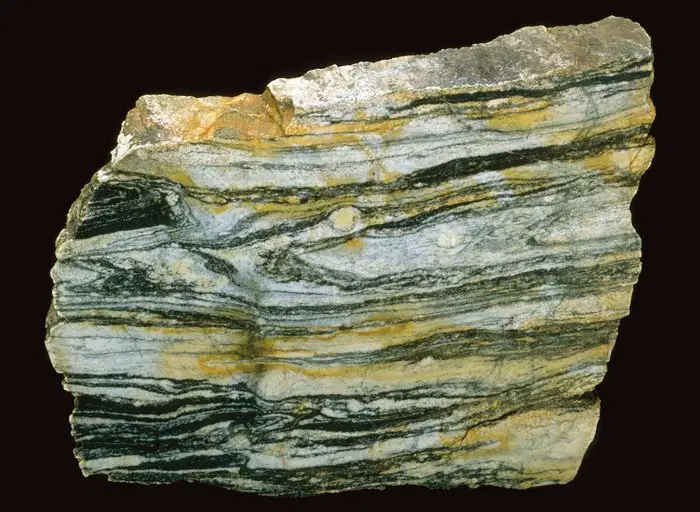
This rock is ___
foliated
non-foliated
bedded
igneous
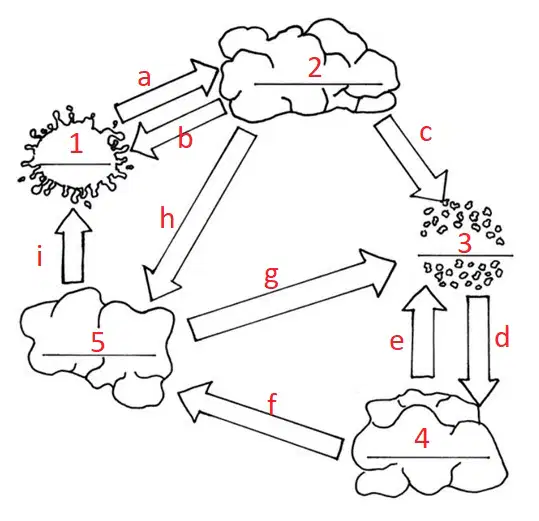
What is "2" in the diagram?
igneous rock
sedimentary rock
metamorphic rock
magma
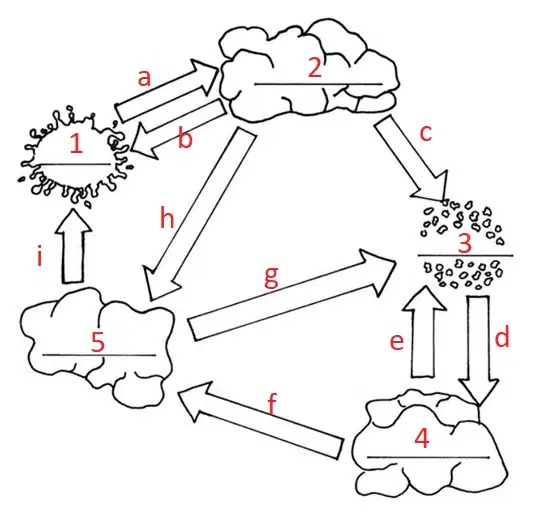
What is "4" in the diagram?
igneous rock
sedimentary rock
metamorphic rock
magma
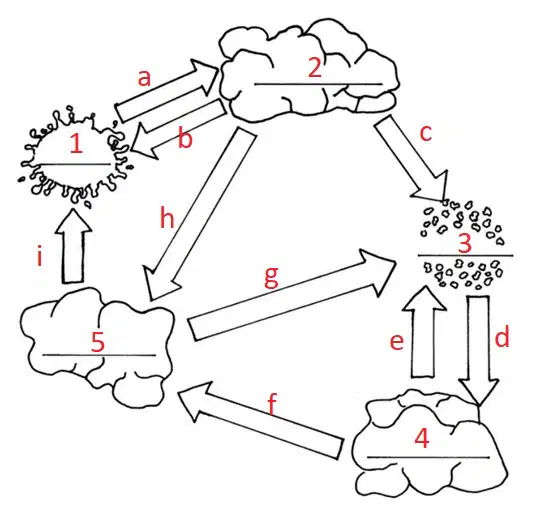
What are "c," "e" and "g" in the diagram?
Melting
Compaction and cementation
Weathering and erosion
Heat and pressure
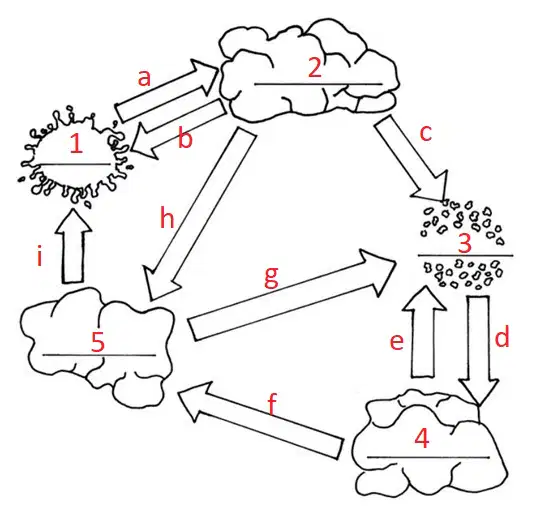
What are "f" and "h" on the diagram?
Melting
Compaction and cementation
Weathering and erosion
Heat and pressure
Resources that are used up faster than they can be replaced are known as
renewable
non-renewable
unbalanced
carboniferous
What does soil depletion do?
Removes nutrients from the soil
Adds salt to the soil
It takes away soil from an area
It makes the soil pieces smaller
Using fertilizers and pesticides can lead to
biodiversity
eutrophication
water pollution
ore depletion
A rock with a valuable metal in it is known as a(n) ____
geode
ore
mineral
geological deposit
Extracting valuable materials from inside the Earth is known as ____
mining
searching
digging
mineralization

