
 Worksheets
Ballistics and Tool Marks Evidence
Total questions: 73
Worksheet time: 1hrs 23mins
The #1 priority of impressions is to preserve it by first
cleaning the area
taking photographs
waxing the impression
clearing out the people
A tool marks left at a crime scene would be considered.
Circumstantial Evidence
Direct Evidence
The study of bullets and firearms is called
serology
Ballistics
DNA Technology
Firearms

Which term accurately describes the part of the gun labeled F
Gun Barrel
Trigger Guard
Action
Trigger
Ballistics can match a bullet to the gun that fired it.
True
False


Sample X was found in a parking lot of a club shooting. Samples A1 - A4 are examplar shootings collected from suspect weapons. Which gun most likely fired the bullet found at a crime scene?
A1
A2
A3
A4
Which of the following can be solved from analyzing Gun Shot Residue?
the type of gun the bullet came from
The distance between the weapon and the victim
the type of bullet the gun shot
The time the gun was shot
Gun barrel marking left on a spent bullet are called
striations
linear markings
bullet fingerprints

In the picture, the part that passes through the gun barrel is
primer
casing
bullet and casing
bullet


The following image is a striation analysis from a crime committed in Macon, GA. The left side of the image is the striation marks from the bullet fired from the crime scene, the right side of the image is the striation marks from a bullet shot from the suspects gun. Is this person’s gun a match for the crime?
yes
no
What does the spinning of the bullet improve?
balance
power
accuracy
speed


Define Trajectory
The flight path of a projectile
Flight path of a bird
The trigger of a gun
The casing of a bullet

What part of the cartridge is the arrow pointing to?
Casing
Primer
Bullet
Gun Powder
True or False: When the trigger of a weapon is pulled, the firing pin hits the bullet and ignites the gunpowder that projects the casing forward through the barrel of the gun.
True
False
Which of the following weapons would NOT be considered a long gun?
Rifle
Revolver
Shot gun
The markings on a bullet/projectile that are unique to each weapon are called _____.
Breech marks
Firing pin markings
Striations
Lands and Grooves
True or False: It is possible to test positive for GSR even if one has never touched a weapon.
True
False
Which of the following CANNOT be determined with ballistics?
Who fired the weapon
Location of the shooter
DNA of the shooter
Weapon used in the crime
Which of the following best describes the trajectory of a projectile?
The height of the shooter
The pattern of the lands and grooves on the bullet
The housing for the cartridge’s gunpowder
The path and flight of the bullet
Shotguns are examples of ______.
Handguns
Long guns
Revolvers
Semiautomatic
Ballistics is the study of _______and __________
Bullets and Firearms
Long guns and short guns
striation marks
guns and explosions
What does GSR stand for?
Glock safety rounds
Gun shot residue
Gravity semiautomatic revolver
The intact bullet, casing with packed gun powder, and primer before being discharged is known as
slug
clip
cartridge
magazine
Why is rifling important for forensic ballistic analysis?
It spins the bullet, making it more accurate.
It makes the bullet travel farther before losing accuracy/
It can be found in all firearms.
It makes indentations on the bullet that are unique to the firearm.

What is happening to the bullet in the picture:
Striations
Extractor Marks
Mushrooming
Ejector Marks
Define Striations
marks made as the cartridge is removed from the chamber
marking from a firing pin on the cartridge
scratch marks left on the projectile by rifling lines of the inside of the barrel
Marks or scratches made when the cartridge is placed into the chamber
What piece of equipment is used to match bullet striations up?
Comparison microscope
Electron microscope
Light microscope
Proton microscope
What are the two main categories of guns?
pistol and rifles
long guns and handguns
automatic and semi-automatic
bullet-firing and shot-firing
What would you expect of a close range wound?
A very small bullet hole with no GSR
A large wound with GSR and flash burns.
A large wound with no GSR.
A very small bullet hole with flash burns.

What type of gun is this?
pistol
revolver
shotgun
rifle

What type of gun is this?
pistol
revolver
shotgun
rifle

What type of gun would this type of cartridge be compatible with?
pistol
shotgun
rifle
Place the steps of a firearm in order from beginning to end
1) The pressure of the ignition pushes the bullet from the casing and into the barrel of the firearm
2) The bullet follows the lands and groves pattern of the barrel and spirals out of the barrel
3) The trigger is pulled and firing pin from the firearm hits the base of the cartridge, igniting the powder inside the bullet
1,2,3
3,2,1
2,1,3
3,1,2
Which of the following is not a part of ballistics?
Shotgun
Revolver
Slingshot
Pistol
What is the definition of ABRASION MARK?

a mark produced when a surface slides across another

a mark produced along the edge as a surface is cut
What is the definition of CUTTING MARK?

an impression, scratch, or abrasion when contact occurs between two objects

a mark produced along the edge as a surface is cut
What is the definition of INDENTATION MARK?

a mark produced when a surface slides across another surface

a mark or impression made by a tool on a softer surface
What is the definition of TOOL MARK?

any impression, scratch, or abrasion made when contact occurs between a tool and another object

a mark produced along the edge as a surface is cut
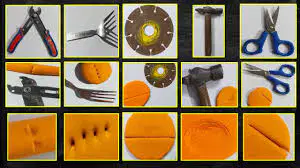
TRUE or FALSE:
Tool mark evidence should NOT be photographed, documented, collected, and/or casted.
TRUE
FALSE

TRUE or FALSE:
Tools have major and minor surface differences that can help identify one tool impression from another.
TRUE
FALSE
TRUE or FALSE:
Tool marks are categorized into one of 4 categories: indentations marks, abrasion marks, cutting marks, and casting marks.
TRUE
FALSE

TRUE or FALSE:
Advancing technology for distinguishing tool marks is helping forensic experts help the courts fight crime and find criminals.
TRUE
FALSE
Why should an investigator not try to put the tool into the tool mark at the crime scene?
it could destroy the tool mark evidence that is there
it could leave new evidence behind covering up the original
it could be questioned in court and excluded as evidence

What is the first step of processing any kind of evidence?
Casting
Photographing
Dusting
Lifting

Which of the following represents the picture?
Indentation Mark
Abrasion Mark
Cutting Mark

Which of the following represents the picture?
Indentation Mark
Abrasion Mark
Cutting Mark

Which of the following represents the picture?
Indentation Mark
Abrasion Mark
Cutting Mark

Which of the following represents the picture?
Indentation Mark
Abrasion Mark
Cutting Mark
How are tool marks formed?
When a harder tool scratches a softer surface
When a soft tool leaves residue on a hard surface
When a tool is pressed into concrete
When two tools are used together
Which factor does NOT influence the creation of a tool mark?
The shape and sharpness of the tool
The type of tool used
The person’s fingerprint on the tool
The amount of force applied
Why is it important to take high-resolution photos of tool marks at crime scenes?
To capture the detail of each tool mark for analysis
To add more photos to the crime scene report
To prevent casting of the marks
To ensure the evidence is kept secret
What is casting in relation to preserving tool marks?
Taking photos of the tool mark
Lifting the tool mark with adhesive tape
Creating a replica of the tool mark using materials like silicone or rubber
Scratching the surface to see if a mark is permanent
How can tool marks help link a suspect to a crime scene?
By identifying the type of tool used
By matching the unique patterns of a tool mark to a specific tool found with the suspect
By analyzing the suspect’s fingerprints on the tool
By determining the brand of the tool
Striation marks are created when:
A tool is pressed into a soft material without movement.
A tool moves across a surface, leaving scratch-like patterns.
A tool is used to break a surface completely.
A soft object moves over a harder surface.
Which of the following best describes an impression mark?
A deep scratch left by a sharp object.
A flat, smooth area created by heavy impact.
An indentation left when a tool presses into a softer material.
A faint, temporary mark left by fingerprints.
Which of the following materials is commonly used to cast tool marks?
Wax
Glue
Silicone
Paint
Why might an investigator cast a tool mark instead of photographing it alone?
Photographs can fade over time.
A cast provides a three-dimensional replica that can show depth and detail.
Casts are easier to store than photographs.
Casting takes less time than photographing.

