

wayground logo

Free Printable Worksheets

NEW

Font size

S
M
L
XL
Worksheets

Steps 1 and 2 of Photosynthesis

Total questions: 57

Worksheet time: 43mins

Name
Class
Date
1.

Energy for the Calvin cycle is supplied by which of the following from the light reactions?

a)

Carbon dioxide and water

b)

ATP and water

c)

ATP and NADPH

d)

Carbon dioxide and ATP

2.

Carbon dioxide fixation occurs when CO2 combines with which among the choices below?

a)

ATP

b)

G3P

c)

NADPH

d)

RuBP

3.

What output of the Calvin cycle is used to generate carbohydrates?

a)

NADPH

b)

G3P

c)

CO2

d)

RuBP

4.

What is the function of the ATP and NADPH from the light reactions?

a)

Split water

b)

Cause RuBP carboxylase to fix CO2

c)

Cause electrons to move along their pathways

d)

Convert 3 PGA to G3P

5.

In what part of the chloroplast does Calvin cycle reactions happen?

a)

Thylakoid membrane

b)

Stroma

c)

Plasma membrane

d)

Cytoplasm

6.

The Calvin cycle starts with which process?

a)

The absorption of photon energy

b)

Carbon fixation

c)

The release of electrons from photosystem II

d)

NADP+ formation

7.

Which of the following substances does not participate in the Calvin cycle?

a)

ATP

b)

NADPH

c)

O2

d)

RuBP

e)

CO2

8.
What are the two products of photosynthesis?
a)
Oxygen and Carbon Dioxide
b)

Oxygen and Sugar

c)
Sunlight and Sugar
9.
Which of the following is the correct equation for PHOTOSYNTHESIS?
a)
CO+ light + H2O --> O+ Sugar
b)
CO+ sugar + H2O --> O+ light
c)
O2 + light + H2O --> CO+ Sugar
d)
CO+ O2 + H2O --> Light+ Sugar
10.

Which plant organelle transforms light into glucose to use as food?

a)

Mitochondria

b)

Vacuoles

c)

Chloroplasts

d)

Nucleus

11.

The Calvin Cycle occurs in the

a)

Thylakoid

b)

Grana

c)

Inner membrane of chloroplast

d)

Stroma

12.
Where do the light reactions happen?
a)
mitochondria membrane
b)
thylakoid membrane
c)
stroma
d)
central vacuole
13.

Choose the statement that best describes light reaction.

a)

It converts CO2 to sugar molecule

b)

It converts light energy to chemical energy of ATP and NADPH

c)

It takes place in the stroma

14.

Which of the following is not needed to start the light reaction

a)

H2O

b)

ADP + P

c)

CO2

15.
What is the function of NADPH and ATP?
a)
They absorb light
b)
They power the light-dependent reactions
c)
They are light-reflecting pigments
d)
They are short term energy carriers
16.
What is the ultimate ORIGINAL source of energy for living things
a)
Sugar
b)
Sun
c)
Moon
d)
Carbon Dioxide
17.
What is the main purpose of the light dependent reactions?
a)
To provide the energy for the calvin cycle
b)
To capture energy and make sugar
c)
To reflect green light
d)
To make sugars
18.

Which of the following would have the least affect on photosynthetic rate?

a)

increase the temp from 20 C to 30 C

b)

increasing the CO2 from 400 ppm to 600ppm

c)

increasing the light intesity from 40 Watts to 60 Watts

d)

increasing the amount of O2 from 20% to 30% in the air
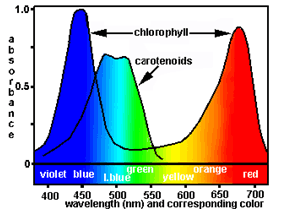
19.
What is one function of the other pigments  besides chlorophyll, in the chloroplast?
a)
to block damaging wavelengths of light
b)
to absorb different wavelengths than the chloroplasts
c)
to provide different colors to the leaves
d)
to transfer energy to a separate photosystem beside the one using chlorophyll a and b.
20.

Which plant would have the most oxygen produced in 1 hour?

a)

plant given red light only

b)

plant given blue light only

c)

plant given white light

d)

plant given green light only

21.
Plants with the largest amount of which pigment will be best suited for growing conditions where light has a green hue.
a)
Chlorophyll A
b)
Chlorophyll B
c)
Carotenoids
d)
A combination of all 3
22.
Which of the following molecules is not needed for the Calvin Cycle?
a)
CO2
b)
ATP
c)
NADPH
d)
H2O
23.

The six carbon sugar initially made in the Calvin Cycle is unstable and breaks into two molecules of

a)

ATP

b)

G3P

c)

RuBP

d)

3-PGA

24.

The six carbon sugar initially made in the Calvin Cycle is unstable and breaks into two molecules of

a)

ATP

b)

G3P

c)

RuBP

d)

3-PGA

25.

5 carbon sugar that combines with CO2 in the Calvin Cycle

a)

3-PGA

b)

G3P

c)

RuBP

d)

Glucose

26.

Which of the following is a way to increase the rate of photosynthesis?

a)

Increase oxygen levels

b)

Decrease CO2 levels

c)

Increase light intensity

d)

Decrease water level

27.
In the Calvin Cycle, carbon from CO2 is added to one molecule of RuBP to create _________.
a)
RUDP
b)
An Unstable 6 Carbon Molecule
c)
PGA
d)
2 3-carbon molecules
28.
In the Calvin Cycle, ________ and ________ from the light dependent reactions convert PGA into G3P
a)
O2, ATP
b)
CO2, H2
c)
ADP, NADPH
d)
NADPH, ATP
29.
In order to efficiently create 1 glucose molecule, the Calvin Cycle must occur how many times?
a)
3
b)
6
c)
1
d)
12
30.
The energy provided by ATP comes from what?
a)
Adenosine
b)
The phosphate groups
c)
The bonds between the phosphate groups
d)
The excited electron
31.
After reaching an excited state, electrons jump from the chlorophyll molecules to the __________.
a)
Stroma
b)
Electron transport chain
c)
Photosystem 2
d)
H+ ion reservoir 
32.
The energy required to pump H+ ions into the H ion reservoir comes from the _____________
a)
ATP molecules
b)
Electron Transport Chain
c)
Light 
d)
Thylakoid Membrane
33.
Adenosine Triphosphate is created after an H+ passes through ____________. 
a)
The Stroma
b)
ATP Synthase 
c)
The Calvin Cycle
d)
The electron transport chain
34.
The process which joins together ADP and P is called ______________
a)
ATP Creation
b)
Glycolysis 
c)
Active Transport
d)
Chemiosmosis
35.
The 5-Carbon molecules that the Calvin Cycle starts and ends with, is called _____________.
a)
PGA
b)
G3P
c)
RuBP
d)
RuDp
36.
After 12 G3P molecules are created, 10 are used to regenerate _________, while the other 2 are used to create __________.
a)
RuBP, C6H12O6
b)
Glucose, CO2
c)
ATP, Glucose
d)
Glucose, RUBP
37.
The final step of the Light Dependent Phase involves the creations of _____________.
a)
NADPH
b)
Glucose
c)
ATP
d)
CO2
38.
What are the two products of the light reactions that are needed for the calvin cycle?
a)
NAD and NADPH
b)
NADP + and Glucose
c)
NADPH and ATP
d)
Oxygen and NADPH
39.
What supplies the electron that is lost in PS II?
a)
oxygen
b)
water
c)
glucose
d)
rubisco
40.
ATP gets formed in the light dependent reaction by which process?
a)
Chemiosmosis
b)
Photosmosis
c)
Diffusion
d)
Active Transport
41.
What supplies the electrons that are lost in photosystem I (PSI)?
a)
the electrons from PS II
b)
water
c)
glucose
d)
oxygen
42.
What is the purpose of splitting water in PS2 of the light dependent reaction?
a)
Provides e- for PS2 and H+ for the thylakoid space
b)
To produce Oxygen for animals
c)
There is no purpose
43.
It is important to create a concentration of H+  in the thylakoid space so that the H+ can diffuse through_________ to create ______.
a)
ATP synthase, ATP
b)
NADH, NADPH
c)
proton pump, protons
44.
Protons move into the thylakoid due to the
a)
concentration gradient in the stroma
b)
  Brownian motion of the protons.
c)
  peer pressure of the cool electrons in the stroma.  
d)
movement of electrons through the electron transport chain
45.
Which of the following is NOT a product of the light reactions?
a)
ATP
b)
NADPH
c)
Oxygen
d)
Glucose
46.

Choose the statement that best describes light reaction.

a)

It converts CO2 to sugar molecule

b)

It converts light energy to chemical energy of ATP and NADPH

c)

It takes place in the stroma

47.

Which of the following is not needed to start the light reaction

a)

H2O

b)

ADP + P

c)

CO2

48.

What is the waste-product of light-dependent reaction?

a)

oxygen

b)

water

c)

carbon dioxide

49.

What is the unit of light?

a)

proton

b)

photon

c)

photosystem

50.
In the ________________________, energy from the sun is used to make ATP 
a)
light-independent reaction
b)
dark reaction
c)
light-dependent reaction
d)
Calvin cycle
51.

Sunlight is used during photosynthesis to-

a)

Break down the xylem

b)

Break down the stomata

c)

Break down the water

d)

Capture the water

52.
The energy required to pump H+ ions into the H ion reservoir comes from the _____________
a)
ATP molecules
b)
Electron Transport Chain
c)
Light 
d)
Thylakoid Membrane
53.
What is the function of NADP+?
a)
It absorbs light
b)
It is an electron carrier
c)
It is a light-reflecting pigment
d)
It acts as long-term energy storage
54.
Water is split during
a)
photosystem 1 of the light dependent reaction
b)
photosystem 2 of the light dependent reaction
c)
calvin cycle
d)
cell respiration
55.

This molecule is similar to ADP. It carries hydrogen ions.

a)

NADP+

b)

NADPH

c)

ADP+H

d)

ATP-P

56.

What is the process where the energy in light is used to break up a molecule of water?

a)

hydrolysis

b)

photolysis

c)

glycolysis

d)

nicolysis

57.

What does light do when it strikes the chlorophyll molecules of photosystems I and II?

a)

Light causes glucose to be synthesized directly inside the chlorophyll molecules of the photosystems.

b)

Light causes electrons to get excited (gain energy) and travel down the electron transport chain embedded in the thylakoid membrane.

c)

Light causes the conversion of water into carbon dioxide, oxygen, and electrons.

d)

Light directly causes carbon dioxide to attach to RuBP during the carbon fixation stage of the Calvin Cycle.
