Wayground logo

Free Printable Worksheets

Font size

S
M
L
XL
Worksheets

Chapter 5/6 Quizizz

Total questions: 92

Worksheet time: 2hrs 59mins

Name
Class
Date
1.
You roll a six sided die. What is the probability of rolling an even number three times in a row? 
a)
3/100
b)
1/2
c)
1/6
d)
1/8
2.
A coin and a number cube with the numbers 1 through 6 are tossed. What is the probability of the coin showing tails and the number cube showing the number 3? 
a)
1/12
b)
1/4
c)
1/8
d)
1/2
3.

A ten sided die is rolled.


P (3 or 5)

a)

3/10

b)

1/5

c)

1/10

d)

25%

4.

Probability is defined as...

a)

...the likelihood that an event will occur.

b)

...a game that involves coins.

c)

...a guarantee.

5.
You flip a coin 20 times and record the results. Is this experimental or theoretical probability?
a)
Experimental
b)
Theoretical
6.

Probability is also a proportion. What is that proportion?

a)

eventtotal\frac{event}{total}  

b)

totalevent\frac{total}{event}  

c)

chanceodds\frac{chance}{odds}  

d)

probabilitytotal\frac{probability}{total}  

7.

What is the probability of not drawing a queen in a deck of cards. (A deck of cards has 52 total cards.)

a)

1213\frac{12}{13}  

b)

113\frac{1}{13}  

c)

452\frac{4}{52}  

d)

2152\frac{21}{52}  

8.

What is the probability of rolling an eight on a standard number cube?

a)

1

b)

0

c)

12\frac{1}{2}  

d)

2

9.

What is the probability of drawing a 4 from a standard deck of cards?

a)

113\frac{1}{13}  

b)

1213\frac{12}{13}  

c)

152\frac{1}{52}  

d)

44  

10.

What is the probability of drawing an odd number from a deck of cards?

a)

552\frac{5}{52}  

b)

55  

c)

513\frac{5}{13}  

d)

12\frac{1}{2}  

11.

A card is drawn at a random from a 52 deck of card. Find the probability of getting:

a. a king or an ace

a)

213\frac{2}{13}  

b)

1013\frac{10}{13}  

c)

952\frac{9}{52}  

d)

652\frac{6}{52}  

12.

From a well shuffled pack of cards, one card is drawn. What is the probability of it being a black card?

a)

12\frac{1}{2}

b)

14\frac{1}{4}

c)

113\frac{1}{13}

d)

213\frac{2}{13}

13.

From a well shuffled pack of cards, what is probability of choosing a face card?

a)

352\frac{3}{52}

b)

326\frac{3}{26}

c)

313\frac{3}{13}

d)

none of these

14.

A card is drawn from a well shuffled pack of cards. Find the probability that it is not a club card.

a)

12\frac{1}{2}

b)

14\frac{1}{4}

c)

34\frac{3}{4}

d)

None of these

15.

A standard six sided die is rolled 5

a)

0

b)

1/5

c)

5/6

d)

1/6

16.

A die is rolled once. What is the probability of getting an odd number?


HINT 1, 3, or 5 - make sure your reduce the fraction

a)

1/3.

b)

1/2

c)

1/4

d)

1/6

17.

A die is rolled. What is the probability that the result is greater than 4 ?


HINT 5 or 6- make sure your reduce the fraction

a)

1/2

b)

1/3

c)

1/4

d)

1/6

18.
James purchased 3 shirts, 3 jackets and 2 pairs of pants.  How many different outfits using a shirt, a jacket, and pants are possible?
a)
8
b)
18
c)
54
19.
The value of 5! is ____.
a)
25
b)
15
c)
120
d)
720
20.
How many 2-digit numbers can you make using the digits 1, 2, 3, & 4 without repeating the digits? Think: Does order matter?
a)
90
b)
100
c)
12
d)
24
21.
At  a New Car Dealership a particular model comes in 4 trim levels, 5 different colors, and 3 different interiors. How many different versions of this car model can be created from these options?
a)
180
b)
23
c)
12
d)
60
22.
What is the total number of outcomes for picking a cat or dog and choosing the colors black, brown or spotted?
a)
2
b)
4
c)
6
d)
8
23.
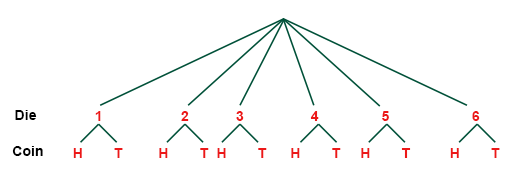
This tree diagram shows the outcomes of rolling a die and flipping a coin. 
How many total outcomes are there?  
a)
6
b)
12
c)
24
d)
36
24.

A coin is tossed 5 times. How many total outcomes are possible?

a)

32

b)

10

c)

5

d)

2

25.

A die is rolled 3 times. How many total outcomes are possible?

a)

18

b)

216

c)

120

d)

3

26.

Mr. Hickman is making a sandwich with ham, turkey, or roast beef; Swiss or provolone cheese; and mustard or mayonnaise. How many total outcomes are possible for the makeup of his sandwich?

a)

12

b)

3

c)

2

d)

36

27.

Dave is choosing from 3 sizes of bottled water and from distilled, filtered, or spring water. How many total outcomes are possible for this event?

a)

3

b)

6

c)

9

d)

12

28.
At Papa John's you are deciding on what you want for dinner. The pizza offers 8 different meats, 4 different cheeses, 3 different crust types and 2 different sauces. How many different pizzas do you have to choose from?
a)
32
b)
192
c)
40,320
d)
51,200
29.
How many ways can a club select a president, vice president, and a secretary from a group of 5 people?
a)
12
b)
60
c)
15
30.
How many ways can you listen to 3 songs from a CD that has 12 selections?
a)
1320
b)
33
c)
36
31.
A disc jockey has to choose three songs for the last few minutes of his evening show.  If there are nine songs that he feels are appropriate for that time slot, then how many ways can he choose and arrange to play three of those nine songs?
a)
84
b)
504
c)
9!
d)
3!
32.
The ski club with ten members is to choose three officers for captain, co-captain and secretary.  How many ways can those offices be filled?
a)
720
b)
120
c)
10!
33.
A restaurant offers four appetizers, nine entrees,and three desserts. How many different ways can Angela choose a three course meal?
a)
36
b)
100
c)
108
d)
27
34.

The number of possible outcomes when a coin is tossed 6 times is

a)

36

b)

64

c)

12

d)

32

35.
An internet code consists of one digit followed by one letter,  The number zero and letter O are excluded.  How many codes are possible?
a)
35
b)
260
c)
225
36.

Homecoming has 7 candidates for King. How many ways can a King and a First Runner-up be chosen to form the Festival Court?

a)

23

b)

840

c)

42

d)

3,628,800

37.
9 * 8 * 7 * 6 * 5 * 4 * 3 * 2 * 1
a)
45
b)
362,880
c)
90
38.
How many ways ways can you arrange the letters in the word math?
a)
15
b)
4
c)
24
39.
7 * 6 * 5 * 4 * 3 * 2 * 1
a)
42
b)
28
c)
5,040
40.
In how many ways can 3 different vases be arranged on a tray?
 
a)
3
b)
9
c)
6
d)
12
41.
Sarah plays softball over the summer.  If there are 10 players on the team, how many ways can the coach make a batting order that includes all players?
a)
1
b)
3628800
c)
100
d)
1814400
42.

~ (~A) =

a)

A

b)

~A

c)

1

d)

0

e)

Ugly muffins

43.

Which of the following is not a Boolean Operator?

a)

AND

b)

OR

c)

NOR

d)

NOT

44.

Which of the following statements will provide the fewest results?

a)

Year 8 Student AND

Boy

b)

Year 8 Student

OR

Boy

c)

Year 8 Student

NOT

Boy

45.

Which of the following statements will provide the most results?

a)

Cat

AND

Dog

b)

Cat

OR

Dog

c)

Cat

NOT

Dog

46.

Which of the following operators requires two conditions to be true?

a)

AND

b)

OR

c)

NOT

d)

>

47.

Which of the following operators requires one condition to be true?

a)

AND

b)

OR

c)

NOT

d)

>

48.

Which of the following operators requires a condition to be false?

a)

AND

b)

OR

c)

NOT

d)

>

49.

Which statement will require girls with brown hair to stand up?

a)

Girl OR Brown Hair

b)

NOT Girl AND Brown Hair

c)

Brown Hair AND Girl

50.

What is the Boolean value for True?

a)

0

b)

1

51.

What is the Boolean value for False?

a)

0

b)

1

52.

This symbol, ∧, means?

a)

and

b)

or

c)

not

d)

if, then

53.

This symbol, ∨, means?

a)

and

b)

or

c)

not

d)

if, then

54.
For the inverse we _________ the hypothesis and conclusion
a)
switch
b)
negate
c)
switch and negate
55.
For the contrapositive we _________ the hypothesis and conclusion
a)
switch
b)
negate
c)
switch and negate
56.
Write the converse of the statement:
If an animal is a dog then it does not moo.  
a)
If an animal is not a dog then it does moo
b)
If an animal can moo then it is not a dog
c)
If an animal does not  moo then it is a dog
d)
An animal is a dog if and only if it can moo
57.

Given the statement;

"If it snows then the school will be closed"

Which is the inverse?

a)

If the school is open, then it didn't snow.

b)

If the school is closed, then it snowed.

c)

If it doesn't snow, then the school will be open.

d)

Let it Snow!

58.
When taking the converse we ___________ the hypothesis and conclusion.
a)
negate
b)
switch
c)
leave the same
d)
switch and negate
59.
When taking the inverse we _____________ the hypothesis and conclusion.
a)
negate
b)
switch
c)
switch and negate
d)
leave the same
60.
What is this?
a)
Conditional
b)
Inverse
c)
Converse
d)
Contrapositive
61.
Given, "If angles are congruent, then the measures of the angles are equal." Identify the contrapositive.
a)
If the measures of the angles are equal, then the angles are congruent.
b)
If angles are not congruent, then the measures of the angles are not equal.
c)
If the measures of the angles are not equal, then the angles are not congruent.
d)
If the angles are not congruent, then the measure of the angles are equal.
62.
Given, "If angles are congruent, then the measures of the angles are equal." Identify the converse.
a)
If the measures of the angles are equal, then the angles are congruent.
b)
"If angles are not congruent, then the measures of the angles are not equal."
c)
If the measures of the angles are not equal, then the angles are not congruent.
d)
If the angles are not congruent, then the measure of the angles are equal.
63.
Conditional: If Jenny buys a guitar, then she will not buy a keyboard.
What is this? If Jenny does buy a keyboard, then she will not buy a guitar.
a)
Converse
b)
Inverse
c)
Contrapositive
d)
Negation
64.
Given, "If I have a Siberian Husky, then I have a dog." Identify the hypothesis.
a)
If I have a Siberian Husky.
b)
I have a Siberian Husky.
c)
Then I have a dog.
d)
I have a dog.
65.
Given, "If I have a Siberian Husky, then I have a dog." Identify the conclusion.
a)
If I have a Siberian Husky.
b)
I have a Siberian Husky.
c)
Then I have a dog.
d)
I have a dog.
66.
What is the if-then-form of the following statement? "It is time for dinner if it is 6 pm."
a)
If it is 6pm, then it is time for dinner.
b)
If it is time for dinner, then it is 6pm.
c)
If you want to eat dinner, then you must eat at 6pm.
d)
None of these are right
67.
Which of the following is the converse of the statement:
"If you are a guitar player, then you are a musician."
a)
If you are not a guitar player, then you are not a musician.
b)
If you are a musician, then you are a guitar player.
c)
If you are a guitar player, then you are not a musician.
d)
If you are not a musician, then you are not a guitar player.
68.
Which of the following is the inverse to the statement: 
"If you diet and exercise, then you will lose weight."
a)
If you don't diet and exercise, then you will not lose weight.
b)
If you don't diet and exercise, then you will lose weight.
c)
If you lose weight, then you dieted and exercised.
d)
If you don't lose weight, then you diet and exercise. 
69.

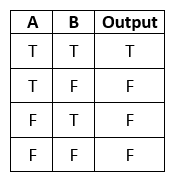
What type of logic is this table showing:

a)

AND

b)

OR

c)

NOT

d)

NOR

70.

What type of logic is this table showing:

a)

AND

b)

OR

c)

NOR

d)

XOR

71.

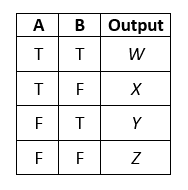
Use the logic condition to find the value of X:


A and not B

a)

True

b)

False

72.

Use the logic condition to find the value of X:


Not A or B

a)

True

b)

False

73.

Use the logic condition to find the value of Y:


A or B or C

a)

True

b)

False

74.

Use the logic condition to find the value of X:


A or (B and C)

a)

True

b)

False

75.

Use the logic condition to find the value of W:


not A or B or C

a)

True

b)

False

76.

The venn diagram represents

a)

A∪BA\cup B  

b)

A∩BA\cap B  

c)

A−BA-B  

d)

B−AB-A  

77.

The venn diagram represents

a)

A∪BA\cup B  

b)

A∩BA\cap B  

c)

A−BA-B  

d)

B−AB-A  

78.

The venn diagram represents

a)

A∪BA\cup B  

b)

A∩BA\cap B  

c)

A−BA-B  

d)

B−AB-A  

79.

The venn diagram represents

a)

A∪BA\cup B  

b)

A∩BA\cap B  

c)

A−BA-B  

d)

B−AB-A  

80.

The venn diagram represents

a)

  (A−B)∪(B−A)\left(A-B\right)\cup\left(B-A\right)   

b)

A∩BA\cap B  

c)

A−BA-B  

d)

B−AB-A  

81.

The venn diagram represents

a)

  A∪BA\cup B   

b)

A∩BA\cap B  

c)

(A∪B)−(A∩B)\left(A\cup B\right)-\left(A\cap B\right)   

d)

B−AB-A  

82.

From the Venn diagram A∪B=From\ the\ Venn\ diagram\ A\cup B=  

a)

{ 1,2,3,4,5,6,8}

b)

{3,6}

c)

{1,2,5}

d)

{4,8}

83.

From the Venn diagram A∩B=From\ the\ Venn\ diagram\ A\cap B=  

a)

{ 1,2,3,4,5,6,8}

b)

{3,6}

c)

{1,2,5}

d)

{4,8}

84.

From the Venn diagram A−B=From\ the\ Venn\ diagram\ A-B=  

a)

{ 1,2,3,4,5,6,8}

b)

{3,6}

c)

{1,2,5}

d)

{4,8}

85.

From the Venn diagram B−A=From\ the\ Venn\ diagram\ B-A=  

a)

{ 1,2,3,4,5,6,8}

b)

{3,6}

c)

{1,2,5}

d)

{4,8}

86.

Venn diagram of A∪BVenn\ diagram\ of\ A\cup B  

a)

b)

c)

d)

87.

Venn diagram of A∩BVenn\ diagram\ of\ A\cap B  

a)
b)
c)
d)
88.

The venn diagram represents

a)

A⊂BA\subset B  

b)

B⊂AB\subset A  

c)

A and B are Disjoint sets 

d)

A-B 

89.

The venn diagram represents

a)

A⊂BA\subset B  

b)

B⊂AB\subset A  

c)

A and B are Disjoint sets 

d)

A-B 

90.

The venn diagram represents

a)

A⊂BA\subset B  

b)

B⊂AB\subset A  

c)

A and B are Disjoint sets 

d)

A-B 

91.

From the Venn diagram A−B=From\ the\ Venn\ diagram\ A-B=  

a)

{ 1,2,3}

b)

{5,7,9}

c)

ϕ\phi  

d)

{1,2,3,5,7,9}

92.

From the Venn diagram A∩B=From\ the\ Venn\ diagram\ A\cap B=  

a)

{ 1,2,3}

b)

{5,7,9}

c)

ϕ\phi  

d)

{1,2,3,5,7,9}