
 Worksheets
Evolution/Genetics Quiz Review
Total questions: 35
Worksheet time: 53mins
In some areas of the world, like California and Japan, earthquakes are a common occurrence. How can this best be explained?
The strong ocean currents are undermining both areas causing earthquakes.
Both areas are located near the edge of the Pacific Ocean, the unstable sand causes earthquakes.
Both areas are subjected to strong ocean wind and waves that causes earthquakes.
Both areas are on the boundary of active plates, the motion of the plates causes earthquakes.
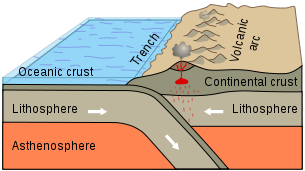
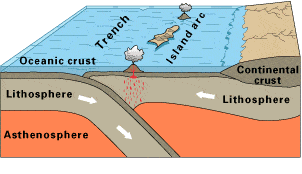
Observe this diagram of a plate boundary. One statement BEST describes what is happening. It is that
the oceanic crust is melting.
the denser ceanic crust is subducting under the less dense oceanic crust
volcanic islands are forming.
the tectonic plates are moving away from each other.
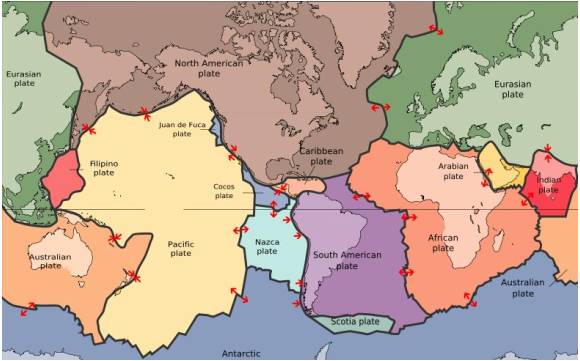
The map in the picture shows tectonic plate boundaries. This map would be useful in predicting the location of future
droughts
hurricanes
earthquakes
tornadoes
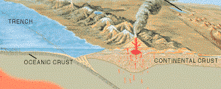
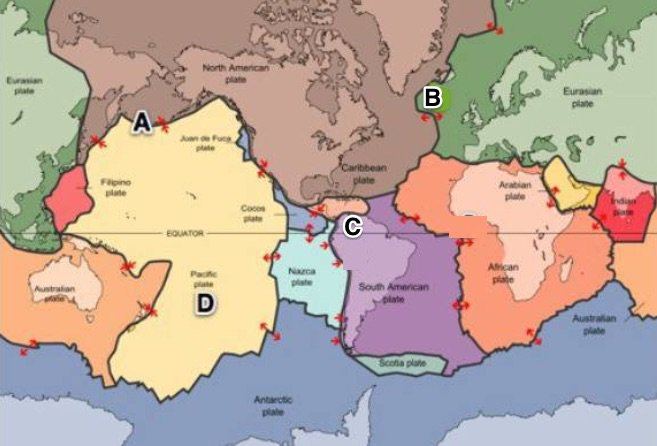
Where would sea floor spreading most likely occur?
At convergent boundaries (oceanic vs. oceanic)
At convergent boundaries (oceanic vs. continental)
At divergent plate boundaries (oceanic vs. oceanic)
At transform plate boundaries
Identical rock types, identical fossils, and very similar mountain ranges are found on different continents that are separated by a wide ocean. Which of these best explains these observations?
Organisms traveled between these continents on land bridges.
The same forces erode mountains in different locations.
These continents were joined together at one time in the past.
Some rock types are very common and are found everywhere.
What theory explains how the plates of the Earth are continually moving?
The Continental Drift Theory
The Theory of Evolution
The Plate Tectonic Theory
The Big Bang Theory
Which of the following is the best evidence that Earth's continents were once in vastly different positions than they are today?
Penguins are found only in the Southern hemisphere.
Fossils of tropical plants are found in Antarctica.
Volcanoes encircle the Pacific Ocean.
Major rivers form deltas from continental erosion.

Where are most of the active volcanoes?
Hawaii
The United States
The Atlantic Ocean
The Ring of Fire

How do mountains form?
They form when two continental plates collide with each other.
They from when one plate subducts under another.
They form when volcanoes create new rock and it builds up creating mountains.
They are formed when water erodes canyons and they turn into mountains.
The magnetic field around earth responsible for GPS, satellites, and ship navigation
Geomagnetism
Catastrophism
Uniformitarianism
Subduction
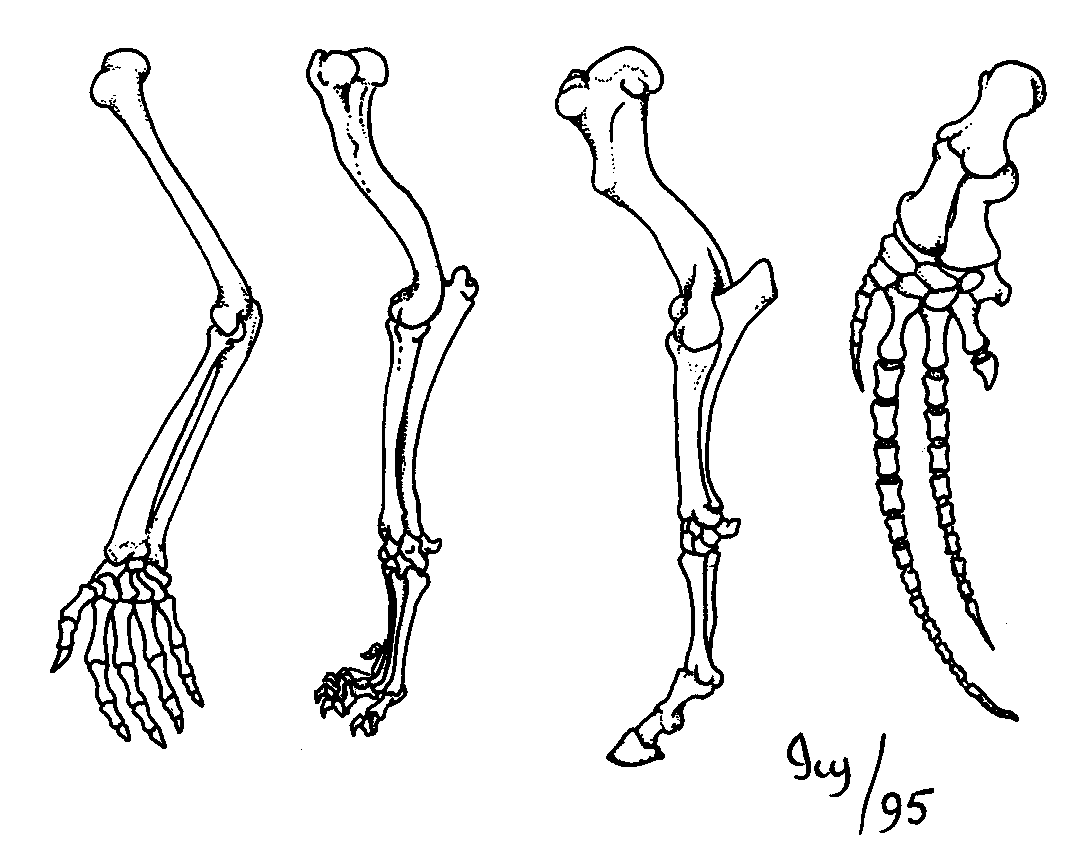


Vestigial structures
structures that perform a similar function but are not similar in origin
remnants of once-important structures that have slowly lost all or most of their function
features found in different organisms that share structural similarities but may have very different functions
preserved remains of an organism
Which best describes the term evolution?
Naturally occurring mutations
inherited, genetic changes in organisms over time
the ability of an organism to survive and reproduce
random changes in a DNA sequence

When scientists see similarities between a hippopotamus embryo and a rabbit embryo, this suggests:
Rabbits evolved from hippopotamus.
Hippopotamus share a common ancestor with rabbits.
Hippopotamus evolved from rabbits.
Hippopotamus and rabbits share the same traits.
When organisms are better adapted to their environment they will survive and reproduce more successfully than organisms less adapted. This process is called what?
Selective breeding
Natural Selection
Cloning
Evolution of all species
A physical or behavioral trait that helps an organism survive and reproduce in its environment is called a what?
An adaptation
A response to a stimulus
A mutation
Evolution
If a new trait DOES NOT help an organism survive, what may happen to it?
Not survive or reproduce
Survive & reproduce
Survive
Die
What happens to new traits that HELP organisms survive over time?
Nothing
That trait becomes MORE COMMON in the population
That trait becomes LESS COMMON in a population
Equally common
Body parts that function like each other, but are different in structure and NOT shared by common ancestor
embryos
homologous structures
analogous structures
vestigial structures

Which statement below describes RECESSIVE alleles?
expressed when at least one is present
only expressed when 2 are present
The alleles that an organism has/inherits are its
genotype
phenotype
chromosome
recessive
A characteristic that an organism can pass on to its offspring through its genes
Trait
Gene
Chromosome
Genetic information
Describes a trait that covers over, or dominates, another form of that trait. Shown as a capital letter
Heterozygous
Homozygous
Dominant
Recessive
The classification system of hierarchy is:
Kingdom, domain, phylum, class, order, family, genus and species
Kingdom, phylum, class, order, family, genus, species
Domain, kingdom, phylum, class, order, family, genus and species
Domain, kingdom, phylum, class, order, family, species and genus
In the scientific name Canis latrans, Canis is the
phylum
order
genus
species
In the scientific name Ursus americanus, americanus is
kingdom
genus
species
family

