
 Worksheets
Newton's Laws of Motion
Total questions: 23
Worksheet time: 40mins
A force can____________.
make an object move
make a moving object stop moving
slow an object down
all of the above
What is Inertia?
An object at rest will move and an object in motion will stop.
Objects are lazy.
An object at rest will stay at rest, and an object in motion will stay in motion unless acted upon by an outside force.
F=M X A
What is the unit called that measures force?
Isaac
Newton
Yee
Kilogram
A 20 kg bike accelerates at 10 m/s2. What was the force?
25 Newtons
20 Newtons
200 Newtons
10 Newtons
A book sitting on the table does not move.
Law 1
Law 2
Law 3

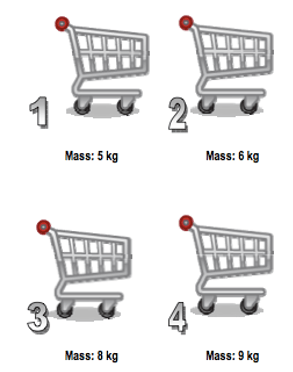

____ force is needed to move objects of larger mass.
less
equal
more
light


Why is it harder to push a van filled with bowling balls than it is to push a van with basketballs?
The mass of the car is greater than the mass of the basketballs
The mass of the bowling balls is greater than the mass of the basketballs
The van with the basketballs is bigger than the van with the bowling balls
It should be equally as hard to push the two vans
An object has a mass of 30 kg and an acceleration of 2 m/s2. What must be the net force on the object?
Use this equation: F=m×a
60 N
45 N
15 N
0.067 N
A 10 kg object experiences a net force of 20 Newtons. Calculate the object's acceleration.
2 s2m
0.5 s2m
200 s2m
3.33 s2m
An object has a mass of 30 kg and an acceleration of 2 m/s^2. What must be the net force on the object?
60 N
45 N
15 N
0.067 N
A rocket pushes burning gases DOWN which causes the rocket to launch UP. Which law is this?
Law 1
Law 2
Law 3
It is much more difficult to move a dresser full of clothes than an empty dresser.
Law 1
Law 2
Law 3
A skateboarder pushes the ground BACKWARDS which causes the board to move FORWARD.
Law 1
Law 2
Law 3
A 20 kg bike accelerates at 10 m/s2. What was the net force?
25 Newtons
20 Newtons
200 Newtons
10 Newtons

Which one of Newton’s Laws of Motion best explains why the dishes do not move when the tablecloth is removed?
Newton's 1st Law
Newton's 2nd Law
Newton's 3rd Law

Which arrow shows the direction of the friction force?
A
B
C
D

