
NEW
Font size
 Worksheets
Biochemistry Review
Total questions: 25
Worksheet time: 1hrs 15mins
Which biomolecule contains fats, oils, and waxes?
Proteins
Nucleic Acid
Lipids
Carbohydrate
The monomer of a protein is called...
an amino acid
a monosaccharide
a fatty acid
a nucleotide
Which organic molecule would a long-distance runner most likely choose to eat two hours before a race?
A protein, because it builds muscle mass.
A lipid because it provides long term energy storage.
A carbohydrate because it releases energy quickly.
A protein, because it transports oxygen into the blood stream.
How are the functions of a carbohydrate and a lipid similar?
Both are a source of energy.
Both are replicated during meiosis.
Both lower the activation energy of reactions.
Both dissolve nutrients in the digestive system.
What are the monomers of a lipid?
fat cubes and glycogen
glycerol and amino acids
fatty acids and glycerol
amino acids
Nucleotides are a monomer of which biomolecule?
Nucleic acids
Proteins
Carbohydrates
Lipids
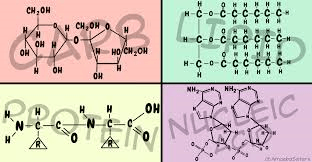
What elements are common to all 4 biomolecules?
Carbon, hydrogen, nitrogen
Carbon, Nitrogen, Phosphorus
Carbon, Hydrogen, Oxygen
Carbon, Hydrogen, Phosphorus
Which biomolecule contains pastas and breads?
Lipid
Protein
Nucleic Acid
Carbohydrate
Which biomolecule helps form muscles?
Nucleic Acid
Carbohydrate
Protein
Lipids
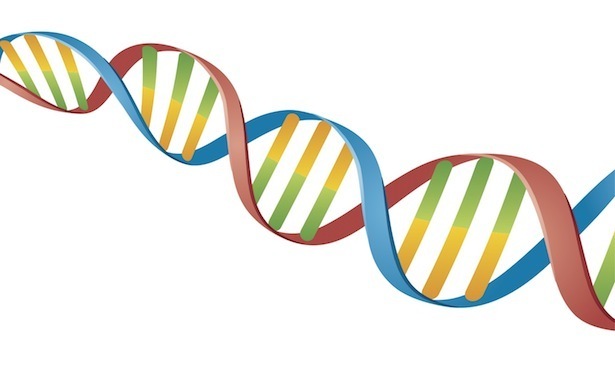
What is the function of a nucleic acid?
Stores genetic information
Stores energy
Quick source of energy
Builds structures
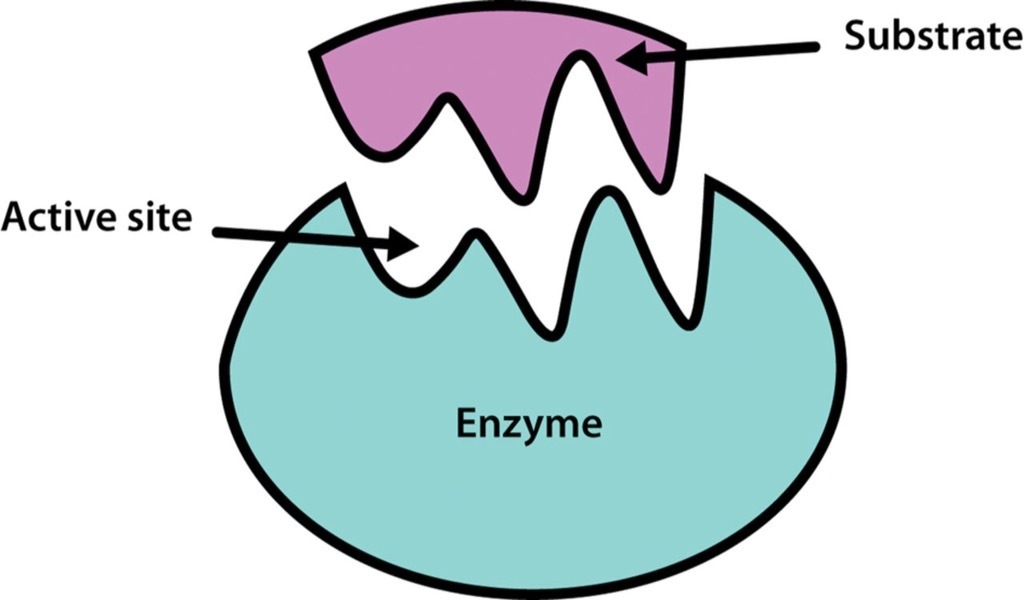
What biomolecule do enzymes belong to?
Carbohydrate
Lipid
Nucleic Acid
Protein
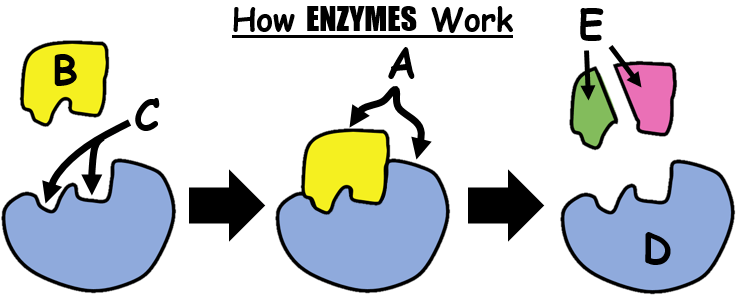
Identify what is labeled with the letter D
active site
enzyme
substrate
products
What makes an enzyme specific?
Size
Shape
Name
Location it is found in
Enzymes need certain environmental conditions in order to function properly. What happens when enzymes are heated to a high temperature?
they die
they denature
they change their amino acid sequence
they work better
What is the primary role of enzymes inside of living cells?
store genetic information
store energy
they help fight infections
speed up chemical reactions
Based on their role in the cell, enzymes can also be classified as –
inhibitors
catalysts
sources of energy
vitamins
Each enzyme only has one substrate that will fit its active site. What is this called?
reusablility
denaturation
specificity
fragility
With what 3 letters do enzymes typically end?
-ose
-ase
-ese
-tic
Enzymes are composed of which of the following monomers?
amino acids
proteins
nucleotides
monosaccharides
Any substance that is acted upon by an enzyme is called a(n)?
Coenzyme
Substrate
Vitamin
Polypeptide

Which of the following conclusions can be drawn from this graph?
The optimum pH of the enzyme is 6.6.
This enzyme works best in highly acidic environments
The enzyme’s activity increases as pH increases 7.0 to 9.0
The enzyme’s activity is greater around pH of 8.0 .
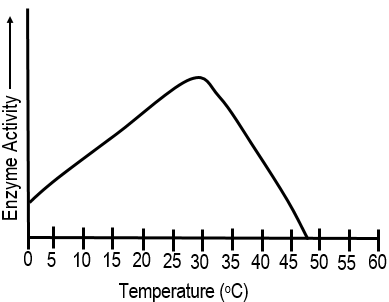
Based on the graph, what is the optimal temperature for this enzyme?
15oC
40oC
30oC
35oC

Pepsin and trypsin are two of the digestive enzymes that break down protein. A group of students studied the pH requirements of these enzymes. The graph below shows the results. The students found that pepsin functions best in an acidic environment and trypsin functions best in a neutral environment.
Based on their observations, pepsin most likely aids in digestion in which part of the human body?
Pancreas
Intestines
Mouth
Stomach
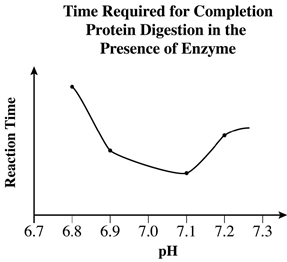
A student measured the time required for a protein sample to be completely digested in the presence of an enzyme under different pH levels. At which pH is the enzyme LEAST active?
7.1
6.9
6.8
7.2
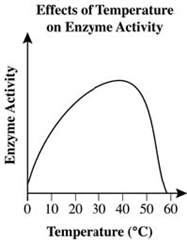
Which is the MOST valid conclusion based on this graph?
Enzymes are not affected greatly by temperature.
Enzymes work most effectively at low temperatures.
Raising the temperature always makes an enzyme work better.
Enzyme function decreases after a certain favorable temperature.

