wayground logo

Free Printable Worksheets

Font size

S
M
L
XL
Worksheets

Atomic Structure Review

Total questions: 40

Worksheet time: 48mins

Name
Class
Date
1.
What are the 3 sub-atomic particles called?
a)
potions, neutrons and electrons
b)
protons, neurons and electrons
c)
protons, neutrons and elections
d)
protons, neutrons and electrons
2.
What is the mass number?
a)
Number of protons plus neutrons
b)
Number of protons plus electrons
c)
Number of neutrons plus electrons
3.
What is the atomic number?
a)
Number of protons plus electrons
b)
Number of protons
c)
Number of protons plus neutrons
d)
Number of protons, neutrons and electrons
4.
What is the charge on a proton?
a)
positive 1
b)
0
c)
negative 1
5.
What is the charge on a neutron?
a)
positive 1
b)
0
c)
negative 1
6.
What is the charge on an electron?
a)
positive 1
b)
0
c)
negative 1
7.
Where are the protons and neutrons found?
a)
In isotopes
b)
In ions
c)
In the nucleus
d)
In shells
8.
Where are the electrons found?
a)
In isotopes
b)
In ions
c)
In the nucleus
d)
In shells
9.
An isotope is an atom with the same number of....
a)
protons and neutrons but a different number of electrons.
b)
neutrons and electrons but a different number of protons.
c)
protons and electrons but a different number of neutrons.
10.
In what order are elements on the modern periodic table?
a)
Mass number
b)
Atomic Mass
c)
Atomic number
d)
Relative Atomic Mass
11.
How many protons, neutrons and electrons does a lithium atom have?
a)
p=3 n=4 e=3
b)
p=3 n=7 e=3
c)
p=3 n=4 e=4
12.

Match the Following

a)

Element

1.

A substance that cannot be broken down into simpler substances by chemical means.

b)

Atom

2.

The smallest unit of an element that keeps the element’s chemical properties.

c)

Nucleus

3.

The dense center of an atom containing protons and neutrons.

d)

Proton

4.

Positively charged particles found in the nucleus of an atom.

e)

Neutron

5.

Particles with a neutral charge found in the nucleus of an atom.

13.

Match the following

a)

Electron

1.

A negatively charged subatomic particle located around the nucleus of an atom.

b)

Electron Shell

2.

Areas around the nucleus filled with electrons. 

c)

Valence Electron

3.

The electrons filling the outermost shell; react with other atoms.

d)

Compound

4.

A substance formed from two or more atoms chemically united in fixed proportions.

e)

Molecule

5.

A group of atoms held together by chemical forces.

14.

How many electron shells does the pictured atom have?

a)

1

b)

2

c)

3

d)

4

15.

How many valence electrons does the pictured atom have?

a)

20

b)

3

c)

2

d)

4

16.

How many valence electrons does this element has?

a)

2

b)

8

c)

12

d)

4

17.

The unknown emissions spectra belongs to the element

a)

Hydrogen

b)

Mercury

c)

Neon

d)

Sodium

18.

The unknown emissions spectra belongs to the element

a)

Hydrogen

b)

Mercury

c)

Neon

d)

Sodium

19.

If an electron moves from n=4 to n=2 it ____

a)

absorbs energy

b)

releases energy

20.
What gases are in the unknown mixture?
a)
Gas B & Gas D
b)
Gas C & Gas B
c)
Gas A & Gas D
d)
Gas D & Gas C
21.

True or False: Protons and Electrons are equal to the atomic number.

a)

True

b)

False

22.

True or False: Protons and Neutrons are always the same number

a)

True

b)

False

23.

True or False: The atomic number is the same number of neutrons.

a)

True

b)

False

24.

What is the correct order of scientists in order of their work related to the atomic theory from earliest to most recent?

a)

Neils Bohr, Ernest Rutherford, JJ Thomson, John Dalton, & Democritus

b)

JJ Thomson, John Dalton, Neils Bohr, Ernest Rutherford, & Democritus

c)

Democritus, John Dalton, JJ Thomson, Ernest Rutherford, and Neils Bohr

d)

John Dalton, Neils Bohr, JJ Thomson, Democritus, & Ernest Rutherford

25.
the smallest particle of an element that retains the chemical properties of that element
a)
ion
b)
isotope
c)
atom
d)
element
26.

how Rutherford discovered that the atom consists of a small, massive, positively charged nucleus

a)

reading quantum mechanics books

b)

by mixing substances

c)

thanks to the The gold-foil experiment

d)

exposing it to the heat

27.

From his experiments, J. J. Thomson concluded that

a)

cathode ray particles can move at very fast speeds.

b)

cathode ray particles can be moved by electric current.

c)

atoms contain small positively charged particles that are called protons.

d)

atoms contain small negatively charged particles that are called electrons.

28.

Whose work directly resulted in the development of an atomic model that has negative electrons stuck within a sea of positive material?

a)

Democritus

b)

Rutherford

c)

Thomson

d)

Dalton

29.
24.1% of all the isotopes of a an element have a mass of 75.23 amu, 48.7% have a mass of 74.61 amu, and 27.2% have a mass of 75.20 amu.
What is the average mass of this element?
a)
74.92 amu
b)
24.97 amu
c)
75.01 amu
d)
74.51 amu
30.
An element with 4.35% have a mass of 49.9461 amu, 83.79% have amass of 51.9405 amu, 9.50% have a mass of 52.9407 amu, and 2.36% have a mass of 53.9389amu.
a)
51.99 amu
b)
52.19 amu
c)
53.45 amu
d)
17.33 amu
31.
4.35% of all X atoms have a mass of 39.946 amu. 83.79% have a mass of 41.941 amu, 9.50% have a mass of 42.941 amu, and 2.36% have a mass of 43.939 amu. What is the average atomic mass of atom X?
a)
41.97 amu
b)
42.19 amu
c)
10.43 amu
d)
40.04 amu
32.
An element has two naturally occurring isotopes. One is 10.013 amu and is 19.9% abundant. The other is 11.01 amu and is 80.1% abundant. What is the average atomic mass? What element is it?
a)
9.012, Beryllium
b)
12.011, Carbon
c)
6.941, Lithium
d)
10.812, Boron
33.

Compute the average atomic mass for this element.

a)
27.977
b)
28.09
c)
28.976
d)
The average mass cannot be determined from provided information.
34.
How many neutrons does the isotope of lithium have?
a)
8
b)
3
c)
5
35.
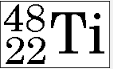
How many protons does this isotope of titanium have?
a)
48
b)
22
c)
26
36.
If a sulfur atom has 16 protons, 16 electrons, and 16 neutrons, its atomic mass is:
a)
16
b)
32
c)
48
37.
What is the name of the pictured isotope?
a)
Copper-29
b)
Copper-63
c)
Copper-34
d)
CopperWopperHopperBopper
38.
How is carbon-12 different from carbon-14?
a)
They have a different number of protons
b)
they have a different number of electrons
c)
they have a different number of neutrons
39.

12 protons and 13 neutrons

a)

Mg-12

b)

Mg-13

c)

Mg-25

d)

Mg-24.305

40.

Which of these pairs of atoms are isotopes?

a)

pair A

b)

pair B

c)

pair C