wayground logo

Free Printable Worksheets

Font size

S
M
L
XL
Worksheets

Sumative Test Science

Total questions: 87

Worksheet time: 1hrs 8mins

Name
Class
Date
1.

The phase change from water vapor to liquid water is known as ____.

a)

Sublimation

b)

Condensation

c)

Evaporation

d)

Precipitation

2.

What do you call a change from solid to gas without passing through a liquid state?

a)

Sublimation

b)

Freezing

c)

Evaporation

d)

Condensation

3.

A change of state from a liquid to a solid is called ______.

a)

Melting

b)

Freezing

c)

Precipitation

d)

Evaporation

4.

A change from solid to liquid is known as _____.

a)

Freezing

b)

Deposition

c)

Melting

d)

Evaporation

5.

The following are the evidence of chemical change, EXCEPT.

a)

Color change

b)

Odor change

c)

Changes in Shape

d)

Gas Production

6.

Which of the following waste management limit the amount of trash you throw away?

a)

Reduce

b)

Repair

c)

Reuse

d)

Recycle

7.

When you reuse, it means that you _____.

a)

Fix the broken items.

b)

Use the object by shredding in order to make a new product.

c)

Use old objects again for another purpose.

d)

Sell the objects to earn money.

8.

If you make a flowerpot from an old tumbler, you are ____.

a)

Repairing

b)

Reusing

c)

Recycling

d)

Recovering

9.

this occurs when teeth grind or when the stomach churns

a)

mechanical digestion

b)

chemical digestion

c)

enzymes

d)

involuntary

10.

occurs when saliva breaks down food and when stomach acid breaks down food

a)

chemical digestion

b)

mechanical digestion

c)

salivary glands

d)

voluntary

11.

This is where digestion begins

a)

mouth

b)

stomach

c)

large intestine

d)

small intestine

12.

chemical digestion occurs in the

a)

mouth only

b)

stomach only

c)

mouth and stomach

13.

Which is LONGER?

a)

small intestine

b)

large intestine

14.

Which is WIDER around?

a)

small intestine

b)

large intestine

15.

What is the correct order in which food travels through the body?

a)

Small intestine, large intestine, rectum, anus

b)

large intestine, pancreas, rectum, liver

c)

large intestine, anus, small intestine, liver

d)

anus, rectum, small intestine, large intestine

16.

The chewing and grinding of food into smaller pieces is an example of...

a)

Mechanical Digestion

b)

Chemical Digestion

17.
Nutrients from digested food are absorbed in which digestive organ?
a)
Small Intestine
b)
Stomach
c)
Large Intestine
d)
Gallbladder
18.
Number 3 is pointing to the...
a)
Small intestine
b)
Rectum
c)
Large intestine
d)
Stomach
19.
Number 2 is pointing to the...
a)
Esophagus
b)
Stomach
c)
Small intestine
d)
Anus
20.
Which organ pushes food down to the stomach?
a)
Mouth
b)
Esophagus
c)
Rectum
d)
Large intestine
21.
As waste moves through the digestive system, the ______ absorbs water before storing waste in the rectum.
a)
Small intestine
b)
Stomach
c)
Esophagus
d)
Large intestine
22.
Number 4 in the diagram represents the:
a)
Small intestine
b)
Liver
c)
Large intestine
d)
Gall Bladder
23.
Number 3 is pointing to the ...
a)
Esophagus
b)
Rectum
c)
Small Intestine
d)
Stomach
24.
Number 5 is pointing to the ...
a)
Large intestine
b)
Rectum
c)
Small Intestine
d)
Stomach
25.
9
a)
Stomach
b)
Small Intestine
c)
Large Intestine
d)
Rectum
26.

Which organ has the job of absorbing nutrients from the food?

a)

small intestine

b)

large intestine

c)

pancreas

d)

rectum

27.

Which organ has the job of absorbing water before waste is removed from the body?

a)

large intestine

b)

small intestine

c)

liver

d)

gallbladder

28.

What is matter?

a)

Everything that weighs a lot and is big.

b)

Nothing.

c)

Everything that has mass and takes up space.

d)

Everything that is red.

29.

What is it called when a liquid turns to a solid?

a)

melting

b)

freezing

c)

evaporation

d)

ice cubes

30.

On a super hot, sunny day, puddles will ...

a)

evaporate

b)

freeze

c)

condense

d)

melt

31.

What are the three states of matter?

a)

Solid, liquid, cola

b)

Liquid, gas, solid

c)

hard, soft, slime

d)

volume, mass, temperature

32.

What is it called when a liquid turns to a solid?

a)

melting

b)

freezing

c)

evaporation

d)

ice cubes

33.

This image shows what change in matter?

a)

Liquid to a Solid - Freezing

b)

Solid to a Gas - Sublimation

c)

Gas to a liquid - Condensation

d)

Gas to a solid - Deposition

34.
A state of matter that has a definite volume and shape.
a)
solid
b)
liquid
c)
gas
d)
matter
35.
Water in the form of a gas is called _________.
a)
water vapor
b)
gasoline
c)
ice
d)
liquid
36.
Liquid matter takes the shape of _______.
a)
a gas
b)
water
c)
a pet
d)
Its container
37.
Helium is a ____________.
a)
liquid
b)
solid
c)
gas
38.
Sand is a ___________________.
a)
liquid
b)
solid
c)
gas
39.
Gasoline is a ________________.
a)
liquid
b)
solid
c)
gas
40.

If purple drink mix is added to water, what change will occur to the water?

a)

The drink mix will cause the water to freeze

b)

The water will totally disappear

c)

The drink mix will heat the water

d)

The water will change color

41.
Which type of objects would float?
a)
Those heavier than water
b)
Those with the same density as water
c)
Those less dense than water
d)
Those that are only made of gas
42.
A large piece of ice is placed on the sidewalk on a warm day. What will happen to the ice? 
a)
It will melt to form liquid water
b)
It will melt to form water vapor
c)
It will not change at all.
d)
It will freeze to form liquid water. 
43.
An ice cube is placed in a pan. The pan is placed over an open flame. Which change will MOST likely happen over time?
a)
The ice changes to a gas then a liquid
b)
The ice changes to a gas and then back to a solid
c)
The ice changes to a liquid then to a gas.
d)
The ice changes to a liquid and back to a solid. 
44.
How can you make liquid water become a solid?
a)
Add a lot of salt to the water.
b)
Put the water in a very cold place
c)
Shake the water container very fast.
d)
Heat the water on the stove.
45.
Snow turns to liquid water when it
a)
freezes
b)
evaporates
c)
condenses
d)
melts.
46.
Bob filled a tray with juice and put it in the freezer. The next day Bob opened the freezer. How did the juice MOST likely change?
a)
It became a solid.
b)
It became a gas
c)
It condensed
d)
It evaporated.
47.
John placed a pot of water on a stove. As the water boils, how does the state of the water change?
a)
from gas to liquid
b)
from liquid to a gas
c)
from a liquid to a solid
d)
from a solid to a liquid
48.
When ice melts, it becomes a 
a)
solid
b)
liquid
c)
gas
d)
plasma
49.
Which is MOST likely to happen to a solid substance that is heated?
a)
It will evaporate.
b)
It will boil
c)
It will melt.
d)
It will harden.
50.
A student places a pan of water on a stove. What happens to some of the water as it is heated to a boil?
a)
It gets destroyed.
b)
It gets new atomic bonds
c)
It becomes solid.
d)
It becomes a gas.
51.
Which change can occur when  you add heat energy to water?
a)
The water can change from a liquid to a solid
b)
The water can change from a gas to a liquid
c)
The water can change from a liquid to a gas
d)
The water can change from a solid to a liquid
52.
Anna is holding an ice cube. Why does the ice cube melt in her hand?
a)
Heat moves from her hand to the ice cube.
b)
Cold moves from her hand to the ice cube.
c)
Heat moves from the ice cube to her hand.
d)
Cold moves from the ice cube to her hand. 
53.

Butter on a hot pancake is an example of?

a)

Freezing

b)

Melting

c)

Condensation

d)

Freezing

54.

Water turning into ice is an example of?

a)

Condensation

b)

Freezing

c)

Melting

d)

Evaporation

55.

When your glasses get foggy is an example of?

a)

Freezing

b)

Melting

c)

Condensation

d)

Evaporation

56.

Steam is an example of?

a)

Condensation

b)

Melting

c)

Freezing

d)

Evaporation

57.

A lit candle is an example of?

a)

Melting

b)

Condensation

c)

Freezing

d)

Evaporation

58.

When you hang your clothes outside to dry is an example of?

a)

Condensation

b)

Evaporation

c)

Melting

d)

Freezing

59.

What is happening to the icicles?

a)

They are freezing

b)

They are melting

c)

They are condensing

d)

They are evaporating

60.

When water turns into ice we call it...

a)

Evaporation

b)

Condensation

c)

Melting

d)

Freezing

61.

When you pour juice into a mold and put in the freezer what happens?

a)

It melts

b)

It condensates

c)

It freezes

d)

It evaporates

62.

As a part of the water cycle, water from Earth's surface enters the clouds and finally falls back to the ground in the form of rain. What is the correct sequence of processes water undergoes?

a)

Evaporation, Condensation, Precipitation

b)

Precipitation, Condensation, Evaporation

c)

Condensation, Evaporation, Precipitation

d)

Evaporation, Precipitation, Condensation

63.

What is precipitation?

a)

Sweat from our bodies on hot days

b)

Warm rain but not cold snow or sleet

c)

Gas that we use in furnaces or ovens

d)

Any form of water that falls from the sky

64.

Condensation occurs when water vapor_____________.

a)

heats up and becomes liquid water

b)

cools off and becomes liquid water

c)

freezes and becomes ice

d)

rains on the land

65.

The process when plants release water vapor from their leaves is called _____________.

a)

precipitation

b)

evaporation

c)

transpiration

d)

condensation

66.
What is the process during which water cools and turns from a gas to a liquid?
a)
Condensation
b)
Runoff
c)
Precipitation
d)
Evaporation
67.

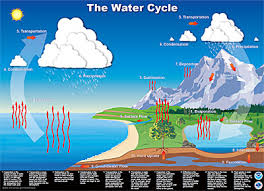
What step of the water cycle does this picture show?

a)

Condensation

b)

Runoff

c)

Precipitation

d)

Evaporation

68.
What source of energy evaporates the most water from Earth’s surface?
a)
volcanoes
b)
the sun
c)
lightning
d)
wind
69.

What are formed when water vapor condenses and come together?

a)

Clouds

b)

Mountains

c)

Transpiration

d)

Valleys

70.

The process by which water changes from a liquid to a gas.

a)

evaporation

b)

condensation

c)

sublimation

d)

precipitation

71.

What is the energy source that drives the water cycle?

a)

The moon T

b)

The heat from our home in the winter all around the world

c)

The sun

d)

he heat generated solely from the core of the earth

72.

What are formed when water vapor condenses?

a)

Clouds

b)

Mountains

c)

Transpiration

d)

Valleys

73.

The act of turning from a gas into a liquid. ________________________

a)

Condensation

b)

Evaporation

c)

Transpiration

d)

Precipitation

74.

The act of turning from a liquid into a gas. ___________________

a)

Transpiration

b)

Condensation

c)

Evaporation

d)

Precipitation

75.

The fall of water, ice, or snow deposited on the surface of the Earth from the atmosphere. __________

a)

Condensation

b)

Evaporation

c)

Precipitation

d)

Transpiration

76.
Forms of precipitation are-
a)
only sleet and snow
b)
rain, sleet, hail, and snow
c)
only dew and rain 
d)
only snow and rain
77.

On which kind of day would you expect the most evaporation from the surface of a pond?

a)

warm, sunny

b)

cold, rainy

c)

cold, sunny

d)

rainy, warm

78.
What is condensation?
a)
The part of the water cycle when the sun heats up water, turning it from a liquid into water vapor or steam. It rises from the ground into the air.
b)
The part of the water cycle when the water vapor in the air gets cold. The water turns back into a liquid and forms clouds.
c)
The part of the water cycle when clouds get heavy and can no longer hold the liquid water. This causes the water to fall from the sky to the earth as rain, snow, sleet, or hail.
79.
A student looks outside her window after it has rained. She sees many puddles of water. later that same day, the puddles are gone. Which process explains why the puddles are gone? 
a)
accumulation of runoff
b)
precipitation 
c)
evaporation 
d)
condensation 
80.
During which stage do clouds form?
a)
condensation
b)
evaporation
c)
precipitation
81.
What is A?
a)
Evaporation
b)
Condensation
c)
Precipitation
d)
Runoff
82.
What is B?
a)
Evaporation
b)
Condensation
c)
Precipitation
d)
Runoff
83.
What is C?
a)
Evaporation
b)
Condensation
c)
Precipitation
d)
Runoff
84.

Water in its gas form is called ____________________,

a)

water vapor

b)

precipitation

c)

ice

d)

air

85.

If water were heated in a pot on the stove to model the water cycle, the stove best represents what?

a)

sun

b)

clouds

c)

ocean currents

d)

precipitation

86.

If water were heated in a pot on the stove to model the water cycle, the water in the pot best represents?

a)

sun

b)

clouds

c)

ocean

d)

condensation

87.

Where is 97% of the Earth's water located?

a)

Rivers and Lakes

b)

Glaciers and Icecaps

c)

oceans

d)

groundwater