wayground logo

Free Printable Worksheets

Font size

S
M
L
XL
Worksheets

Optional Practice - Unit 7 Study Guide Part A

Total questions: 66

Worksheet time: 2hrs 41mins

Name
Class
Date
1.
The pair of figures is similar. Find the missing side.
2.

The pair of figures is similar. Find the missing side.

3.

The pair of figures is similar. Find the missing side.

4.
Find missing side
5.
Find the missing side length.
6.

What is the measure of x?

7.
Solve for x.
8.
What is a Ratio?
a)
A comparison of two quantities 
b)
To multiply two fractions 
c)
A number over another number
d)
Two decimals that can be multiplied
9.
Is this proportion equal?
4/5  20/25
a)
=
b)
10.
Is this proportion equal?
1/3     4/12
a)
=
b)
11.

Solve:
7x=2130\frac{7}{x}=\frac{21}{30}

12.
Ella has 5 balloons. Taylor has 7 balloons. Write the ratio of Ella's balloons to Taylor's balloons.
a)
7:5
b)
5:7
c)
3:5
d)
5:3
13.

Find y

14.

Solve the proportion.

15.

Solve the proportion.

16.

A pattern has 4 blue triangles to every 12 yellow triangles. What is the ratio of blue triangles to all triangles?

a)

1:4

b)

4:12

c)

4:16

d)

4:1

17.

What is the constant of proportionality (multiplier)?

a)

none

b)

2

c)

4

d)

6

18.

All of the following are proper representations of a ratio EXCEPT

a)

a/b

b)

a to b

c)

a:b

d)

a over b

19.

A proportion is a

a)

ratio statement

b)

an "if-then" statement

c)

a statement of 2 ratios that are equal to each other

d)

a comparison

20.

To solve for missing info in a proportion statement you must first

a)

Cross multiply

b)

Divide everything

c)

Get rid of variables

d)

Guess

21.
Simplify the ratio of
35 : 14
a)
5 : 2
b)
2 : 5
c)
3 : 1
d)
35: 14
22.
Express the ratio as a fraction in simplest form:
18 ounces to 3 cups
a)
6 to 1
b)
1/6
c)
18/3
d)
3/18
23.

The point A (8, 12) was dilated to become point A' (2, 3). What was the scale factor?

a)

½

b)

¼

c)

4

d)

2

24.
A dilation is which of the following: 
a)
only an enlargement
b)
only a reduction
c)
Either an enlargement or a reduction
d)
Neither an enlargement or a reduction
25.
When a dilation has a scale factor greater than one, the dilation is an enlargement.
a)
True
b)
False
26.

State the coordinate of the image of the given point G (-10,-6) under a dilation with center at the origin with the given scale factor of 1/2.

a)

G' (5,3)

b)

G' (20,12)

c)

G' (-20,-12)

d)

G' (-5,-3)

27.

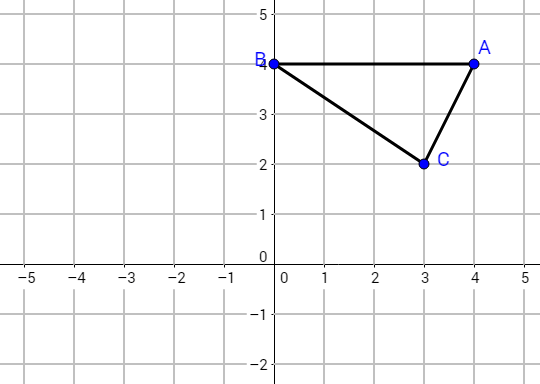
Dilate Point B by a scale factor of 3:

(a)  

28.

Dilation changes a shape's __________?

a)

Size

b)

Position

c)

Form

d)

Orientation

29.
Dilate the figure by a scale factor of 3 with the origin as the center of dilation. What are the coordinates of the image?
A(3,3) B(6,6) C(9,3)
a)
A'(9,9) B'(18,18) C'(27,9)
b)
A'(6,6) B'(9,9) C'(12,6)
c)
A'(0,0) B'(3,3) C'(6,0)
d)
A'(1,1) B'(2,2) C'(3,1)
30.

What scale factor was used to produce the image?

31.
Choose the correct scale factor:
32.

If two figures are similar, the corresponding angles are...

a)

Congruent

b)

Supplementary

c)

Proportional

d)

Different

33.
How does a dilation change the angles of a polygon?
a)
It changes by the scale factor.
b)
Dilations do not change the angles.
c)
It is impossible to answer this question.  The angles change unpredictably.
d)
The angles all change to larger angles.
34.
If two figures are similar, the corresponding sides are ______________.
a)
equal
b)
congruent
c)
proportional
d)
none of these
35.

Triangle PQR is the image of triangle JKL after a dilation. Is the dilation an enlargement or a reduction? Explain.

a)

Enlargement, because the image is larger than the original figure.

b)

Enlargement, because the image is smaller than the original figure.

c)

Reduction, because the image is smaller than the original figure.

d)

Reduction, because the image is larger than the original figure.

36.
What scale factor was used to produce the image?
37.
How do you write the algebraic notation when the scale factor is 3?
a)
(x, y) goes to (1/3x, 1/3y)
b)
(x, y) goes to (-3x, -3y)
c)
(x, y) goes to (x + 3, y + 3)
d)
(x, y) goes to (3x, 3y)
38.

Dilations are similar figures.

a)

True

b)

False

39.

What is the ratio to find scale factor?

a)

preimageimage\frac{preimage}{image}  

b)

imagepreimage\frac{image}{preimage}  

c)

The order doesn't matter

40.

What operation do we use with scale factor and dilations?

a)

addition

b)

subtraction

c)

multiplication

d)

division

41.

What type of dilation do you have if the scale factor is greater than one?

a)

enlargement 

b)

reduction 

42.

Which of the following algebraic representations/rules represents a dilation?

a)

(x, y) (x + 2, y+ 2)\left(x,\ y\right)\rightarrow\ \left(x\ +\ 2,\ y+\ 2\right)  

b)

(x, y) (0.5x , 0.5y)\left(x,\ y\right)\rightarrow\ \left(0.5x\ ,\ 0.5y\right)  

c)

(x, y) (x , y)\left(x,\ y\right)\rightarrow\ \left(-x\ ,\ -y\right)  

d)

(x, y) (x, y)\left(x,\ y\right)\rightarrow\ \left(-x,\ y\right)  

43.

Which of the following algebraic representations/rules does NOT represent a dilation?

a)

(x, y) (6x, 4y)\left(x,\ y\right)\rightarrow\ \left(6x,\ 4y\right)  

b)

(x, y) (0.5x , 0.5y)\left(x,\ y\right)\rightarrow\ \left(0.5x\ ,\ 0.5y\right)  

c)

(x, y) (0.2x , 0.2y)\left(x,\ y\right)\rightarrow\ \left(0.2x\ ,\ 0.2y\right)  

d)

(x, y) (3x, 3y)\left(x,\ y\right)\rightarrow\ \left(3x,\ 3y\right)  

44.

Which of the following algebraic representations/rules represents an enlargement?

a)

(x, y) (6x, 4y)\left(x,\ y\right)\rightarrow\ \left(6x,\ 4y\right)  

b)

(x, y) (0.5x , 0.5y)\left(x,\ y\right)\rightarrow\ \left(0.5x\ ,\ 0.5y\right)  

c)

(x, y) (0.2x , 0.2y)\left(x,\ y\right)\rightarrow\ \left(0.2x\ ,\ 0.2y\right)  

d)

(x, y) (72x, 72y)\left(x,\ y\right)\rightarrow\ \left(\frac{7}{2}x,\ \frac{7}{2}y\right)  

45.

Which of the following algebraic representations/rules represents a reduction?

a)

(x, y) (6x, 4y)\left(x,\ y\right)\rightarrow\ \left(6x,\ 4y\right)  

b)

(x, y) (0.5x , 0.5y)\left(x,\ y\right)\rightarrow\ \left(0.5x\ ,\ 0.5y\right)  

c)

(x, y) (x0.2 , y0.2)\left(x,\ y\right)\rightarrow\ \left(x-0.2\ ,\ y-0.2\right)  

d)

(x, y) (72x, 72y)\left(x,\ y\right)\rightarrow\ \left(\frac{7}{2}x,\ \frac{7}{2}y\right)  

46.
Which might be a scale factor for a ENLARGEMENT?
a)
1/1
b)
1/2
c)
3/2
d)
2/3
47.
Do the ratios form a proportion?
a)
Yes, they form a proportion.
b)
No, they do not form a proportion.
48.
Two objects that are the same shape but not the same size are _______.
a)
Congruent
b)
Vertical
c)
Similar
d)
Complementary 
49.

Given

ΔJKLΔXYZ\Delta JKL\sim\Delta XYZ  ,  K = ?\angle K\ =\ ?  

a)

X\angle X  

b)

Y\angle Y  

c)

Z\angle Z  

d)

none of the above

50.

Given

ΔJKLΔXYZ\Delta JKL\sim\Delta XYZ  ,  JK corresponds to ?\overline{JK}\ corresponds\ to\ ?  

a)

YZ\overline{YZ}  

b)

XZ\overline{XZ}  

c)

XY\overline{XY}  

d)

none of the above

51.

Given

ΔCDEΔFGH\Delta CDE\sim\Delta FGH  

which is true?

a)

DEFG\overline{DE}\leftrightarrow\overline{FG}  

b)

CEFH\overline{CE}\leftrightarrow\overline{FH}  

c)

CDGH\overline{CD}\leftrightarrow\overline{GH}  

d)

DEFH\overline{DE}\leftrightarrow\overline{FH}  

52.

Rectangles MNQP and FGHJ are similar. Which statement below is true about the rectangles?

a)

FGMN=HJNQ\frac{FG}{MN}=\frac{HJ}{NQ}

b)

MPFJ=QPHJ\frac{MP}{FJ}=\frac{QP}{HJ}

c)

NQHG=PMJF\frac{NQ}{HG}=\frac{PM}{JF}

d)

GNHQ=PJFM\frac{GN}{HQ}=\frac{PJ}{FM}

53.
What is the similarity statement for the triangle pair?
a)
ΔXYZ~ΔNEW
b)
ΔXZY~ΔNWE
c)
ΔZYX~ΔENW
d)
ΔYZX~ΔNWE
54.
All angles in similar figures are congruent.  
a)
True
b)
False
55.

Given: ABCD ~ XYZW


Using the similarity statement above, which of the following relationships is true?

a)

A=X\angle A=\angle X

b)

A=Y\angle A=\angle Y

c)

A=Z\angle A=\angle Z

d)

A=W\angle A=\angle W

56.

Given: ABCD ~ XYZW


Using the similarity statement above, which of the following relationships is true?

a)

B=X\angle B=\angle X

b)

B=Y\angle B=\angle Y

c)

B=Z\angle B=\angle Z

d)

B=W\angle B=\angle W

57.

FHWN  BVLD. Complete the statement below.FHWN\ \sim\ BVLD.\ Complete\ the\ statement\ below.  

FWBV=?LV\frac{FW}{BV}=\frac{?}{LV}  

a)

WN

b)

NH

c)

WH

d)

NF

58.

The lengths of the sides of a triangle are in the extended ratio 3:5:6. The perimeter is 350 cm. Write the equation to solve this problem.

​ ​ ​ (a)   + ​ (b)   +​ (c)   = ​ (d)  

Choose from the below words
3x
5x
6x
350
3
5
6
180
59.

Which of the following is a perfect square?

a)

10

b)

25

c)

50

d)

89

60.

Which of the following in not a perfect square?

a)

49

b)

81

c)

111

d)

144

61.

Which number is a perfect square?

a)

a) 32

b)

b) 25

c)

c) 22

d)

D) 24

62.

Which number is perfect square?

a)

a) 36

b)

b) 39

c)

c) 89

d)

d) 11

63.

Which number is perfect square?

a)

a) 124

b)

b) 144

c)

c) 158

d)

d) 164

64.

Which number is perfect square?

a)

a) 48

b)

b) 49

c)

c) 59

d)

d) 29

65.

4\sqrt[]{4}  

(a)  

66.

81\sqrt[]{81}  

(a)