
 Worksheets
DNA replication and Protein Synthesis
Total questions: 35
Worksheet time: 35mins
Which of the following units are repeatedly joined together to form a strand of DNA?
Amino Acids
Nucleotides
Fatty Acids
Polysaccharides
In what phase of the cell cycle does DNA replication take place?
G1
S
G2
Prophase
The process of DNA replication is called semi conservative because it results in
none of these
Two DNA molecules. One original molecule and one with two new strands
two exact copies with new strands
two DNA molecules, each with 1 original strand and one new.
Why does DNA replicate?
To create a duplicate copy in case the original gets damaged
New cells will have a copy of the DNA
To create a new copy to replace the damaged original
Nitrogen bases are joined by which type of bond?
polar bonds
hydrogen bonds
phosphate bonds
deoxyribose bonds
Adenine bonds with _____
Cytosine
Thymine
Guanine
Uracil
Cytosine bonds with ____
Adenine
Thymine
Guanine
Uracil
What is needed for DNA replication to unzip at the hydrogen bonds?
phosphates
enzymes
deoxyribose (sugar)
hydrogen
What causes mutations?
the environment
random assortment
chemicals
independent assortment
Helicase
The unzipper
Primase
Tells where to start
DNA Polymerase
Builds the new strand
Ligase
Glues fragments together
What are the 2 directions for DNA?
(2 correct answers)
5' --> 3'
3' --> 5'
North --> South
South --> North
What's the first step of DNA replication?
enzymes add complementary nucleotides
enzymes separate the DNA strands
DNA polymerases finish replicating the DNA
DNA synthesis occurs in
all over each strand
different directions on each strand
both
What are the gaps later together joined by?
cells
the strands
an enzyme called DNA ligase
What's the role of DNA polymerase?
seperates from the strands
breaks down strands
builds new strands

Which organelle is the location where protein is made?
Ribosome
Nucleus
Cytoplasm
Nucleotide
During transcription, this type of ribonucleic acid is responsible for copying the DNA and brining it out of the nucleus.
tRNA
mRNA
rRNA
dRNA

mRNA occurs during this process
Translation
Transcription
Replication
Delivery
Which of the following is the complementary mRNA sequence to this DNA strand: AACTGAA
UUGACUU
TTGACTT
AACTGAA
AACUGAA

What brings the amino acids to the ribosome to assemble a protein?
DNA

What amino acids are coded for by the mRNA CGA GGU
Methionine, STOP
Arginine, Glycine
Serine, Glycine
Glycine Arginine

If you have ATT DNA, what amino acid does that code for?
STOP
Tyrosine
Leucine
Serine
How many nucleotides make up a codon?
1
3
5
15
What is the order for Protein Synthesis?
Transcription -> Translation -> Protein
Translation - > Transcription -> Protein
Protein -> Transcription -> Translation
Translation -> Protein -> Transcription
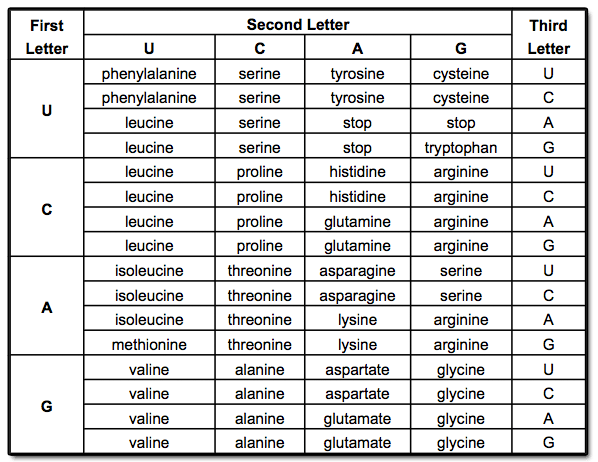
What does tRNA do during translation?
it brings a specific segment of DNA to the ribosome for transcription
it brings any amino acid to the ribosome
it brings a specific amino acid (decided by the DNA) to the ribosome for translation
it brings a specific amino acid (decided by the codon) to the ribosome for translation
2. A base sequence of one strand AATTCG has a complementary base strand of ______
a. AATTCG
b. TTAACG
c. TTAAGC
d. TTGGAC
Is this a strand of DNA or RNA?
TACGGACTA
DNA
RNA
Impossible to tell
What is the complementary pair for the DNA code:
C-T-A-T-G-G
G-A-T-A-C-C
C-T-A-T-G-G
A-T-G-A-T-G
G-T-A-C-T-C
Translate the mRNA molecule for this gene:
C-A-T-G-T-A-A-A-C
T-C-G-A-T-U-U-C-C
G-G-G-A-T-C-U-U-T
G-U-A-C-A-U-U-U-G
G-T-A-C-A-T-T-T-G

WHAT IS #1
TRIPLET
CODON

WHAT IS #2( #2 MATCHES UP WITH #1)
CODON
TRIPLET
ANTI-CODON

