
 Worksheets
Newton's Laws Review
Total questions: 43
Worksheet time: 43mins
What explains why objects resist changes in their state of motion?
gravity
inertia
force
friction
The force that prevents a ball rolling on the ground from continuing on it's path forever is...
Friction
Gravity
Inertia


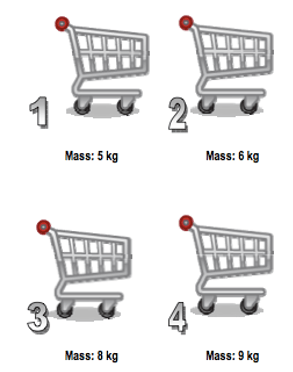

An inflated balloon released from rest moves horizontally.
The law that best explains this event is
Newton's 1st Law
Newton's 2nd Law
Newton's 3rd Law
Law of Gravity
True or False: objects with greater mass require more force to accelerate when compared to objects with less mass.
True
False
Which force causes an object to speed up or slow down (accelerate or decelerate)?
Newton's Second Law is also known as the Law of _______
Inertia
Acceleration
Action - Reaction
Gravitation
While you’re ice-skating with your friends, you push off from one end of the rink and slide forward. Based on Newton’s first law of motion, what is true?
You will lose your balance and fall over before your reach the middle of the ice rink.
You will continue to slide across the ice until a force makes you stop or change direction.
The force of gravity will make you keep your velocity until your friends make you stop.
The size of your ice skates will determine how quickly or slowly you travel across the ice.
A softball and a volleyball collide with equal speed, and then they accelerate at the same rate. What must be true about the masses of the objects?
The softball has more mass than the volleyball.
The softball and the volleyball have equal mass.
The volleyball has more mass than the softball.
It is impossible to compare the mass of the softball and the volleyball
An example of the force of gravity is-
a rocket flying through space
a ball falling to the ground after it has been thrown
a cloud moving across the sky
the Sun rising

If the man pushes with an equal amount of force, which object will accelerate more?
Car because it has more mass
Lawnmower because it has less mass
Car because it has less mass
Lawnmower because it has more mass
A dictionary weighing 15 Newtons is placed on a desk.
What is the force that the desk exerts on the dictionary?
none
15 N
1.5 N
150 N
Which of Newton's Laws explains a rocket's movements during launch?
Newton's 1st Law
Newton's 2nd Law
Newton's 3rd Law
Newton's 4th Law
As more unbalanced force is applied to an object, its acceleration:
stays the same
decreases
increases
A book sitting on the table does not move.
Law 1
Law 2
Law 3
Newton's third law of motion states that for every action there is:
an opposite, but equal reaction.
an opposite and equal reaction.
a reaction.

Which law does this image represent?
1st Law
2nd Law
3rd Law

Which law does this image represent?
1st Law
2nd Law
3rd Law

Which law does this image represent?
1st Law
2nd Law
3rd Law

When you are riding in a car and the car suddenly stops, your body continues to go forward.
Newton's 1st Law
Newton's 2nd Law
Newton's 3rd Law

A skater pushes another skater forward, but the one pushing moves backwards.
Newton's 1st Law
Newton's 2nd Law
Newton's 3rd Law
Which of the following has more inertia?
Bowling ball
Tennis ball

Students wanted to see if the distance a marble rolled down a ramp changed the force it had. They allowed a marble to roll down the ramp from different starting points and strike a second marble. To determine if the force of the rolling marble changed, what should the students measure?
The mass of Marble #2 before and after being struck by Marble #1.
The distance Marble #2 moves after being struck by Marble #1.
The time it takes Marble #2 to move after being struck by Marble #1.
The direction Marble #2 moves after being struck by Marble #1.

Students taped a rubber band to a box of washers, then dragged the box across four different surfaces, using the rubber band. The students are using the distance the rubber band stretches to measure the amount of friction each surface exerts on the box. Based on the observations shown here, which surface had the greatest amount of friction?
Surface A
Surface B
Surface C
SurfaceD
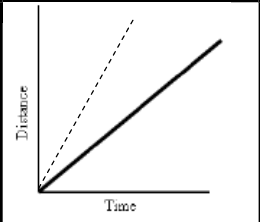
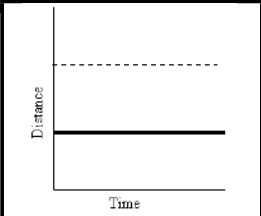


What will the net force on the soccer ball be?
50 N to the left
50 N to the right
200 N to the left
200 N to the right
What effect does friction have on a moving object?
it causes the moving object to slow and eventually stop
it causes the moving object to speed up
it keeps the moving object moving in the same direction forever
it causes the moving object to turn around and move in the opposite direction

What force is pushing up?
gravity
air resistance
friction
normal force

The model shows forces acting on a box when it is sliding down the ramp.
What would most likely happen to the motion of the box if you poured oil on the ramp?
It will slow the box because the force of friction will be increased.
It will speed up the box because the force of friction will be increased.
It will slow the box because the force of friction will be reduced.
It will speed up the box because the force of friction will be reduced.
A person pushes a bowling ball 10 meters and then pushes a tennis ball 10 meters. Which push requires more force and why?
The bowling ball because it has less acceleration
The tennis ball because it has a greater acceleration
The bowling ball because it has a greater mass
The tennis ball because it has less mass

What happens to the gravitational force between objects as the objects move closer together?
It has no pattern
It does not change
It increases
It decreases

According to Newton's first law of motion, a moving object that is not acted on by an unbalanced force will
change its momentum
eventually come to a stop
accelerate
remain in motion

AN OBJECT'S INERTIA IS DIRECTLY PORPORTIONAL TO ITS ________
SPEED
GRAVITY
FRICTION
MASS
Which of the following items would produce the greatest amount of friction when rubbed against another object?
vegetable oit
wax
sandpaper
an ice cube

