
 Worksheets
Fola yr9 Physics 1st term Exam
Total questions: 78
Worksheet time: 55mins
An object has a mass of 140 g and a volume of 100 cu. cm. Find the density of this object.
1 g/cc
2 g/cc
0.14 g/cc
1.4 g/cc
Calculate the density of a marble that weighs 10 grams and has a volume of 5cm3
2 g/cm3
50 g/cm3
15 g/cm3
Calculate the volume of wooden block that has a density of 40 g/cm3 and mass of 80 grams.
2cm3
320cm3
40cm3
Calculate the mass of a liquid that has density of 10g/ml and a volume of 60ml.
6g
60g
600g
The measure of the amount of matter in a substance is called its _______________________.
density
volume
mass
luster
The formula for density is ______________
D = L×W×H
D = M×V
D = M÷V
D = V÷M
The amount of mass per unit of volume of a substance is its ___________. This property can identify a substance.
density
volume
mass
length
Do more dense materials have more or less intermolecular spaces?
More
Less
If oil has a density of 0.9 g/cm3, will it float on top of water or sink beneath it?
Float on top
Sink Beneath it
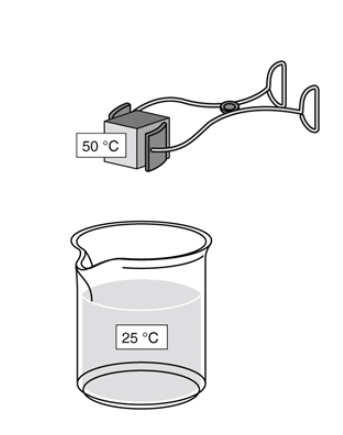
As part of a lab experiment, Tasha drops a metal cube into a beaker of water, as shown in the figure below.
After energy in the form of heat transfers between the substances, what is the final temperature of the water?
The final temperature is 25 °C because there is more water than metal.
The final temperature is 50 °C because the metal warms the water to the temperature of the metal.
The final temperature is between 25 °C and 50 °C because energy is transferred from the metal to the water.
The final temperature is between 25 °C and 50 °C because most of the thermal energy is lost to the air around the substances.

The water in Mario’s swimming pool absorbs energy as heat during the day. Which of the following would the water in the pool be most likely to do?
condense
evaporate
freeze
melt
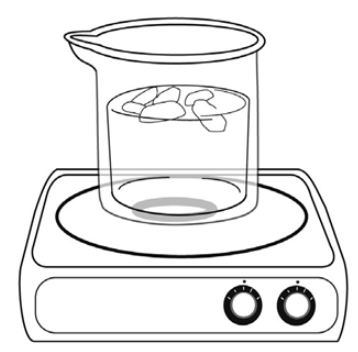
Emerson places a beaker of water on a hotplate and turns the hotplate on. The temperature in the room is 25 ºC. After the water heats to 75 ºC, she adds pieces of ice to the beaker.
Which of the following describes a transfer of heat energy that occurs during this experiment?
from the air to the water
from the ice to the beaker
from the water to the ice
from the water to the hotplate

How does the thermal energy of the liquid in the larger beaker compare to the thermal energy of the liquid in the smaller beaker?
The liquid in the larger beaker has less thermal energy than the liquid in the smaller beaker.
The liquid in the larger beaker has more thermal energy than the liquid in the smaller beaker.
The liquid in the larger beaker has the same amount of thermal energy as the liquid in the smaller beaker.
The exact volume of the liquid in each beaker must be known to compare the thermal energy of the liquids.

A temperature scale that is used mostly in United States.
According to it, water freezes at 32 degrees and boils at 212 degrees.
Celsius
Fahrenheit
Kelvin
All of them

Mariana is at the beach with her parents so she see on a clock that the temperature is 104 ºF, she asks his father what is the temperature in celsius. He father says:
279,5 ºC
40 ºC
55,5 ºC
104 ºC
An object (a) when it gains heat.
You will be able to see an object when light energy (a) from it.
Light travels in (a) lines.
Heat can cause a solid to (a) .
Heat energy travels from regions of (a) temperature to regions
of lower temperature.
Energy is never created nor (a) .
Immobile objects do not have (a) energy.
(a) energy is needed for photosynthesis.
Sound is heard when objects (a) .
Kinetic energy depends on the object’s mass and (a) .
The word (a) means with more energy, more speed, and more force.
(a) means to increase in size.
Method of thermal energy transfer where more vigorously vibrating particles cause neighboring particles to vibrate by colliding
(a)
Method of thermal energy transfer where more vigorously vibrating particles cause expansion and decrease in density in a liquid or gas; the less dense material then rises because it floats, setting up a convection current.
(a)
Method by which all of a liquid or gas becomes heated through convection; particles flow through the material due to differences in density
(a)
(a) means to give out
Method of thermal energy transfer that uses waves and does not depend on particles; occurs through a vacuum, through gases and through transparent solids
(a)
(a) means to take in
A space where there are no particles is called
(a)
To shake backwards and forwards with repeating movement
(a)
What happens to molecules when their kinetic energy increases?
The molecules move slower
The molecules move faster
The molecules get heavier
It depends on the type of molecule

Three containers with the same amount of the same material are shown below. Which container has the substance with the highest amount of energy?
The container on the left
The middle container
The container on the right
All have an equal amount of energy
Amy was sitting outside on a hot, summer day, enjoying a glass of sweet iced tea. She notices some water droplets on the outside of her glass. What is causing those water droplets?
The outside air is heating up the ice, causing it to melt into a liquid.
The cold liquid in the glass is cooling the air around it, making it condense into a liquid.
The outside air is heating up the liquid in the glass, causing it to evaporate.
The liquid in the glass is cooling the air around it, causing it to evaporate.
Amy was sitting outside on a hot, summer day, enjoying a glass of sweet iced tea. She notices some water droplets on the outside of her glass. What is causing those water droplets?
The outside air is heating up the ice, causing it to melt into a liquid.
The cold liquid in the glass is cooling the air around it, making it condense into a liquid.
The outside air is heating up the liquid in the glass, causing it to evaporate.
The liquid in the glass is cooling the air around it, causing it to evaporate.
When you boil water in a pot, some of the water escapes as steam. Which of the following choices explains what is happening with the water molecules in this scenario?
The molecules slow down as the kinetic energy increases and move farther apart from one another.
The molecules slow down as the kinetic energy decreases and move closer together.
The molecules speed up as the kinetic energy increases and the molecules move farther apart from one another.
The molecules speed up as the kinetic energy decreases and the molecules move closer together.
True or false? The interference pattern created from 2 sound sources is similar to the interference pattern created from 2 vibrational sources in a ripple tank.
True
False
When standing between 2 sound sources, it's possible to hear a sound that is louder than either of the sources alone because
both sounds are in phase, so the peaks of 1 sound wave meet with the troughs of the other sound wave
both sounds are in phase, so the peaks of both sound waves interfere and the troughs of both waves interfere
both sounds are out of phase, so the peaks of 1 sound wave meet with the troughs of the other sound wave
both sounds are out of phase, so the peaks of both sound waves interfere and the troughs of both waves interfere
Select all that apply to destructive interference:
When standing between 2 speakers, you don't hear anything even though you know both speakers are emitting sound waves.
2 sound waves are in phase.
2 sound waves are out of phase.
The peaks of 1 sound wave encounter the troughs of the other sound wave.
The peaks of both sound waves meet and the troughs of both sound waves meet.
When increasing the wavelengths of 2 sound sources, their interference pattern will have
more areas of constructive and destructive interference
less areas of constructive and destructive interference
more areas of constructive interference but less areas of destructive interference
less areas of constructive interference but more areas of destructive interference
Noise-cancelling headphones work because
they absorb all sounds from your surroundings
they create constructive interference with sounds from your surroundings
they create destructive interference with sounds from your surroundings
they increase the wavelength of sounds from your surroundings
The collision theory for the formation of the Moon describes an object the same size as Mars. What was this object?
an asteroid
a newly formed star
a newly formed planet
a comet from outside the Solar System
The collision theory is a theory of how the Moon was formed. It refers to a collision that happened relatively soon after the formation of the ...?
universe
Solar System
Milky Way
Moon
Which evidence supports the collision theory?
The Moon has a small iron core, similar to the Earth
Venus has no moon
The Moon is Earth's only permanent natural satellite
The surface of the Earth does not appear to ever have been molten
Nebulae are clouds of ... ?
Phineas and Ferb
dust and gas
Bonnie and Clyde
atoms and molecules
Nebulae are primarily composed of what element?
Hydrogen
Helium
Iron
Oxygen
Which of these statements is correct?
all nebulae act as stellar nurseries
only some nebulae act as stellar nurseries
no nebulae ever act as stellar nurseries
most nebulae are smaller than the Sun
"Nebula" is Latin for ___
cloud
gas
glow
colour
Dust clouds that reflect the light of nearby bright massive stars are called ___
emission nebulae
mirror nebulae
reflection nebulae
gas nebulae
What force acted on the massive nebula to collapse it and eventually form our sun?
electrostatic force
gravity
friction
strong force
Which is a supernova remnant?
Coalsack Nebula
Cat's Eye Nebula
Crab Nebula
Ring Nebula
What is the brightest nebula in the sky?
The Pillars of Creation
The Orion Nebula
NGC 604
Carina Nebular
What is a planetary nebula?
A nebula formed from an interstellar drifting gas giant
Remnants of a white dwarf consuming gas giants
Remnants of a low or mid-mass star's progression
What is the apparent magnitude of the Orion Nebula?
1.0
2.0
3.0
4.0
Where in the constellation Orion can the Orion Nebula be most easily spotted?
The belt
The sword
The shoulder
The foot
Who amazed the world by publishing lists of over 2,500 new nebulae during the 1700s to early 1800s?
Charles Messier
William Huggins
The Herschels
Edwin Hubble
Are all nebulae star-forming regions?
Yes
No
The Horsehead Nebula is an example of what?
An emission nebula
A planetary nebula
A dark nebula
What does the M stand for in celestial object designations such as M57 or M31?
Messier
Magnitude
Maximum declination
Apparent magnitude

Identify the nebula.
Trafalgar Nebula
Ring Nebula
Cat's Eye Nebula
What is the Crab Nebula an example of?
Emission nebula
Planetary nebula
Supernova remnant
What are the mechanisms that have been proposed to explain the movement of Earth’s tectonic plates?
slab pull and sea-floor spreading
mantle convection and continental drift
sea-floor spreading and continental drift
mantle convection, ridge push, and slab pull
A plate boundary is a place where two tectonic plates meet. There are several types of tectonic plate boundaries. Which statement below shows the correct definition of a tectonic plate boundary?
At a divergent boundary, plates separate.
At a transform boundary, plates move apart.
At a convergent boundary, plates slide past each other.
At a divergent boundary, one plate sinks under another plate.

Identify this type of plate movement
Divergent Boundary
Convergent Boundary
Transform Boundary
None
Tectonic plates can be made of continental crust or oceanic crust, or a combination of the two. Besides their locations, how else are these two kinds of crust different?
Continental crust is thinner than oceanic crust.
Continental crust is thicker than oceanic crust.
Tectonic plates made of continental crust are larger than plates made of oceanic crust.
Tectonic plates made of continental crust are smaller than plates made of oceanic crust.
__________ describes the large scale movement of the Earth’s lithosphere.
Crust Displacement
Mantle Movement
Plate Tectonic
None
Tectonic Plates are the pieces of the ____________ that move around on top of the asthenosphere.
Lithosphere
Mantle
Hard Rocks
Both B and C

