
 Worksheets
Conceptual Fall 2022 Review - Part 4
Total questions: 36
Worksheet time: 30mins
Which of the following is an example of a greenhouse gas?
Carbon Dioxide
Hydrogen
Oxygen
Neon
Soot particles deposited on ice or snow are called black carbon, and can warm the planet because they decrease the _____ of the ice and snow.
insulation
albedo
temperature

The reason your car gets hot on a summer day is because (a) energy light can get in, but (b) energy light can't get back out.

If a graph looks like this, it could be representing a
positive feedback loop
negative feedback loop
Which of the following is not an example of a greenhouse gas?
Carbon Dioxide
Methane
Oxygen
Water Vapor
Heat is transferred by conduction, ____________, and radiation.
convection
waves
thermal energy
radiant energy
Convection currents can happen in solids, liquids and gases.
True
False

Jeriah places two metal cubes in contact with each other. Energy transfers as heat flows from Cube A to Cube B. What conclusion can you draw regarding Cube B?
It is larger than Cube A.
It is cooler than Cube A.
It is smaller than Cube A.
It is warmer than Cube A.
Steve wanted to see which type of fertilizer made sunflowers grow larger. What is the dependent variable?
Type of fertilizer
Size of sunflower
Type of sunflower

What was the dependent variable?
What are the two types of crust?
continental and oceanic
ocean and upper
lower and upper
pizza and subway


What type of plate boundary is this?
Continental-Oceanic Convergent
Continental-Continental Convergent
Oceanic-Oceanic Convergent
Transform
Oceanic-Oceanic Divergent

Which of the following is true?
The conduction of the liquid iron in the outer core creates Earth's magnetic field.
The convection of the liquid iron in the outer core creates Earth’s magnetic field.
The conduction of the liquid in the inner core creates the Earth's magnetic field.
The convection of the liquid in the inner core creates the Earth's magnetic field.
Which of the following are constructive processes that build up and add to the Earth's surface? (answer all that apply)
volcanos
sea floor spreading
weathering
erosion
mountain building

Match the features to the proper plate boundary.
Mid-Ocean Ridge, Earthquakes, Volcanic Activity (not like a normal volcano)
Divergent Boundary
Earthquakes, Mountains
Continental- Continental Convergent
Powerful Earthquakes
Transform
Subduction zone, Volcanoes, Earthquakes Deep Trench, Island Arc
Oceanic-Oceanic Convergent
Subduction zone, Volcanoes, Earthquakes Deep Trench, Mountains
Oceanic-Continental Convergent

A valley in the ocean created when one lithospheric plate subducts under another
deep ocean trench
rift valley
oceanic ridge
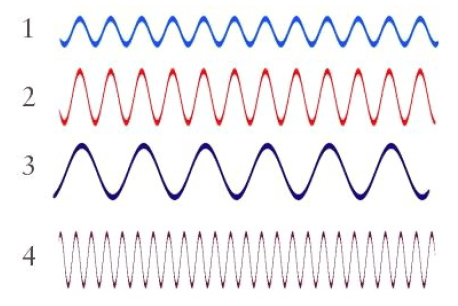
Assuming that each of the four waves pictured is in the same medium, which wave has the greatest frequency?
1
2
3
4
If I increase the frequency of wave as it travels through the same medium, what happens to the wavelength?
it increases also
it decreases
it stays the same
In the same medium, increasing the frequency of a wave will ___________ the speed.
decrease
increase
not change
Which of the following best describes a longitudinal wave?
The medium vibrates parallel to the direction the wave travels.
The medium vibrates perpendicular to the direction the wave travels.
The medium does not vibrate.
S waves can travel through
solids only
solids or liquids
Transverse waves travel faster than longitudinal waves when they are in the same medium.
True
False
What is wave interference?
Which of the following is the correct order of the EM spectrum from low frequency to high frequency?
UV, visible, infrared, microwaves
Infrared, microwave, UV, x-rays
UV, visible violet, visible red, infrared
radio, microwave, UV, gamma
Which is the worst (most energetic and ionizing) type of radiation?
gamma rays
x-rays
ultraviolet waves
visible light
Which of the following are examples of ionizing radiation (choose 2).
x-rays
visible light
gamma rays
microwaves
Light of a given wavelength is used to illuminate the surface of a metal. However, no electrons are emitted. In order to cause electrons to be ejected, light of __________ should be used.
lower energy
higher intensity
shorter frequency
higher frequency

