
 Worksheets
Periodic Table Quiz
Total questions: 188
Worksheet time: 2hrs 38mins
What is the chemical symbol for iron?
I
Ir
Fe
R
What is iron's atomic number?
12
26
55.85
55
Titanium is in group 4. What period is it in?
2
3
4
5
Zinc is in period 4. What group is it in?
12
13
14
15
Krypton is in what group?
16
17
18
19
What is iodine's atomic mass?
53
126.9
130
52
What element is the chemical symbol Au?
gold
silver
Augium
Auxiom
What is silver's chemical symbol?
S
Ag
Si
I
What is calcium's atomic number?
20
21
22
23
What family is on the far right of the periodic table?
alkali metals
transition metals
actinoids
noble gases
What family is on the far left of the periodic table?
noble gases
alkali metals
transition metals
actinoids
What is mercury's chemical symbol?
Me
M
Hg
Mc
What is mercury's atomic mass?
200.59
80
82
201.5
What element is in period 6, group 14?
tin
lead
copper
zinc
What element is in period 4, group 7?
manganese
iron
rutherfordium
radium
What element is in period 4, group 2?
lithium
potassium
magnesium
calcium
What is nickel's chemical symbol?
An
N
Nc
Ni
What is sodium's chemical symbol?
N
Na
S
So

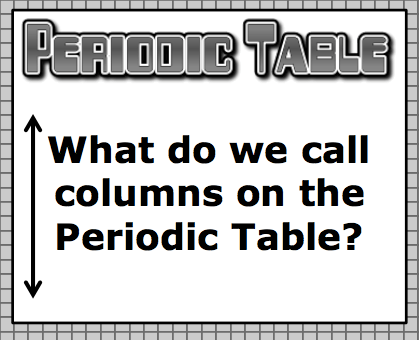
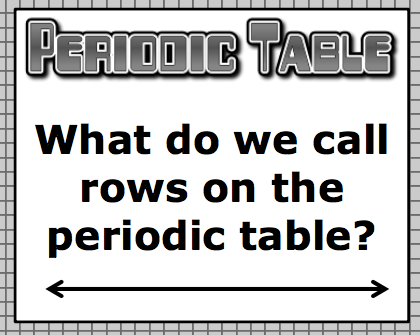


The Atomic number is known as the _______
Number of electrons in an atom
Number of Protons in an atom
Number of neutrons in an atom
Number of Protons and electrons in an atom
What charge do protons have?
Positive
Negative
Neutral
What is Atomic Mass Number ?
Number of Protons
Number of Neutrons
Number of Protons and Neutrons
Number of Protons and Electrons
The number of electrons in an atom is equal to the...
Atomic number
Protons
Atomic Mass
Neutrons
The formula used to calculate the number of neutrons is:
Mass Number - Atomic Number
Protons + Electrons
Atomic Number - Mass Number
Protons x2
How many periods are on the periodic table?
5
6
7
8
The atomic mass of an element is equal to the number of...
protons and neutrons
protons and electrons
protons neutrons and electrons
Groups on the periodic table are arranged...
vertically
horizontally
diagonally
Periods on the periodic table are arranged...
vertically
horizontally
diagonally
Which elements are in the nucleus?
Proton and Electron
Neutron and Electron
Proton and Neutron
The letter, C, is a ... of carbon.
Name
Nickname
Chemical Symbol
Pseudonym
I am a metal
I am in group 2
I am in period 6
I am…
Mo
Re
S
Ba
I am a nonmetal
I am in period 2
I am in group 16/6A
Ba
Si
Ba
O
What are the vertical columns on the periodic called?
groups
periods
nonmetals
metals
metalloids
What are the horizontal rows on the periodic table called?
periods
groups
metals
nonmetals
metalloids
What does the number of proton tell us?
electrons
atomic number
atomic mass
neutrons
How do you calculate the number of neutrons? *
Mass = Atomic number - Neutrons
Mass - Atomic number = Neutrons
Atomic number = Neutrons

How many protons and electrons does nickel have?
28
58.69
Select the element Alkali Earth Metal found in Period 4
Calcium
Potassium
Titantium
Krypton
Select the element that is a metalloid
Gallium
Boron
Oxygen
Magnesium
Select the element that is a nonmetal
Copper
Lead
Hydrogen
Sodium
What element is found in Group 5 period 4?
Zirconium
Magnesium
Strontium
Vanadium
Select all elements that are metals
Thallium
Hydrogen
Sulfur
Argon
Chromium
Which of the following are found in the nucleus?
protons and electrons
protons ONLY
protons and neutrons
Electrons only
________________ have a positive charge, ___________________ have NO charge, and _____________________ have a negative charge.
Protons, Electrons, Neutrons
Neutrons, Electrons, Protons
Protons, Neutrons, Electrons
Electrons, Neutrons, Protons

Which of the following elements is in (period 4 , group 2)
Carbon
Potassium
Calcium
Sodium
Where are nonmetals found on the periodic table?
Left Side
The Bottom
Staircase
Right Side
Which two families have been taken out of the middle and placed at the bottom of the periodic table
Halogens and Oxygen Group
Lanthanides and Actinides
Alkali Metals and Alkaline Earth Metals
Metalloids and Nonmetals
What does the Atomic Number represent?
Number of Protons
Number of Neutrons
Number of Protons and Neutrons
Which family is the largest? (Groups 3-12)
Metalloids
Actinides
Transition Metals
Noble Gases
The vertical columns on the periodic are called _______________.
Rows
Periods
Groups
Valence
The horizontal rows of the Periodic Table are called ______________.
Periods
Groups
Families
Halogens
This element does not match the properties of any other group so it stands alone. It is placed above Group 1 but it is not part of that group. It is very reactive, colorless, odorless, and a gas at room temperature.
Hydrogen
Helium
Nitrogen
Oxygen
Group 1: These metals are extremely reactive. They all have one valence electron. They are shiny and silver in color. They are soft and can be cut with a knife.
Transition Metals
Alkali Metals
Alkaline Metals
Lanthanides
Group 2: Slightly less reactive because they have 2 valence electrons. They are silver colored and more dense that Group 1 metals.
Transition Metals
Alkali Metals
Alkaline-earth Metals
Actinides
Groups 3-12: These metals have a moderate range of reactivity and a wide range of properties. They are shiny and good conductors of heat and electricity. They have higher densities and melting points than Groups 1 and 2. These have 1 or 2 valence electrons.
Transition Metals
Alkali Metals
Alkaline-earth Metals
Lanthanides
Elements with atomic numbers 57-70 and 89-102: These metals were taken out and placed at the bottom of the table so the table wouldn't be so wide. Some are shiny and reactive. Others are radioactive and unstable. Elements 95-103 do not exist in nature but have been manufactured in the lab.
Alkali Metals
Alkaline-earth Metals
Lanthanides and Actinides
Boron Group
Group 13: Contains on metalloid and 4 metals. They are reactive. All have 3 valence electrons (Group # minus 10).
Boron Group
Nitrogen Group
Oxygen Group
Carbon Group
Group 17: All nonmetals. Very reactive. Poor conductors of heat and electricity. Tend to form salts with metals. Example NaCl: sodium chloride which is known as table salt. These elemtns have 7 valence electrons (Group # minus 10).
Boron Group
Oxygen Group
Nitrogen Group
Halogens
Group 18: Unreactive nonmetals. All are colorless, odorless gases at room temperature. These elements have a full outer energy level, usually 8 valence electrons, except for Helium which only has 2 valence electrons.
Nitrogen Group
Oxygen Group
Noble Gases
Halogens
The elements on the right side of the Periodic Table are classified as ________________.
Metals
Nonmetals
The elements on the left side of the periodic table are classified as ________________.
metals
nonmetals
What is the mass of a carbon atom that has 6 protons, 7 neutrons, and 6 electrons?
6
7
13
19
An atom of tin has an atomic number of 50 and a mass number of 119. How many protons, electrons, and neutrons are found in one neutral atom of tin?
50 protons, 69 electrons, 50 neutrons
50 protons, 50 electrons, 69 neutrons
69 protons, 50 electrons, 69 neutrons
69 protons, 69 electrons, 50 neutrons

How many neutrons does calcium have?
20
40
60
0
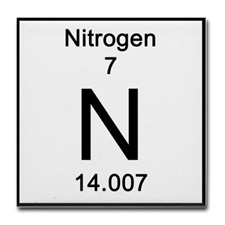
located in the nucleus
protons and electrons
protons and neutrons
neutrons and electrons

The atomic number of Lithium is _.
3
7
6.941
Which charge is POSITIVE?
Proton
Neutron
Electron
Cell
Which charge is NEGATIVE?
Proton
Neutron
Electron
Cell
Which particle is NEUTRAL - NO CHARGE?
Proton
Neutron
Electron
Cell

How many protons are in Sodium?
11
22
12
33

How many electrons are in Aluminium?
40
27
13
14

How many neutrons are in Magnesium?
36
12
24
6

How many neutrons are in Phosphorus?
16
15
31
46

How many electrons are in Sulfur?
32
16
48
8

How many protons are in Chlorine?
35
18
17
52

How many neutrons are in Argon?
18
40
58
22

How many electrons are in Potassium?
19
20
58
39

Arsenic has a mass of _______
33
79
75
47

Oxygen has a mass of...
8
16
15
6

What element is C
Carbon
Calcium
Chlorine
Caesium

What element is Ar
Argon
Arsenic
Astatine

What is the symbol for Hydrogen?
(a)

What is the symbol for Lithium?
(a)

What is the symbol for Fluorine?
(a)

What is the symbol for Sulfur?
(a)

What is the symbol for Lead?
(a)

What is the Symbol for Beryllium?
(a)

What is the symbol for Magnesium?
(a)

What is the Symbol for Nitrogen?
(a)

What is the symbol for Helium?
(a)

What is the symbol for Aluminum?
(a)

What is the symbol for Iron?
(a)

What is the symbol for Silicon?
(a)

What is the symbol for Phosphorus?
(a)

What is the symbol for Boron?
(a)

What is the symbol for Potassium?
(a)

What is the symbol for Carbon?
(a)

What is the symbol for Oxygen?
(a)

What is the symbol for Copper?
(a)

What is the symbol for Gold?
(a)

What is the symbol for Silver?
(a)

What is the symbol for Sodium?
(a)

What is the symbol for Calcium?
(a)

What is the symbol for Chlorine?
(a)
What is the Symbol for Gold
Au
Ag
Ar
Go
Technetium's symbol is
T
Te
Tc
Ti
Which of these elements are a Non-Metal?
Copper
Gold
Oxygen

The chemical symbol for zinc is ...
Z
ZN
Zn
ZI

The chemical symbol for iron is ...
I
Ir
Fe
Io

The chemical symbol for sodium is ...
Na
S
So
K

The chemical symbol N represents
Nitrogen
Neon
Nickel

The chemical symbol Ca represents
Carbon
Chromium
Calcium
Cadmium

The chemical symbol for helium is ...
H
He

The chemical symbol for chlorine is ...
C
Ch
Cl
Ca

The chemical symbol for potassium is....
P
Po
K
Fe
The chemical symbol Be respresents...
Boron
Beryllium
Bromine
Barium
Which of the following is a metal
Magnesium
Oxygen
Fluorine
Neon
magnesium
(a)
potassium
(a)
phosphorus
(a)
chromium
(a)
uranium
(a)
aluminum
(a)
helium
(a)
calcium
(a)
fluorine
(a)
nickel
(a)
lead
(a)
iron
(a)
copper
(a)
carbon
(a)
nitrogen
(a)
silicon
(a)
sodium
(a)
lithium
(a)
sulfur
(a)
iodine
(a)
gold
(a)
bromine
(a)
chlorine
(a)
hydrogen
(a)
mercury
(a)
neon
(a)
silver
(a)
oxygen
(a)
tin
(a)
zinc
(a)
magnesium
(a)
potassium
(a)
phosphorus
(a)
chromium
(a)
uranium
(a)
aluminum
(a)
helium
(a)
calcium
(a)
fluorine
(a)
nickel
(a)
lead
(a)
iron
(a)
copper
(a)
carbon
(a)
nitrogen
(a)
silicon
(a)
sodium
(a)
lithium
(a)
sulfur
(a)
iodine
(a)
gold
(a)
bromine
(a)
chlorine
(a)
hydrogen
(a)
mercury
(a)
neon
(a)
silver
(a)
oxygen
(a)
tin
(a)
zinc
(a)

