
 Worksheets
Final Exam IMI (Part 1) Ms. D
Total questions: 211
Worksheet time: 10hrs 28mins
Solve the inequality.
−5x − 7 < 28
x > -7
x < -7
x > 521
x < 5−21
Solve the inequality.
2(b − 8) > 12
b > 20
b > 6
b > 14
b > 20
Solve the inequality.
−4d − 9 ≤ 3
d ≥ 136
d ≥ 133
d ≥ −121
d ≥ −3
x ≥ -4
x ≥ 4
x ≤ -4
x ≥ 4
-3x ≥ 12
Yes
No
6 + 2h > 30
h < 24
18 > h
h > 12
h < -12
2k - 9≤ -19
8w - 8 = -4w + 16
7w + 5 = 3w - 15
f - 4 = 6f + 26
Jacob solved the following equation using the steps shown.
Step 1 5x + 9 = 2x - 3
Step 2 3x + 9 = -3
Step 3 3x = -12
Step 4 x = -4
What operation did he perform to get from Step 1 to Step 2?
Subtracted 2x from both sides of the equation
Subtracted 9 from both sides of the equation
Multiplied both sides of the equation by 3
Added -3 to both sides of the equation
4( x + 2) = 16
What is the solution to the equation?
-2
0
1
2
What is the solution to this equation?
2x + 3 = x − 4
-3
0
-7
7
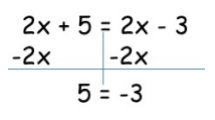
What is the definition of infinite solutions?
no matter what constant is substituted in for the variable, the equation is ALWAYS true
no matter what constant is substituted in for the variable, the equation will NEVER be true
only this ONE solution will make the equation true
What is the definition of no solution?
no matter what constant is substituted in for the variable, the equation is ALWAYS true
no matter what constant is substituted in for the variable, the equation will NEVER be true
only this ONE solution will make the equation true
How many solutions does this equation have?
6x - 3 = 6x + 9
One Solution
No Solution
Many Solutions
How many solutions does this equation have?
8y - 4 = 8y - 4
One Solution
No Solution
Infinitely Many Solutions
How many solutions does this equation have?
2x + 9 = 2x + 9
One Solution
No Solution
Infinitely Many Solutions
Which answer represents an equation with infinite solutions?
2x = 2x
5≠6
3x = 7
3=3
How Many Solutions Does
This Equation Have?
7(2x + 5) = 12x – 1
One Solution
No Solution
Infinitely Many Solutions
m = -1/3 and m = -1/3

Which point on the x-axis lies on the line that passes through point C and is parallel to line AB?
(1, 0)
(1, 1)
(0, 2)
(2, 0)

Which point on the x-axis lies on the line that passes through point P and is perpendicular to line MN?
(0, 1)
(0, 4)
(1, 0)
(4, 0)
y = 3x + 2 (3, -4)

Which point is on the line that passes through point H and is perpendicular to line FG?
(–6, 10)
(–2, –12)
(0, –2)
(4, 2)
Write the equation of the line PARALLEL to the line y = 4x - 9 that passes through the point (-2, 4)
y = 4x + 12
y = -4x -4
y = -1/4x + 5/2
y - 3 = 2(x + 4),
the line has a slope of 2 and contains what point?
y + 1 = -3(x - 5),
the line contains the point (5, -1) and has a slope of?
(4, -7); m = -1/4
(-2, -1); m= -3
(-2, -1); m= -3
(-2, -3), (4, 3)
Determine the slope and y-intercept from the following equation:
4x + y = -10
slope: 4 y-intercept: (0,10)
slope: -4 y-intercept: (0,-10)
slope: -4 y-intercept: (0,10)
slope: 4 y-intercept: (0,-10)
y = -3x + 5
2x - 2 = 6y
y = 2x +1
4y - 3 = 6x + 6
y - 2 = 3x


Write down the equation of this line.
y= 2x+1
y= −2x+1
y= 2x−½
None of the above

What is the equation of this line in the form of y=mx+b.
(a)


Describe the slope of the line.
negative slope
0 slope
positive slope
undefined slope
Which graph represents 2x + 4y = 12? Convert into y=mx+b


Compare the function
t(x)=x−7 to the parent function f(x)=xVertical Translation Up 7 units
Vertical Translation Down 7 units

Compare the function (red) to the parent function (black).
Vertical Translation Up 3 units
Vertical Translation Down 3 units
Compare the function
w(x)=x+13 to the parent function f(x)=xVertical Translation Up 13 units
Vertical Translation Down 13 units

Compare the function (red) to the parent function (black).
Vertical Translation Up 9 units
Vertical Translation Down 9 units
Compare the function
a(x)=x−1.5 to the parent function f(x)=xVertical Translation Up 1.5 units
Vertical Translation Down 1.5 units
Compare the function
c(x)=x+100 to the parent function f(x)=xVertical Translation Up 100 units
Vertical Translation Down 100 units

Compare the function (red) to the parent function (black).
Vertical Translation Up 8 units
Vertical Translation Down 8 units

Compare the function (red) to the parent function (black).
Vertical Translation Up 4 units
Vertical Translation Down 4 units
Compare the function
d(x)=x−38 to the parent function f(x)=xVertical Translation Up 8/3 units
Vertical Translation Down 8/3 units
Compare the function
r(x)=x+83 to the parent function f(x)=xVertical Translation Up 3/8 units
Vertical Translation Down 3/8units


Quadratic


Which set of ordered pairs is a function?
{(9,5), (10,5), (9,-5), (10,-5)}
{(3,4), (4,-3), (7,4), (3, 8)}
{(6,-5), (7, -3), (8, -1), (9, 1)}
{(2, -2), (5, 9), (5, -7), (1, 4)}
The function rule is f(x) = -2x + 7. If the input is 10, what is the output?
27
-13
-27
13
f(x)=2x+2
for x = 4
6
-8
10
0
Evaluate f(x) = x2 for x = -8
64
-64
-16
16


What is the missing number?
y = x+8
6
7
5
4
Solve the inequality.
−5x − 7 < 28
x > -7
x < -7
x > 521
x < 5−21
Solve the inequality.
2(b − 8) > 12
b > 20
b > 6
b > 14
b > 20
Solve the inequality.
−4d − 9 ≤ 3
d ≥ 136
d ≥ 133
d ≥ −121
d ≥ −3
-3x ≥ 12
3x ≥ 12
6 + 2h > 30
h < 24
18 > h
h > 12
h < -12
7k – 2 ≥ -9
2k - 9≤ -19
10x + 9 = 4x - 9
8w - 8 = -4w + 16
7w + 5 = 3w - 15
f - 4 = 6f + 26
Jacob solved the following equation using the steps shown.
Step 1 5x + 9 = 2x - 3
Step 2 3x + 9 = -3
Step 3 3x = -12
Step 4 x = -4
What operation did he perform to get from Step 1 to Step 2?
Subtracted 2x from both sides of the equation
Subtracted 9 from both sides of the equation
Multiplied both sides of the equation by 3
Added -3 to both sides of the equation
Solve: 5x + 15 = 10x - 40
x = 10
x = -10
x = 11
x = -11
4( x + 2) = 16
What is the solution to the equation?
-2
0
1
2
4k + 24 = 6k -10
k = 17
k =-17
k= 5
k = 1/5
What is the solution to this equation?
2x + 3 = x − 4
-3
0
-7
7
11 - 3x = 44
What is the definition of one solution?
no matter what constant is substituted in for the variable, the equation is ALWAYS true
no matter what constant is substituted in for the variable, the equation will NEVER be true
only this ONE solution will make the equation true
What is the definition of infinite solutions?
no matter what constant is substituted in for the variable, the equation is ALWAYS true
no matter what constant is substituted in for the variable, the equation will NEVER be true
only this ONE solution will make the equation true
What is the definition of no solution?
no matter what constant is substituted in for the variable, the equation is ALWAYS true
no matter what constant is substituted in for the variable, the equation will NEVER be true
only this ONE solution will make the equation true
How many solutions does this equation have?
6x - 3 = 6x + 9
One Solution
No Solution
Many Solutions
How many solutions does this equation have?
8y - 4 = 8y - 4
One Solution
No Solution
Infinitely Many Solutions
How many solutions does this equation have?
2x + 9 = 2x + 9
One Solution
No Solution
Infinitely Many Solutions
How many solutions does this equation have?
3z + 7 = 7 + 3z
One Solution
No Solution
Infinitely many solutions
Which answer represents an equation with infinite solutions?
2x = 2x
5≠6
3x = 7
3=3
How many solutions does the following equation have?
−2x + 9 + 6x = −3x + 2
One Solution
No Solutions
Infinitely Many Solutions
Two solutions
How Many Solutions Does
This Equation Have?
7(2x + 5) = 12x – 1
One Solution
No Solution
Infinitely Many Solutions
Which answer choice describes the two lines?
m = 5 and m = -1/5
m = -1/3 and m = -1/3

y = 3/2x + 6?
Which point on the x-axis lies on the line that passes through point C and is parallel to line AB?
(1, 0)
(1, 1)
(0, 2)
(2, 0)
Which point on the x-axis lies on the line that passes through point P and is perpendicular to line MN?
(0, 1)
(0, 4)
(1, 0)
(4, 0)
y = 3x + 2 (3, -4)
Which point is on the line that passes through point H and is perpendicular to line FG?
(–6, 10)
(–2, –12)
(0, –2)
(4, 2)
Write the equation of the line PARALLEL to the line y = 4x - 9 that passes through the point (-2, 4)
y = 4x + 12
y = -4x -4
y = -1/4x + 5/2
y - 3 = 2(x + 4),
the line has a slope of 2 and contains what point?
y + 1 = -3(x - 5),
the line contains the point (5, -1) and has a slope of?
(4, -7); m = -1/4
(-2, -1); m= -3
(-2, -1); m= -3
(-2, -3), (4, 3)
Determine the slope and y-intercept from the following equation:
4x + y = -10
slope: 4 y-intercept: (0,10)
slope: -4 y-intercept: (0,-10)
slope: -4 y-intercept: (0,10)
slope: 4 y-intercept: (0,-10)
y = -3x + 5
2x - 2 = 6y
y = 2x +1
4y - 3 = 6x + 6
y - 2 = 3x
Define arithmetic sequences.
A sequence whose terms change by adding the same number each time.
A sequence whose terms change by multiplying the same number each time.
A sequence whose terms change by dividing the same number each time.
A list of numbers that often (but not always) form a pattern.
What does a1 represent?
Any term
First term
Last term
Identify a1
97, 86, 75, 64, ...
64
11
-11
97

a1 =
1
2
3
5
a3 =
14
2
3
8

Is this graph Arithmetic or Geometric?
Arithmetic
Geometric

This sequence represents a(n)....
Arithmetic Sequence
Geometric Sequence
Neither

This sequence is a(n)...
Arithmetic Sequence with a common difference of 5
Arithmetic Sequence with a common ratio of 5
Geometric Sequence with a common difference of 5
Geometric Sequence with a common ratio of 5
Write the recursive rule for the given sequence
a1 = 2 ; an= an+1 + 3
2 a1 = 2 ; an= an+1 + 2
a1 = 1 ; an= an+1 ⋅ 3
5 a1 = 1 ; an= an+1 ⋅ 2
Given the sequence:
125, 25, 5, ....
Write the explicit rule:
an = (125)(1/5)(n-1)
an = 625(1/5)(n-1)
an = 625(5)(n)
an = 125 + 5n
Which sequence is represented by the equation an = 2(7)n-1 ?
7, 14, 28, 56...
2, 14, 98, 686...
2, 9, 16, 23...
7,9,11,13...
Given the sequence:
25, 21, 17, 13,...
Write the explicit equation that models the sequence.
an = 29-4(n-1)
an = 4+25(n-1)
an = 25-4(n-1)
an = 4n + 25
Given the following sequence and an = 7, what is an+1?
2, 7, 12, 17,...
2
12
17
22

The explicit rule for the given graph is...
a an= 2⋅3n−1
an= 2⋅2n−1
an= 2+ 2(n−1)
an= 3 + 2n−1
This graph is...
Arithmetic
Geometric
Neither
Compare the function
t(x)=x−7 to the parent function f(x)=xVertical Translation Up 7 units
Vertical Translation Down 7 units
Compare the function (red) to the parent function (black).
Vertical Translation Up 3 units
Vertical Translation Down 3 units
Compare the function
w(x)=x+13 to the parent function f(x)=xVertical Translation Up 13 units
Vertical Translation Down 13 units
Compare the function (red) to the parent function (black).
Vertical Translation Up 9 units
Vertical Translation Down 9 units
Compare the function
a(x)=x−1.5 to the parent function f(x)=xVertical Translation Up 1.5 units
Vertical Translation Down 1.5 units
Compare the function
c(x)=x+100 to the parent function f(x)=xVertical Translation Up 100 units
Vertical Translation Down 100 units
Compare the function (red) to the parent function (black).
Vertical Translation Up 8 units
Vertical Translation Down 8 units
Compare the function (red) to the parent function (black).
Vertical Translation Up 4 units
Vertical Translation Down 4 units
Compare the function
d(x)=x−38 to the parent function f(x)=xVertical Translation Up 8/3 units
Vertical Translation Down 8/3 units
Compare the function
r(x)=x+83 to the parent function f(x)=xVertical Translation Up 3/8 units
Vertical Translation Down 3/8units
Quadratic
Which set of ordered pairs is a function?
{(9,5), (10,5), (9,-5), (10,-5)}
{(3,4), (4,-3), (7,4), (3, 8)}
{(6,-5), (7, -3), (8, -1), (9, 1)}
{(2, -2), (5, 9), (5, -7), (1, 4)}
The function rule is f(x) = -2x + 7. If the input is 10, what is the output?
27
-13
-27
13
f(x)=2x+2
for x = 4
6
-8
10
0
Evaluate f(x) = x2 for x = -8
64
-64
-16
16
What is the missing number?
y = x+8
6
7
5
4

