
 Worksheets
Covalent Bonding Test Review
Total questions: 45
Worksheet time: 2hrs 51mins
Which of the following is the correct formula for phosphorus trichloride?
KCl3
PCl3
K3Cl
P3Cl
Which of the following is the correct formula for silicon dioxide?
SO2
NaO2
SiO2
SiO
Which of the following is the correct formula for dinitrogen pentoxide?
N2O5
NO5
N5O2
N2O6
Which of the following is the correct formula for SiCl4?
silicon tetrachloride
silicon quadchloride
monosilicon tetrachloride
silicon chloride
Which of the following is the correct formula for P₄S₁₀?
tetrapotassium decasulfide
phosphorus decasulfide
tetraphosphorus decasulfide
phosphorus (X) sulfide
pairs of electrons are shared between two non-metal atoms.
two non-metal atoms are attracted to each other by opposite charges.
What type of bond involves the sharing of electrons between atoms?
covalent bond
ionic bond
metallic bond
transfer bond
What two types of atoms make a covalent bond?
2 non-metals
1 metal and 1 non-metal
2 metals
An electron located in the outermost shell of the atom, that can be transferred to or shared with another atom.
Ionic bond
Valence electrons
Ion
Anion
Type of covalent bond in which the electrons are being shared equally.
Nonpolar bond
Reactant
Coefficient
When two nonmetals do not share electrons evenly, the resulting covalent bond will be
(a)

What type of covlaent bond is the strongest?
single
Double
coordination
triple

How many electrons are shared in a single bond?
2 pairs
4
2
1

How many electrons are shared in a double bond?
2
4 pairs
6
4



1
2
3
4
Yes
No

(a)

Which is the correct Lewis dot structure for the molecule fluorine, F2?
A
B
C
D
How many electrons should argon have around its Lewis dot model?
5
6
7
8
Which is the correct Lewis dot structure for ammonia, NH3?


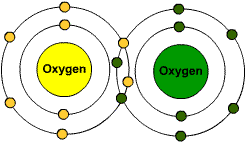
Which Lewis Dot Model drawing correctly shows an O2 molecule?


a noble gas
other elements in its family
other elements in its period
it used to have before reacting
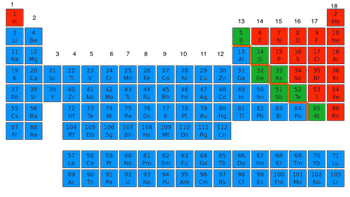
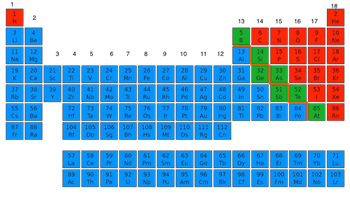
VSEPR theory is a model for predicting
ionization energy
the strength of metallic bonds
the shape of molecules
lattice energy values
Which of the following covalent bonds is the most polar?
H-N
H-C
H-H
H-F
A neutral group of atoms held together by covalent bonds is a
chemical formula
molecular formula
molecule
polyatomic ion
According to VSEPR theory, molecules adjust their shapes to keep which of the following as far apart as possible?
electrons closest to the nuclei
pairs of valence electrons
mobile electrons
protons
If the difference in electronegativity between two bonding atoms is less than 1.7 but greater than .03 the bond is
ionic
polar covalent
metallic
nonpolar covalent

The red dots indicate .
(a)

What type of bond is pictured?
Ionic bond
Single Covalent Bond
Double Covalent Bond
Triple Covalent Bond

How many lone pairs are pictured?
0
2
3
4

Which is the correct molecular structure for carbon dioxide?


Electronegativity _______ across a period and ______ down a group.
increases, increases
increases, decreases
decreases, increases
decreases, decreases
Which of these atoms is the most electronegative?
Bromine
Fluorine
Hydrogen
Potassium
Electronegativity refers to an atom's ability to _____________ shared electrons in a covalent bond.
attract
donate
The polarity of a bond is determined by...
The sum of the electronegativities of the two atoms
The difference in the electronegativities of the two atoms
The charges of the atoms
None of the Above
What must the difference in electronegativity between two atoms be in order for the bond between them to be nonpolar covalent?
less than 0.4
greater than 1.7
between 0.4 and 1.7
exactly 0


What is the name of this compound? (HINT: think of what the formula for this compound would be)
P2O5
Phosphorous PentaOxide
Diphosphorous pentaoxide
Phosphourous Oxide

