
Font size
 Worksheets
7th_Topic 2_Lesson 2
Total questions: 14
Worksheet time: 8mins

Solid sodium carbonate is added to vinegar in a beaker and stirred.
The water in the watch glass freezes.
Which statement about the reaction explains why the water freezes?
It is a redox reaction.
It is an endothermic reaction.
It is catalysed by sodium carbonate.
It is thermal decomposition.

The diagram shows how the temperature change is measured when magnesium powder reacts with dilute hydrochloric acid. Thermometer reading before adding magnesium powder = 20.6 °C Thermometer reading after adding magnesium powder = 32.4 °C Which statement is correct?
The reaction is endothermic and gives out heat.
The reaction is endothermic and takes in heat.
The reaction is exothermic and gives out heat.
The reaction is exothermic and takes in heat.

The energy level diagram for a reaction is shown.
Which statement is correct?
X is the energy change of the reaction.
Y is the activation energy of the reaction.
The energy change of the reaction is larger than the activation energy of the reaction.
The reaction is exothermic.

Choose the best description below for the image
physical change
chemical change

Which of the following are physical properties of the matter pictured?
Check all that are true
reacts to oxygen
smooth
malleable (bendable)
reddish-brown
shiny
Which of these actions cause a PHYSICAL change?
rusting of metal pipes
burning a log
cooking an egg
crushing an aluminum can
Salt water, a mixture, is made by dissolving salt in water. Mixtures like this can be separated by using the physical properties of the mixture. Which would be the best way to separate a mixture made of salt and water?
evaporation
chromotography
magnetism
filtering
How does a catalyst work in speeding up a reaction?
By lowering the activation energy or reaction
by giving them more energy
by making them more available

Which factors increase the rate of a reaction?
increasing temperature
increasing concentration
increasing total surface area
All of these
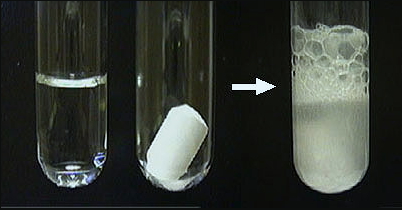
How could we make this reaction happen more quickly?
Decrease the concentration of the acid
crush the chalk to increase the surface area
Put the test tube in an ice bath

Which group of particles shows that increasing surface area increases collisions among particles?
Left side
Right side
Cannot be determined by either picture
A powdered zinc reacts vigorously with hydrochloric acid. If you want to slow down the reaction, what could you do?
Heat it up on a hotplate
use a large chunk of zinc.
add more particles of hydrochloric acid

