
 Worksheets
Periodic Table Exam Review
Total questions: 75
Worksheet time: 50mins
What element has the lowest electronegativity value with the following elements?
Rubidium (Rb)
Silver (Ag)
Oxygen (O)
Hydrogen (H)
Which of the following elements is in the same period as Neon
Argon
Nitrogen
Potassium
None of these
The horizontal row in the periodic table is
(choose the best answer)
a group
full of elements
a period
contains no elements
Which of the following is a halogen?
Neon
Oxygen
Flourine
Molybdenum
As you move left to right across a period, ionization energy
increases
decreases
says the same
Ionization Energy is
The ability of an atom to attract another atom's electrons
The ability of an atom to react with water
The energy required to remove an atom's electron
The distance from the nucleus to the outer electrons
Which of the following atoms would have the largest radius?
chlorine
silicon
sodium
argon
What element has the lowest electronegativity value with the following elements?
Rubidium (Rb)
Silver (Ag)
Oxygen (O)
Hydrogen (H)
Which of the following elements is in the same period as Neon
Argon
Nitrogen
Potassium
None of these
Which of the following will have a lower ionization energy than Scandium (Sc)?
Helium (He)
Titanium (Ti)
Calcium (Ca)
Magnesium (Mg)

Which of the following halogens has the greatest electronegativity?
Chlorine (Cl)
Bromine (Br)
Iodine (I)
Astatine (At)
What is the amount of energy required to remove an electron from an atom?
atomic energy
ionization energy
ionic energy
electron energy
What is one-half the distance between the nuclei of identical atoms that are bonded together?
atomic radius
atomic diameter
atomic width
atomic length
What is a measure of the tendency of an atom to attract a bonding pair of electrons when the atom is in a compound?
ionization energy
electropositivity
electronegativity
electron energy
Elements in the same column of the periodic table always have the same number of _______ as one another.
Copper is a common metal. Which of the following properties does this metal most likely have?
High conductivity, high malleability, and low luster
Low conductivity, low malleability, and low luster
High conductivity, high malleability, and high luster
Low conductivity, high malleability, and high luster
Name this group: These metals are the most reactive.


by alphabetical
by density
by melting point
by atomic mass


Neon is colorless, a poor conductor of heat and is not able to be stretched. How would it be classified?
Nonmetal
Metalloid
Metal
None of the above
Manganese is shiny, conducts heat and electricity, and can be hammered into thin sheets. What is is?
Nonmetal
Metal
Metalloid
None of the above
What properites do nonmetals have in common?
Poor conductor of electricity
Good conductor of thermal energy
Soft and Malleable
Shiny, lustrous surface

Where are the nonmetals located on the Periodic Table?
On the right
On the left
On the stairstep

Where are the metalloids located on the Periodic Table?
On the right
On the left
On the stairsteps
What is iron's atomic number?
12
26
55.85
55
What is the chemical symbol for iron?
I
Ir
Fe
R
Titanium is in group 4. What period is it in?
2
3
4
5
Zinc is in period 4. What group is it in?
12
13
14
15
What family is copper in?
alkali metals
alkaline earth metals
noble gases
transition metals
Krypton is in what group?
16
17
18
19
What family is on the far left of the periodic table?
noble gases
alkali metals
transition metals
actinoids
What family is on the far right of the periodic table?
alkali metals
transition metals
actinoids
noble gases
Which pair of properties describes the elements in Group 1?
They are chemically stable
They have 8 valence electrons
They are the most reactive metals
They are the most reactive non metals

What property does element X have based on its location in the periodic table?
Highly reactive gas
Manmade radioactive substance
Nonreactive nonmetal
Metallic solid
Which two families have been taken out of the middle and placed at the bottom of the periodic table
Halogens and Oxygen Group
Lanthanides and Actinides
Alkali Metals and Alkaline Earth Metals
Metalloids and Nonmetals
Malleable means...
Breaks Easily
Gets Hot
Can be hammered into thin sheets or formed into wires.
Can be bent and will not break.
Select the sequence that correctly orders from smallest to largest atomic radius
Sn, Y, Ru
Cu, Ga, Br
Al, S, Na
F, N, Li
Select the group that is the most reactive metals
Transition Metals
Alkali Earth Metals
Alkali Metals
Halogens
Select the element with the highest ionization energy
Sodium
Aluminum
Phosphorous
Chlorine
Select the element Alkali Earth Metal found in Period 4
Calcium
Potassium
Titantium
Krypton
Select the element that is a metalloid
Gallium
Boron
Oxygen
Magnesium
Select the element below that is least reactive
Hydrogen
Chlorine
Lithium
Neon
Select the element with the largest atomic radius
Cesium
Lithium
Hydrogen
Potassium
Select the element with the highest electronegativity
Chlorine
Silicon
Argon
Magnesium
Select the element that has 3 valence electrons
Calcium
Sodium
Aluminum
Sulfur
Select the element that is a nonmetal
Copper
Lead
Hydrogen
Sodium
Select the sequence of increasing electronegativity.
Sn, Ag, I
I, Sn, Ag
Ag, Sn, I
Sn, I, Ag
Select all elements that are metals
Thallium
Hydrogen
Sulfur
Argon
Chromium
Select the element with the lowest ionization energy.
Barium
Beryllium
Magnesium
Strontium
What group contains elements with 7 valence electrons
Noble Gasses
Alkali Earth Metals
Halogens
Transition Metals

What happens to the force between two charged objects when you double the distance between them?
it doubles
it is cut in half
it quadruples
it is cut by 1/4
Electronegativity is
the ability of an atom to accept/ attract electrons
the energy required to remove an electron from an atom in a gaseous or ion state
a life philosophy (the glass is half empty)
the ability of an atom to lose electrons
As you move down the periodic table, atoms tend to get bigger because...
They have more mass
They have more protons
They have more energy levels
They have more mass
Ionization energy is ....
the energy required to add an electron to an atom
the energy required to shield the outer electrons from the nucleus
a measure of the ability of an atom to attract electrons
how much energy it takes to remove an electron from an atom
An element has similar chemical properties as oxygen and selenium. It has an atomic number greater than krypton but less than iodine. Use the periodic table to identify the element
selenium
polonium
tellurium
sulfur

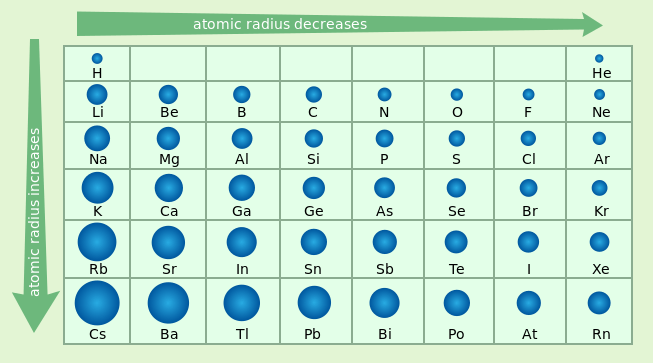
Which would be a correct title for this diagram?
Electronegativity trends
Atomic Radius trends
Atomic Mass trends

Select all the nonmetals (choose all that apply)
H
P
In
Na
Which of the following is a metalloid?
Pb
Bi
Po
Which of the following has an electron distribution ending in s2p1?
Na
Mg
Al
Which of the following is a gas at room temperature?
B
C
N
Of the following elements, which is most likely to form a negative ion with a charge of 1-?
Ba
Ca
Si
P
Cl

Most of the elements on the periodic table are nonmetals.
True
False

Which group of elements has the lowest ionization energies?
Alkali Metals (Group 1)
Alkaline Earth Metals (Group 2)
Halogens (Group 17)
Noble Gases (Group 18)

