
 Worksheets
Friction and Motion
Total questions: 50
Worksheet time: 8hrs 20mins
m
s
m/s
What is the speed of a car travelling 50m in 4s?
200 m/s
12.5 m/s
12.5 m
200m
How far does a lorry move if it is travelling at 12m/s for 180s?
2160 m
0.06 m
15 m
21.6 m
How long does it take a car to travel 40m at 12m/s?
4.8 s
480 s
3.33 s
33.3 s
What is the speed of a car that travels 0.5 km in 1 min?
0.5 m/s
8.33 m/s
0.008 m/s
500 m/s
How far does a truck move if it's travelling at 15m/s for 20 min?
18000 m
300 m
0.75 m
180 km
How long does it take to travel a distance of 2 km at a speed of 16 m/s?
32 s
32000 s
0.125 s
125 s
The team of 8 rowers row 500 m in 180 s. If they keep going at the same speed, how long does it take them to row 2 km?
2.78 s
12 min
725 s
90000 s
the unit of acceleration is
(m/s2)
jouls
m
s
A negative acceleration means that your object is
constant
speeding up
at rest
slowing down
A positive acceleration means that your object is
at rest
speeding up
moving
slowing down
When is an object under uniform acceleration?
none of the following
when the direction is straight
when the velocity change is constant per unit time
when the time is constant
A bus starts from rest and accelerates to 14 m/s in 4 s. What is the average acceleration of the bus?
3.5 m/s2
5.9 m/s2
10.5 m/s2
24 m/s2
1. Change in speed = 14 m/s; time taken = 2 seconds. The acceleration is....
6 m/s2
7 m/s
7m/s2
6 m/s
A cyclist in the Tour de France accelerates down a hill from 22 m/s to a speed of 37 m/s. This acceleration takes him 2 seconds. The acceleration is...?
7.5 m/s2
11 m/s2
18.5 m/s2
44 m/s2
To calculate the acceleration we use the formula.....
a=tΔv
a=tΔd
a=Δv×t
a=Δvt
1. If a Ferrari accelerates at a rate of 50 m/s2 for 3 seconds, what will its change in velocity be?
50 m/s
53 m/s
16.67 m/s
150 m/s
To calculate the time that a change in speed needed to take happen for a certain acceleration rate we use the formula.....
t=Δv×t
t=aΔv
t=Δv×a
t=Δva
To calculate the change in speed if we know the acceleration and the time it was accelerating for we use the formula.....
Δv=ta
Δv=at
Δv=a×t
A horse accelerates from 5 m/s to 10 m/s with acceleration of 2 m/s2. For how many seconds did it accelerate for?
20 s
10 s
5 s
2.5 s

Which runner stopped for a rest?
Albert
Bob
Charlie
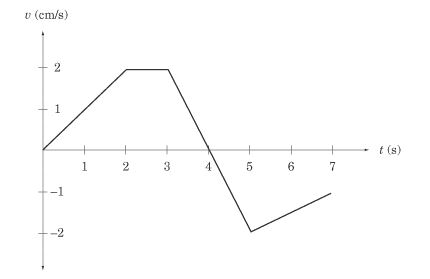
What is happening between 2 and 3 seconds?
The object is not moving.
The object is not accelerating.
The object is slowing down.
The object is speeding up.

What is happening between 3 seconds and 4 seconds?
The object is moving in a negative direction.
The object is returning to its starting position.
The object is slowing to a stop.
The object is changing direction.

During which interval is the object traveling at a constant velocity?
B to C
D to E
F to G
All of the above

During which intervals is the object speeding up?
A to B
B to C
D to E
G to H

This distance-time graph shows an object that is
Accelerating
Moving with constant speed
Decelerating
Stationary

This distance-time graph shows an object that is
Increasing speed away from the start
Moving away from the start at a constant speed
Decreasing speed toward the start
Moving toward the start at a constant speed

This distance-time graph shows an object that is
Increasing speed toward the start
Moving away from the start at a constant speed
Decreasing speed away from the start
Moving toward the start at a constant speed


This speed-time graph shows an object that is
Moving with constant speed
Accelerating
Decelerating
Stationary

This speed-time graph shows an object that is
Moving with constant speed
Accelerating
Decelerating
Stationary

This speed-time graph shows an object that is
Moving with constant speed
Accelerating
Decelerting
Stationary

This speed-time graph demonstrates an object that is
Moving with constant speed
Accelerating
Decelerating
Stationary


What is the velocity at 12.5 seconds?
0 m/s
2 m/s
10 m/s
20 m/s
What is the displacement from 0-10 seconds?
10 m
10 m
100 m
200 m
What is the acceleration during interval A?
0 m/s/s
2 m/s/s
10 m/s/s
20 m/s/s

What is occurring on this graph?
Negative acceleration
moving at a constant speed in the positive direction
positive acceleration
negative net force
Static Friction is present only when an object is at rest.
True.
False.
A 2.0-N force acts horizontally on a 10-N block that is initially at rest on a horizontal surface. The coefficient of static friction between the block and the surface is 0.50.What is the magnitude of the frictional force that acts on the block?
5 N
8 N
2 N
0 N
Static and kinetic friction can be present simultaneously.
True
False.
The mass of a brick is 5kg, and it is stationary. What is the maximum static friction if the coefficient is 0.66?
3.3
33
3.3N
33N
There are 25N of friction that keep a 10kg brick moving at a constant rate. What is the coefficient of friction?
0.25
0.25N
4
4N

