
 Worksheets
Topic 1 Exam Review
Total questions: 220
Worksheet time: 7hrs 49mins

What is the maximum height?
200
50
3
0
When is the maximum height reached?
200
50
3
0

At what time is the ball 128 feet off the ground? Select all that apply.
1
2
3
4
5

How long is the ball's height decreasing?
2 seconds
5 seconds
6 seconds
3 seconds

What is the minimum of the blue function?
y = -2
y = 1
y = -4
y = 0
What is the minimum of the red function?
y = -1.75
y = 1
y = 1.5
y = 0
Which comparison is correct?
The blue graph has a smaller minimum than the red graph.
The red graph has a smaller minimum than the blue graph.
The red and blue graph have the same minimum value.
The red graph has a larger maximum than the blue graph.
Which comparison is correct?
The blue graph has a smaller y-intercept than the red graph.
The red graph has a smaller x-intercept than the blue graph.
The red and blue graph have the same y-intercept.
The red graph doesn't have a y-intercept and the blue graph does.
What is the y-intercept of the red graph?
(0, 1)
(1, 0)
(2.5, 0)
(0.5, 0)
What is the y-intercept of the blue graph?
(0, 0)
(-2, 0)
(0, 2)
(2, 0)

What is the range of the graph?
[-7, 5)
(-3, 1]
[-3, 1)
(-7, 5]

What is the domain?
[-2, 3]
[-2, 3)
(-2, 3]
[-3, 4]
(-3, 4]
What is the range?
[-3, 4]
(-3, 4)
(-3, 4]
(-2, 3]
[4, -3]

What is the domain?
(−∞, −3]
[3, −∞)
(−∞,3]
(−∞,∞)
None of the answer choices
What is the range?
(−∞, −3]
[3, −∞)
(−∞,3]
None of the answer choices
[−3, ∞)

What is the domain?
(∞,−2]
[−2, ∞)
[-2,3]
(−∞, −2]
None of the answer choices
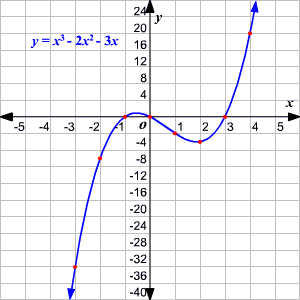

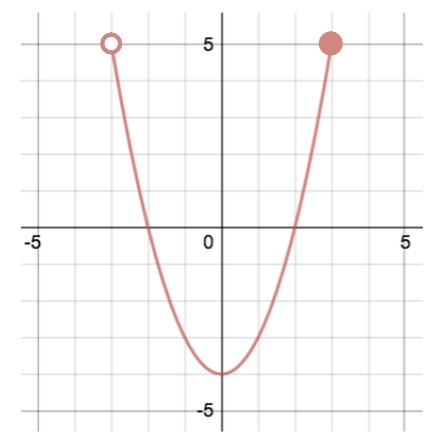


What is the range of the graph?
[-15, 9]
(-∞, ∞)
(-15, ∞)
[-15, ∞)
The set of all y-values used to graph a function are called the ____.
Domain
Range
Relation
Function
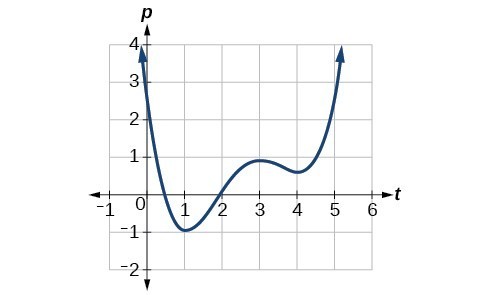
In interval notation, positive and negative ∞ are always closed in by ______.
( ) Parentheses
[ ] Square Brackets
{ } Curly Brackets
DOMAIN is found by reading the ends of a graph from ___ to ___.
Right to left
Left to right
Bottom to top
Top to bottom
RANGE is found by reading the ends of a graph from ___ to ___.
Right to left
Left to right
Bottom to top
Top to bottom
The set of all x-values used to graph a function are called the ____.
Domain
Range
Relation
Function

Is the function positive or negative from a to b?
Positive
Negative
Is the function positive or negative from c to d?
Positive
Negative
Is the function positive or negative from d to e?
Positive
Negative
Is the function positive or negative from −∞ to a?
Positive
Negative
Is the function positive or negative from b to c?
Positive
Negative
Is the function positive or negative from g to ∞ ?
Positive
Negative

Is the function increasing or decreasing on the interval from e to ∞ ?
Increasing
Decreasing
Is the function increasing or decreasing on the interval from c to d?
Increasing
Decreasing
Is the function increasing or decreasing on the interval from −∞ to a?
Increasing
Decreasing
Is the function increasing or decreasing on the interval from b to c?
Increasing
Decreasing
Is the function increasing or decreasing on the interval from d to e?
Increasing
Decreasing

It is positive and increasing
It is positive and decreasing
It is negative and increasing
It is negative and decreasing.

It is positive and increasing
It is positive and decreasing
It is negative and increasing
It is negative and decreasing.

It is positive and increasing
It is positive and decreasing
It is negative and increasing
It is negative and decreasing.

It is positive and increasing
It is positive and decreasing
It is negative and increasing
It is negative and decreasing.

It is positive and increasing
It is positive and decreasing
It is negative and increasing
It is negative and decreasing.

The shaded area represents ___________?
Decreasing Interval
Increasing Interval
Constant Interval
Positive Interval
Negative Interval

The shaded area represents ___________?
Decreasing Interval
Increasing Interval
Constant Interval
Positive Interval
Negative Interval

The shaded area represents ___________?
Decreasing Interval
Increasing Interval
Constant Interval
Positive Interval
Negative Interval

The shaded area represents ___________?
Decreasing Interval
Increasing Interval
Constant Interval
Positive Interval
Negative Interval

The shaded area represents ___________?
Decreasing Interval
Increasing Interval
Constant Interval
Positive Interval
Negative Interval

The shaded area represents ___________?
Decreasing Interval
Increasing Interval
Constant Interval
Positive Interval
Negative Interval

The shaded area represents ___________?
Decreasing Interval
Increasing Interval
Constant Interval
Positive Interval
Negative Interval

The shaded area represents ___________?
Decreasing Interval
Increasing Interval
Constant Interval
Positive Interval
Negative Interval

The shaded area represents ___________?
Decreasing Interval
Increasing Interval
Constant Interval
Positive Interval
Negative Interval

The shaded area represents ___________?
Decreasing Interval
Increasing Interval
Constant Interval
Positive Interval
Negative Interval

The shaded area represents ___________?
Decreasing Interval
Increasing Interval
Constant Interval
Positive Interval
Negative Interval

The shaded area represents ___________?
Decreasing Interval
Increasing Interval
Constant Interval
Positive Interval
Negative Interval

The shaded area represents ___________?
Decreasing Interval
Increasing Interval
Constant Interval
Positive Interval
Negative Interval

The shaded area represents ___________?
Decreasing Interval
Increasing Interval
Constant Interval
Positive Interval
Negative Interval

The shaded area represents ___________?
Decreasing Interval
Increasing Interval
Constant Interval
Positive Interval
Negative Interval

The shaded area represents ___________?
Decreasing Interval
Increasing Interval
Constant Interval
Positive Interval
Negative Interval


What is the slope?
7
4
3
0

What is the slope?
2
-2
6
0


This is a _______________ function.
Linear
Exponential
Quadratic

Name the parent function.
quadratic
cubic
square root
logarithmic

Which is the set of all y-values or the outputs?
Domain
Range
Relation
Function
Describe the transformation
f(x)+3
3 Units Up
3 Units Down
3 Units Left
3 Units Right
Describe the transformation
f(x−2)
2 Units Up
2 Units Down
2 Units Left
2 Units Right
Describe the transformation
f(x+5)
5 Units Up
5 Units Down
5 Units Left
5 Units Right
Describe the transformation
f(x)−6
6 Units Up
6 Units Down
6 Units Left
6 Units Right
Describe the transformation
f(x)−6
6 Units Up
6 Units Down
6 Units Left
6 Units Right
Describe the transformations
g(x+4)−6
4 Units Left
6 Units Up
4 Units Left
6 Units Down
4 Units Right
6 Units Up
4 Units Right
6 Units Down
Describe the transformations
−g(x)+2
Reflected across the x-axis
2 Units Up
Reflected across the x-axis
2 Units Down
Reflected across the y-axis
2 Units Up
Reflected across the y-axis
2 Units Down
Describe the transformation
3h(x)
Vertically Stretched by a factor of 3
Vertically Compressed by a factor of 3
Horizontally Stretched by a factor of 3
Horizontally Stretched by a factor of 3
Describe the transformations
g(−x)−4
Reflected across the x-axis
4 Units Left
Reflected across the x-axis
4 Units Down
Reflected across the y-axis
4 Units Left
Reflected across the y-axis
4 Units Down
y = g(x) to y = - g(x + 6) - 10
Shifted down 10 units
Shifted left 6 units
Shifted up 10 units
Shifted left 6 units
Shifted up 10 units
Shifted right 6 units
Shifted down 10 units
Shifted left 6 units

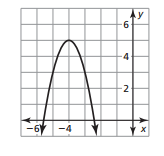
If the blue is f(x)=x2, then the red must be

What is another word for translation?
Slide
Turn
Shrink
Flip
What is another word for rotate?
Turn
Flip
Slide
Shrink
f(x) = 3 Ix+8I


f(x) = IxI -5
y = (x - 3)2

Given the function y=(x+4)2+2 , what is the parent function?
y=x2
y=a(x−h)2+k
y=mx+b
y=0(x−0)2+0
Write the equation that results if the parent absolute value function is shifted right 15 units, down 3 units, and reflected vertically.
y=−∣x−15∣−3
y=−∣x+15∣−3
y=21∣x+3∣−15
y=21∣x−3∣−15
y=∣−x−15∣−3
Describe the transformation of the equation below from the absolute value parent function
y=−2∣x−3∣+3
reflected over x axis, stretched by 2, right 3, up 3
reflected over x axis, stretched by 2, left 3 up 3.
reflected over x axis, shrunk by 2, right 3, up 3
reflected over the x axis, shrunk by 2, left 3, up 3
What steps transform the graph y=x2 to y=−21(x−4)2+1 ?
Compressed by 1/2, shifted 4 units right and 1 unit up
Reflected across x-axis, compressed by 1/2, shifted 4 units right and 1 unit up
Reflected across x-axis, stretched by 1/2, shifted 4 units left and 1 unit up
Stretched by 1/2, shifted 4 units right and 1 unit down
Up 2
Up 2
Down 2
Down 2

If the blue is f(x)=x2, the red must be
- f(x+2)


y = -2|x|


If f(x) is the red graph and g(x) is the blue graph, what transformation changes f(x) to g(x)?
translation
rotation
reflection
vertical stretch
Which function DOES NOT represent a horizontal shift of the function f(x)=x2
g(x)= x2+3
g(x)= (x+3)2
g(x)= (x-3)2
g(x) =(x-2)2

What is the equation of this parent graph?
y=∣x∣
y=x2
y=x
y=x3
y=bx

If the parabola with the purple solid line is the parent, which parabola has a>1
RED one with the
dashed line
Not enough information to tell.
BLUE on with the
dotted line
The all have the same a.

The parabola with the solid PURPLE line is the parent. Which parabola has a larger positive value for k?
The RED one with the dashed line
Not enough information to tell
The BLUE one with the dotted line
They have the same k value

Find g(7)


What is the domain interval for the green piece of this function?
-2 < x ≤ 1
-1 < x ≤ 0.5
x > -2
x ≤ 1

Find f(0)
0
19
9
-19

How many "pieces" are graphed in this function?
1
2
3
4


Find f(0)
-3
18
4
0

Match the graph with the correct equation.


Match the graph with the correct equation.


Find f(2)
f(2) = 0
f(2) = 1
f(2) = 3
f(2) = 4

Graph the function


What is f(4)?
What is the domain interval for the green piece of this function?
-2 < x ≤ 1
-1 < x ≤ 0.5
x > -2
x ≤ 1
Evaluate f(0)
0
19
9
-19
What is the domain interval for the green piece of this function?
-2 < x ≤ 1
-1 < x ≤ 0.5
x > -2
x ≤ 1


Graph


Graph


Graph

Graph


Graph

Graph


Graph


Which of the piecewise functions matches this graph?


Graph


Graph

Graph


Graph

Match the graph with the correct equation.


Which of the piecewise functions matches this graph?
Match the graph with the correct equation.


4-x for x<2
2x-6 for x>=2

Match the graph with the correct equation.


What is the domain of the Green line?
all real numbers
x=-1
x≤-3
x<-3

What is the domain to the blue line?
-3<x<1
-3≤x≤1
all real numbers
x≤-3, x≥1

What is the domain of the last line segment?
3<x≤5
3≤x≤5
-3≤x<-2
3≤x<5
Match the graph with the correct equation.

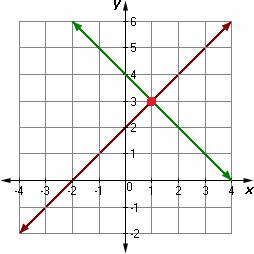
Find the solution(s) of the following equation: (Round the solutions to the nearest tenth)
Select all that apply
x2−4=3x−1
-0.8
3.4
3.8
10.4
No solutions
Find the solution(s) of the following equation: (Round the solutions to the nearest tenth)
Select all that apply
∣x−4∣=−x−5
3
1
4
0
No solutions
Find the solution(s) of the following equation: (Round the solutions to the nearest tenth)
Select all that apply
5=x2+3
1.4
-1.4
5
3
No solutions
Find the solution(s) of the following equation: (Round the solutions to the nearest tenth)
Select all that apply
∣x−3∣=x2+4
4
0
3
5
No solutions
5 ≥ x
Use a graph to solve the equation.
4x+6=8x−10
0
4
-4
1
Use a graph to solve the equation.
−43x−2=−21x+1
0
-12
12
5
Use a graph to solve the equation. Select all that apply.
∣4−2x∣+5=9
0
-4
4
5
Use a graph to solve the inequality.
x2+4x−5<0
−5<x<1
−5≤x≤1
5<x<−1
−1>x>5
Use a graph to solve the inequality.
x2−x−12≥0
−3<x<4
x≤−3 or x≥4
x>−3 or x<4
x≥3 or x<−4
Use a graph to solve the inequality.
−2x+5<−7−3x
x<−12
x≤−12
x>−12
x≥−12
Use graphing technology to approximate the solutions of the equation to the nearest tenth.
31x2+2x−9=6+∣x−2∣
-12.9
12.9
-4.9
4.9
Use graphing technology to approximate the solutions of the equation to the nearest tenth.
x2+5x−2=6+∣3x+1∣
-8.8
8.8
-2.2
2.2
Use graphing technology to approximate the solutions of the equation to the nearest tenth.
3+∣x−3∣=31∣x+2∣+5
-0.3
0.3
-8.5
8.5
Solve the system of equations by graphing:
x+y=6
x−y=2
Enter your answer as an ordered pair - (x,y)
(a)
Solve the system:
4x+3y=−16
−x+y=4
Choose the TWO correct answers
x=-4
y=0
y=-4
x=0
x=4
Solve the system of equations. Write your answer as an ordered pair.
y=7−x
x+3y=7
(a)
Solve the inequality. Write your answer as an ordered pair.
2x−4y=−4
3x−y=4
(a)

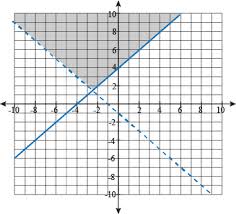
Solve the system of inequalities by graphing.


Identify each choice below that is a solution for the graph
(2, 3)
(4, -2)
(2, -4)
(-2, 0)
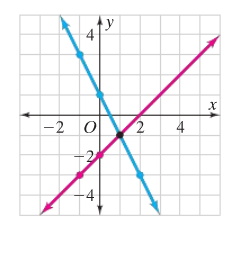
What is the solution to the system of equations? Write your answer as an ordered pair.
(a)


How many solutions?

HINT: - 1/3x + 4 = 2/3x + 1 and then solve for x. Once you find x go back and find y.
y = 2x + 1
y = 4x - 1
y = 3x - 8
y = 4 - x
y = 2/3x - 2
y = -x + 3
3x + 2y = 16
7x + y = 19


y < 2
y < 2
y < 2
y < -2

y < x + 4
y ≥ x + 4
y ≥ x + 4
y ≥ x + 3

1) Solve the system of linear equations.
(-1, 5, 2)
(1, -5, -2)
no solution
infinitely many solutions

2) Solve the system of linear equations.
(-1, 1, 2)
(2, 1, -1)
no solution
infinitely many solutions

3) Solve the system of linear equations.
(3, 1, -5)
(-3, 1, -1)
no solution
infinitely many solutions

4) Solve the system of linear equations.
(1, -3, -4)
(-1, 3, -4)
no solution
infinitely many solutions

7) Solve the system of linear equations.
(3, -1, -4)
(-3, 1, 4)
no solution
infinitely many solutions

8) Solve the system of linear equations.
(3, -1, 1)
(-3, -1, -1)
no solution
infinitely many solutions

