wayground logo

Free Printable Worksheets

Font size

S
M
L
XL
Worksheets

CPCTC

Total questions: 36

Worksheet time: 45mins

Name
Class
Date
1.
What does CPCTC stand for?
a)
Congruent parts of congruent triangles are congruent
b)
Corresponding parts of congruent triangles are congruent
c)
Corresponding parts of corresponding triangles are corresponding
d)
Corresponding parts of congruent triangles are Canadian.
2.
What congruency postulate proves the triangles congruency?
a)
SAS
b)
ASA
c)
SSS
d)
HL
3.
What postulate would prove triangle ∆NYQ is congruent to ∆PYQ?
a)
ASA
b)
SAS
c)
SSS
d)
HL
4.
Fill in the blank.
a)
Given
b)
Reflexive Property
c)
Transitive Property
d)
They're the same side!!!!!! 
5.
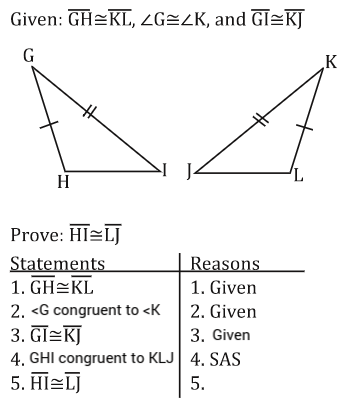
What is the correct choice for Statement 5?
a)
SAS
b)
Definition of Congruence
c)
Prove
d)
CPCTC
6.
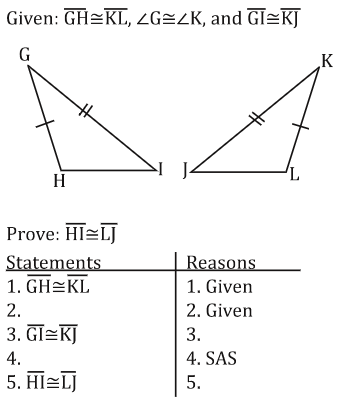
What is the correct choice for Statement 2?
a)
Segment GH ≅ Segment KL
b)
∠G ≅ ∠K
c)
Segment GI ≅ Segment KJ
d)
Segment HI ≅ Segment LJ
7.
What is the reason?
a)
Definition of Angle
b)
Definition of Congruence
c)
Definition of bisects
d)
Definition of midpoint
8.
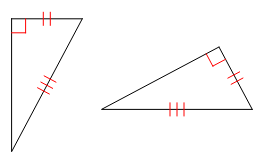
What postulate proves these triangles congruent?
a)
HL
b)
SSS
c)
SAS
d)
ASA
9.
What postulate proves these triangles congruent?
a)
SAS
b)
HL
c)
AAS
d)
ASA
10.
What postulate proves these triangles congruent?
a)
SAS
b)
ASA
c)
AAS
d)
Not enough information
11.

Fill in the two missing steps in the proof.

a)

Transitive Property, SAS (Side-Angle-Side)

b)

Reflexive Property, SAS (Side-Angle-Side)

c)

Reflexive Property, Vertical Angles Theorem

d)

Transitive Property, SSS (Side-Side-Side)

12.

Select all of the FALSE reasons below.

a)

Definition of Angle

b)

Definition of Bisector

c)

Definition of Congruence

d)

Definition of Midpoint

e)

Definition of Reflexive

13.
State if the two triangles are congruent.  If they are, state how you know.
a)
A
b)
B
c)
C
d)
D
14.
State if the two triangles are congruent.  If they are, state how you know.
a)
A
b)
B
c)
C
d)
D
15.
What additional information is required for the 2 triangles to be congruent by ASA?
a)
A
b)
B
c)
C
d)
D
16.

Determine the correct response for #5 in the proof.

a)

All right angles are congruent

b)

Reflexive Property

c)

Triangle HEF is congruent to Triangle GFE

d)

Corresponding Parts of Congruent Triangles are Congruent

17.

Determine the correct response for #2 in the proof.

a)

All right angles are congruent

b)

Reflexive Property

c)

Triangle HEF is congruent to Triangle GFE

d)

Corresponding Parts of Congruent Triangles are Congruent

18.

Explain how you would prove that line AB is congruent to line DE

a)

AAS and CPCTC

b)

SAS and CPCTC

c)

ASA and CPCTC

d)

HL and CPCTC

19.
When can we use the HL Congruence Theorem?
a)
Right Triangles
b)
Isosceles Triangles
c)
When we have a reflexive side
d)
SSA
20.
Can the HL Congruence Theorem be used to prove the triangles congruent? If so, write a congruence statement.
a)
Yes, △ABC≅△NLM
b)
Yes, △CBA≅△NLM
c)
Yes, △CBA≅△MLN
d)
No
21.

State if the two triangles are congruent. If they are, state which theorem you would use.

a)

Yes, SAS

b)

Yes, SSS

c)

Yes, HL

d)

Yes, SSA

e)

Not Congruent

22.

State if the two triangles are congruent. If they are, state which theorem you would use.

a)

Yes, SAS

b)

Yes, SSS

c)

Yes, HL

d)

Yes, ASA

e)

Not Congruent

23.

Determine the response for #4 in the proof.

a)

Given

b)

All right angles are congruent

c)

angle ECD is congruent to angle ACB

d)

triangle CDE is congruent to triangle CBA

e)

CPCTC

24.

Given: ∆MAN ≅∆DEN

∠M ↔ _

a)

∠N

b)

∠D

c)

∠E

d)

∠A

25.

Given: ∆MAN ≅∆DEN

∠E ↔ _

a)

∠A

b)

∠M

c)

∠N

d)

∠D

26.

Given: ∆MAN ≅∆DEN

∠END ↔ ___

a)

∠AMN

b)

∠NMA

c)

∠MNA

d)

∠ANM

27.

Given: ∆MAN ≅∆DEN
AN ↔ __

a)

NE

b)

EN

c)

DE

d)

MA

28.

∆EMA ≅ ∆ENA

a)

True

b)

False

29.

∆NEA ≅ ∆EAM

a)

True

b)

False

30.

∆EAN ≅ ∆AEM

a)

True

b)

False

31.

∆NAE ≅ ∆MAE

a)

True

b)

False

32.

Given: ∆MAN ≅∆DEN
∠D ↔ __

a)

∠A

b)

∠M

c)

∠E

d)

∠N

33.

Given: ∆MAN ≅∆DEN
MA  ↔ __

a)

ED

b)

DE

c)

DN

d)

NE

34.

Given: ∆MAN ≅∆DEN
NE  ↔ __

a)

NA

b)

AN

c)

NM

d)

MA

35.

Given: ∆MAN ≅∆DEN
MN  ↔ __

a)

ND

b)

DE

c)

DN

d)

EN

36.

Given: ∆MAN ≅∆DEN
ND  ↔ __

a)

MN

b)

NM

c)

NA

d)

AM