
 Worksheets
Chemical Bonds and Periodic Table Review
Total questions: 50
Worksheet time: 49mins

This is a correct dot diagram for neon (Ne)
true
false


Which is the correct molecular structure for carbon dioxide CO2?



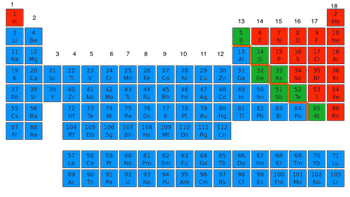
Where are metals located on the periodic table?
right side of the staircase
on the staircase
left side of the staircase

H2O has how many covalent bonds?
0
1
2
3

How many covalent bonds in this molecule
1
2
3
4

N2 is an example of a
Single Bond
Double Bond
Triple Bond

Chloroform was used as anesthesia and a sedative a long time ago. Which of these is the probable formula of the molecule shown?
Cl2
C6H12O6
CHCl3
CH4
H2O

This could be the dot diagram of
Mg
Cl
C
O
What is the goal of the Lewis Dot Structure?
To determine the electron position.
To show the element's valence electrons & bonding capabilities.
To find the atomic mass of an element.
To search for the number of electrons in an individual atom.

This is a correct dot diagram for carbon (C)
true
false
Which of the following is the correct electron-dot diagram for an atom with an electron configuration of 2-8-18-5?


Bohrs Model of the Atom shows ______ orbiting the nucleus in certain energy levels. Similar to how planets orbit the sun.
Protons
Neutrons
Electrons
I have recorded the valence numbers on my periodic table.
Yes
I do not have a copy of the periodic table
How many valence electrons does Be have?
2
4
5
9
Which element is in group 14 and period 3?
N
Na
Si
Li
Which element is in group 11 and period 5?
Na
B
Ag
Rb
How many valence electrons does Xenon have?
54
131
8
18
In what section of the periodic table can Silver be found?
Alkali Metals
Noble Gases
Transition Metals
Rare Earth Elements
An atom that gains or loses an electron becomes
an isotope
a new element
an ion
a molecule
What type of bond forms CaF2
covalent bond
ionic bond
metallic bond
all answers are correct

How many electrons (total) does Si contain when it is neutral?
14
28
2
4
What are the columns referred to on the Periodic Table of Elements?
Families or groups
Periods
What are the rows referred to on the Periodic Table of Elements?
Families or groups
Periods
Atomic Mass equals the combined number of
Protons and Electrons
Electrons and Neutrons
Protons and Neutrons
The number of valence electrons ________ by 1 as you move across the period.
increases
decreases
Aluminum has an atomic number of 13 and a mass number of 27. How many neutrons does Aluminum have?
13
14
27
40
Which of the following is a metal?
Lithium
Silicon
Sulfur
Boron
Which element is a member of the halogen family?
Sulfur
Chlorine
Argon
Carbon
Which element is a member of the noble gases?
Te
Iodine
Xenon
Nitrogen
Which of the following is a nonmetal?
Sulfur
Lithium
Sodium
Silicon
Which of the following is a transition metal?
Mercury
Oxygen
Calcium
Aluminum
Where are the metalloids located on the periodic table?
To the right of the staircase
On the staircase
To the left of the staircase
Who knows
What type of element loses electrons in order to achieve a stable valence shell?
Nonmetal
Metalloid
Alkali Earth Metal
They all lose electrons
This group is the most reactive of the metals
Alkali
Alkaline earth
Transition
Other metals
Which two elements are in the same period?
Sn and Rb
F and Cl
K and Ba
Se and Te
Which element has similar properties to magnesium?
Sodium
Aluminum
Calcium
Chlorine

This group contains two elements that are used for fertilizer, and it has one of the oldest poisons on earth.
oxygen family
noble gases
nitrogen family
carbon family

