wayground logo

Free Printable Worksheets

Font size

S
M
L
XL
Worksheets

Dna Midterm review

Total questions: 42

Worksheet time: 21mins

Name
Class
Date
1.
Which of the following units are repeatedly joined together to form a strand of DNA?
a)
amino acids
b)
nucleotides
c)
fatty acids
d)
polysaccharides
2.
The enzyme that unwinds the DNA to prepare for replication
a)
helicase
b)
replicase
c)
polymerase
d)
synthase
3.
DNA replication results in two DNA molecules,
a)
each one with two original strands
b)
each one with two new strands
c)
each one with one new strand and one original strand
d)
one with two new strands and the other with two original strands
4.
order of replication
a)
3, 4, 2, 1
b)
3, 1, 4, 2
c)
2, 1, 4, 3
d)
3, 4, 1, 2
5.
A process in which DNA has the unique ability to make an exact copy of itself.
a)
Replication
b)
Translation
c)
Transcription
6.
Which enzyme is responsible for adding nucleotides?
a)
Topoisomerase
b)
DNA Polymerase
c)
Ligase
d)
Primase
7.
The process of DNA replication is called semi conservative because it results in
a)
none of these
b)
Two DNA molecules.  One original molecule and one with two new strands
c)
two exact copies with new strands
d)
two identical molecules, each with 1 original strand and one new.
8.
Based on the diagram, how many origins of replication are represented?
a)
1
b)
2
c)
3
d)
4
9.
Why does DNA replicate?
a)
To create another copy for the new cell
b)
To create a duplicate copy in case the original gets damaged
c)
To create a new copy to replace the damaged original
10.
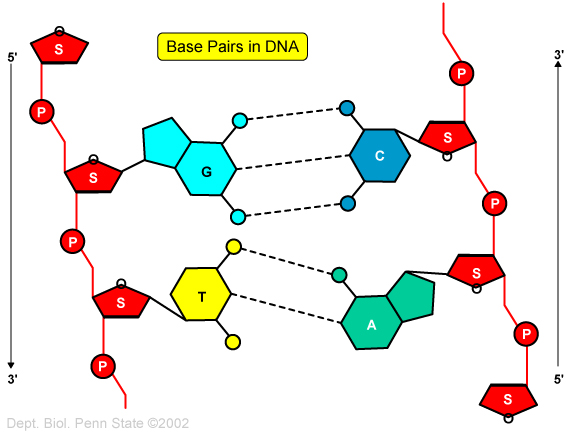
Nitrogenous bases are joined by which type of bond?
a)
polar bonds
b)
ionic bonds
c)
covalent bonds
d)
hydrogen bonds
11.
Adenine bonds with ______________.
a)
Guanine
b)
Thymine
c)
Cytosine
d)
Adenine
12.
Guanine bonds with ______________.
a)
Adenine
b)
Guanine
c)
Cytosine
d)
Thymine
13.
Why is DNA important?
a)
it is very small and very complicated
b)
it's in everything
c)
it serves as the blueprint for traits of all living things
d)
because we eat it every day for energy
14.
What does DNA stand for?
a)
Deoxyribonucleic acid
b)
Denitrogenous acid
c)
Deribonucleic acid
d)
Diribonucleic acid
15.
Which organelle is DNA usually found in?
a)
cell membrane
b)
vacuole
c)
chloroplast
d)
nucleus
16.
What nitrogen base pairs with adenine in DNA?
a)
T
b)
U
c)
C
d)
G
17.
Which nucleic acid is single stranded?
a)
RNA
b)
DNA
18.
Which nitrogen base pairs with T in mRNA?
a)
A
b)
U
c)
C
d)
G
19.
The mRNA codon UGA would correspond with which tRNA anticodon?
a)
ACT
b)
ACU
c)
UCU
d)
ACA
20.
A three base code for an amino acid is called a/an
a)
nucleotide
b)
deoxyribose sugar
c)
codon
d)
phosphate
21.
A nitrogen base, sugar and phosphate make up a unit that connects together to make a nucleic acid.  This unit is called a/an
a)
amino acid
b)
nucleotide
c)
hydrogen bond
d)
nucleus
22.
A long chain of amino acids is a/an
a)
protein
b)
nucleic acid
c)
tRNA
d)
mRNA
23.
If a DNA molecule consists of 29% Guanine, how much cytosine will it contain?
a)
29%
b)
58%
c)
21%
d)
I have no idea.
24.
If a DNA molecule contains 44% for A and T combined, how much G will be present?
a)
66%
b)
56%
c)
28%
d)
22%
25.
When DNA is copied into mRNA it is called
a)
protein synthesis
b)
translation
c)
transcription
d)
replication
26.
tRNA carries an anticodon on one side and a/an __________ on the other side.
a)
amino acid
b)
nucleic acid
c)
protein
d)
mRNA codon
27.
Any change in the DNA is called a/an
a)
mistake
b)
exon
c)
mutation
d)
intron
28.
Where does mRNA meet up with tRNA to translate the code into amino acids?
a)
ribosome
b)
nucleus
c)
cytoplasm
d)
ribose sugar
29.

Which of the following is correctly matches: ATT GTA CGA

a)

TAA CAT GCT

b)

ATT GTA CGA

c)

TAA GTA TCG

d)

GCC ACG TAC

30.

What do genes do?

a)

make proteins

b)

store energy

c)

create covalent bonds

d)

create hydrogen bonds

31.

The 'backbone' or 'ribbon' of the DNA strand is made of:

a)

phosphate and sugar

b)

phosphate only

c)

phosphate and base

d)

sugar and base

32.

Covalent bonds occur:

a)

on the ribbon (between the sugar)

b)

between the bases

c)

only between A & T

d)

only between G & C

33.

Hydrogen bonds occur:

a)

on the ribbon (between the sugar)

b)

between the bases

c)

only between A & T

d)

only between G & C

34.

What is this a picture of?

a)

nucleotide

b)

DNA strand

c)

chromosome

d)

gene

35.

Label the picture in order:

a)

phosphate ; sugar ; base

b)

phosphate ; base ; sugar

c)

base ; sugar ; phosphate

d)

base ; phosphate ; sugar

36.

Which of the following correctly matches: GCT AGA TCG

a)

CGA TCT AGC

b)

TAG CTC GAT

c)

ATC GAG CTA

d)

ATG CTC CGT

37.

DNA is shaped in a:

a)

double helix

b)

tightly packed swirl

c)

twisted ladder

d)

nucleotide

38.

antiparallel stands of nucleotides run in:

a)

opposite directions

b)

the same direction

c)

base pairs

d)

chromosomes

39.

What is the amino acid sequence for the following mRNA strand:


UGG-ACU-CGA-GUG

(a)  

40.

What is the amino acid sequence for the following mRNA strand:


AUU-AAG-UGC-GGG

(a)  

41.

What is the amino acid sequence for the following mRNA strand:


AUG-CAG-UAC-AGC

(a)  

42.

What is the amino acid sequence for the following mRNA strand:


CCA-GAG-UUU-UAG

(a)