Wayground logo

Free Printable Worksheets

Font size

S
M
L
XL
Worksheets

Unit 4 Bonding

Total questions: 51

Worksheet time: 2hrs 30mins

Name
Class
Date
1.

Ionic compounds involve the:

a)

sharing of electrons

b)

give/take of electrons

c)

don't involve electrons at all

d)

sharing of protons

2.

Name the following ionic compound: NaCl

a)

sodium chloride

b)

sodium chlorine

c)

nitrogen chlorine

d)

nitrogen chloride

3.

Name the following compound:

a)

lithium oxygen

b)

lithium oxide

c)

lithium (II) oxide

d)

lithium (II) oxygen

4.

A polyatomic ion is a...

a)

charged compound composed of multiple atoms

b)

neutral compound composed of multiple atoms

c)

a charged element

d)

a neutral element

5.

If you see an "ate" at the ending of the name of a compound, you know...

a)

its a regular ionic compound

b)

it has a transition metal

c)

something is fishy, must be a polyatomic ion

d)

everything is a-okay i love science class

6.

What is the name for the following formula?

a)

magnesium sulfur oxide

b)

magnesium sulfide

c)

magnesium sulfate

d)

magnesium sulfide oxide

7.

What is the name of the following formula?

a)

calcium (II) chlorate

b)

calcium chlorate

c)

calcium chlorine oxide

d)

calcium chlorine dioxide

8.

Roman numerals are used for elements who:

a)

have multiple charges

b)

have one charge

c)

have no charge, are neutral

d)

none of the above

9.

Which of the following groups of elements have multiple charges?

a)

calcium, nitrogen, sodium

b)

iron, copper, silver

c)

fluorine, lithium, oxygen

d)

neon, krypton, potassium

10.

What is the name for the following compound?

a)

iron oxide

b)

iron (ii) oxide

c)

iron oxygen

d)

iron (iii) oxide

11.

The negative ions tend to _____________ electrons.

a)

lose

b)

gain

12.

The positive ions tend to _____________ electrons.

a)

lose

b)

gain

13.

Why do all bonds form?

a)

so the number of protons equals the number of electrons

b)

so an atom can become unstable

c)

to fill the outermost energy level

14.
Ionic bonds are between...
a)
Metal and Non-metal
b)
Non-metal and Non-metal
c)
Metal and Metal
15.
Why do elements bond?
a)
To be friends
b)
To create a new element
c)
To become stable
16.
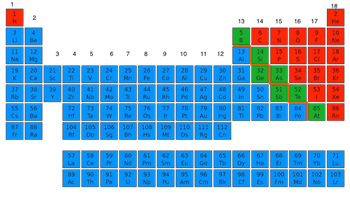
Where are the nonmetals located on the periodic table? 
a)
Blue
b)
Red
c)
Green
17.
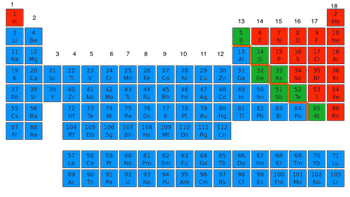
Where are metals located on the periodic table?
a)
Blue
b)
Green
c)
Red
18.
Ionic bonds form between two ions that have...
a)
ionic compounds
b)
negative charges
c)
positive charges
d)
opposite charges
19.

Cations

a)

Gain electrons, has an overall positive charge

b)

Lose electrons, has an overall positive charge

c)

Lose electrons, has an overall negative charge

d)

Gain electrons, has an overall negative charge

20.

Anions

a)

Gain electrons, has an overall positive charge

b)

Lose electrons, has an overall positive charge

c)

Lose electrons, has an overall negative charge

d)

Gain electrons, has an overall negative charge

21.

How does calcium become an calcium ion?

a)

it loses 2 electrons

b)

it gains 2 electrons

22.

How does oxygen become an oxide ion?

a)

it loses 2 electrons

b)

it gains 2 electrons

23.
Is hydrogen considered a metal or a non-metal?
a)
A metal
b)
Nonmetal
c)
Metalloid
24.
Is this ionic bond drawn correctly?
a)
Yes
b)
No
25.
An electron has what kind of charge?
a)
no charge
b)
positive 
c)
negative
d)
it depends
26.

How many Aluminum atoms are in Al2O3?

a)

3

b)

5

c)

2

d)

1

27.
How do covalent bonds form?
a)
Donating & receiving valence e- between atoms.
b)
Opposite slight charges attract each other between compounds.
c)
Scientists are still not sure how they form.
d)
Sharing valence e- between atoms.
28.
What two types of atoms make a covalent bond?
a)
2 Nonmetals
b)
1 Nonmetal and 1 Metal
c)
2 Metals
d)
2 Noble Gases
29.
Compared to ionic compounds, molecular compounds generally have...
a)
stronger chemical bonds
b)
poor conductivity
c)
a high melting point
d)
lower densities
30.
Covalent bonds are between...
a)
Metal and Non-metal
b)
Non-metal and Non-metal
c)
Metal and Metal
31.
H2O
a)
Ionic Bond
b)
Covalent Bond
c)
Both bonds
d)
Neither bond
32.
Low melting point
a)
Ionic Bonds
b)
Covalent Bonds
c)
Both bonds
d)
Neither bond
33.
Name the following compound: 
CO2
a)
monocarbon dioxide
b)
carbon oxide
c)
carbon dioxide
d)
oxygen carbonide
34.
How many valence electrons does nitrogen have?
a)
3
b)
2
c)
5
d)
1
35.
Outer shell electrons are called
a)
outer electrons
b)
valence electrons
c)
negatives
36.
silicon dioxide
a)
SO2
b)
NaO2
c)
SiO2
d)
SiO
37.
phosphorus trichloride
a)
KCl3
b)
PCl3
c)
K3Cl
d)
P3Cl
38.

dinitrogen pentoxide

a)

N2O5

b)

NO5

c)

N5O2

d)

N2O6

39.

P₄S₁₀

a)

tetrapotassium decasulfide

b)

phosphorus decasulfide

c)

tetraphosphorus decasulfide

d)

phosphorus (X) sulfide

40.

What two types of atoms make a covalent bond?

a)

2 non-metals

b)

1 metal and 1 non-metal

c)

2 metals

41.

Which element is this a Bohr Model of?

a)

Hydrogen

b)

Helium

c)

Neon

d)

Oxygen

42.

The Periodic Table is arranged by

a)

atomic mass

b)

it is completely random

c)

atomic number

d)

none of the above

43.
Which is the correct name for CaBr2?
a)
Calcium Bromine
b)
Bromine Calcium
c)
Calcium Bromide
d)
Carbon and Bromine
44.
What is the formula of calcium oxide?
a)
CaO2
b)
CaO
c)
Ca2O
d)
CO
45.
In the chemical formula for an ionic compound, which item is written first?
a)
positive ion
b)
negative ion
c)
subscript
d)
the female
46.
Iron III Chromate
a)
Fe2(CrO4)3
b)
Fe3CrO4
c)
Fe2(Cr2O7)3
d)
FeCrO4
47.
Which of these is CoCl4?
a)
cobalt chlorine IV
b)
cobalt chloride
c)
cobalt IV chlorine
d)
cobalt IV chloride
48.
Rb2O
a)
rubidium oxalate
b)
rubidium oxide
c)
rubidium (II) oxide
d)
rubidium oxygen
49.
What is the name of this compound: Li3N?
a)
Lithium Nitrogen
b)
Lithium nitride
c)
Lithium nitrite
d)
Lithium (III) nitride
50.
When naming an ionic compound with a ______ metal needs a Roman Numeral after its name.
a)
Alkali
b)
Alkaline-Earth
c)
Transition 
d)
Metalloid
51.
If I am in group 17 how many valence electrons do I have?
a)
17
b)
1
c)
7
d)
none, I am a noble gase