
 Worksheets
C-1 Review
Total questions: 65
Worksheet time: 3hrs 15mins
Subatomic particles with a negative charge
Electrons
Neutrons
Protons
Quarks

Look at this picture of Argon off the periodic table. Which of the following is true for this element?
18 protons
40 protons
22 protons
21.9 protons
Which part of an atom is used to identify it?
number of protons
number of neutrons
number of electrons

Which part of the diagram represents the proton?
a
b
c
d
What is the mass number of an atom that contains 9 protons, 10 neutrons, and 9 electrons?
9
10
18
19
What is the mass number of an atom that contains 8 protons, 9 neutrons, and 8 electrons?
8
9
16
17

What is the mass number of a calcium atom that has 21 neutrons?
20
21
41
40

What is the mass number of a beryllium atom that has 3 neutrons?
4
7
9
3
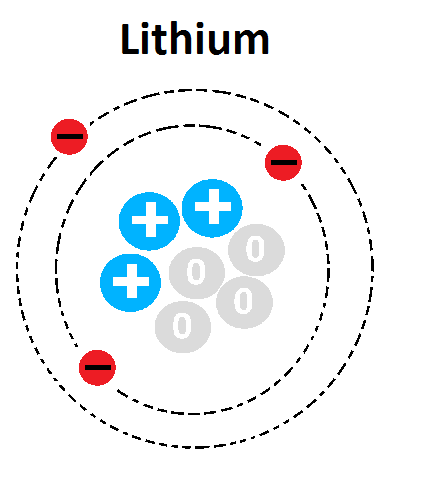
What is the mass number of this atom?
1
3
4
7
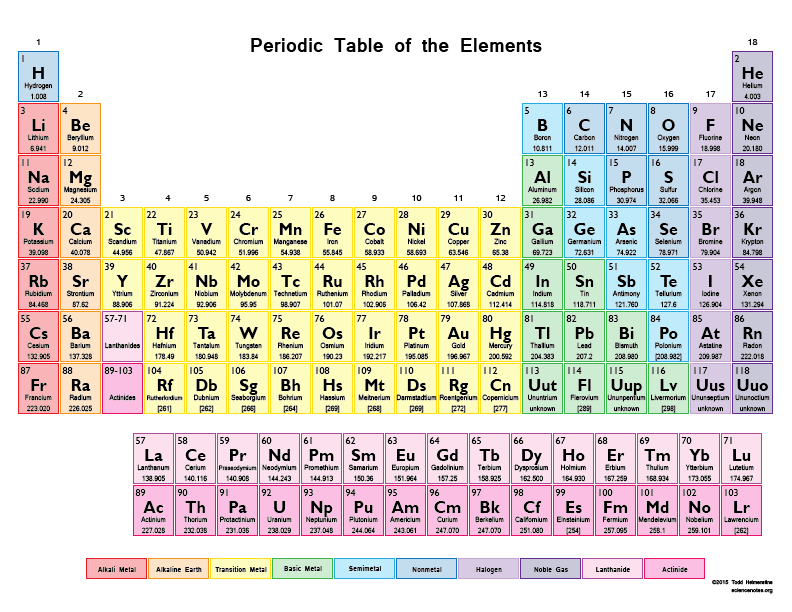
What is the atomic number of Barium, Ba? (enlarge the periodic table)
20
38
56
88

What is the atomic number of Nickel? (enlarge the periodic table)
110
28
46
78


A) Ernest Rutherford
B) J.J. Thomson
C) John Dalton


Which part of the atomic theory did Niels Bohr prove?
there are electrons
there is a nucleus
electrons are in energy levels
gold foil experiment
Which part of the atomic theory did JJ Thomson prove?
there are electrons
electrons are in energy levels
there is a nucleus
cathode ray tube
He claimed that matter was made of small, hard particles that he called “atomos.”
Democritis
Dalton
Moseley
Einstein
The scientist responsible for discovering the nucleus is:
Bohr
Rutherford
Schroedinger
Einstein
John Dalton stated:
Atoms are tiny, invisible particles.
Atoms of one element are all the same.
Atoms of different elements are different.
Compounds form by combining atoms.
All of the statements listed.
The currently accepted model of the atom is
the billiard ball model
the chocolate chip cookie model
the solar system model
the electron cloud model
Democritus stated that
electrons orbit the nucleus in fixed patterns
atoms are indivisible pieces of matter
atoms form substances in fixed ratios
at the center of the atom is a dense, positively charged nucleus
Dalton stated that
electrons orbit the nucleus in fixed patterns
atoms are indivisible pieces of matter
atoms form substances in fixed ratios
at the center of the atom is a dense, positively charged nucleus
Bohr's new contribution to atomic theory stated that
electrons orbit the nucleus in fixed patterns
atoms are indivisible pieces of matter
atoms form substances in fixed ratios
at the center of the atom is a dense, positively charged nucleus
Rutherford stated that
electrons orbit the nucleus in fixed patterns
atoms are indivisible pieces of matter
atoms form substances in fixed ratios
at the center of the atom is a dense, positively charged nucleus
The Electron Cloud Model is unique because
it places electrons in zones of probability
it treats electrons as both particles and waves
it is the currently accepted model of the atom
all of the above
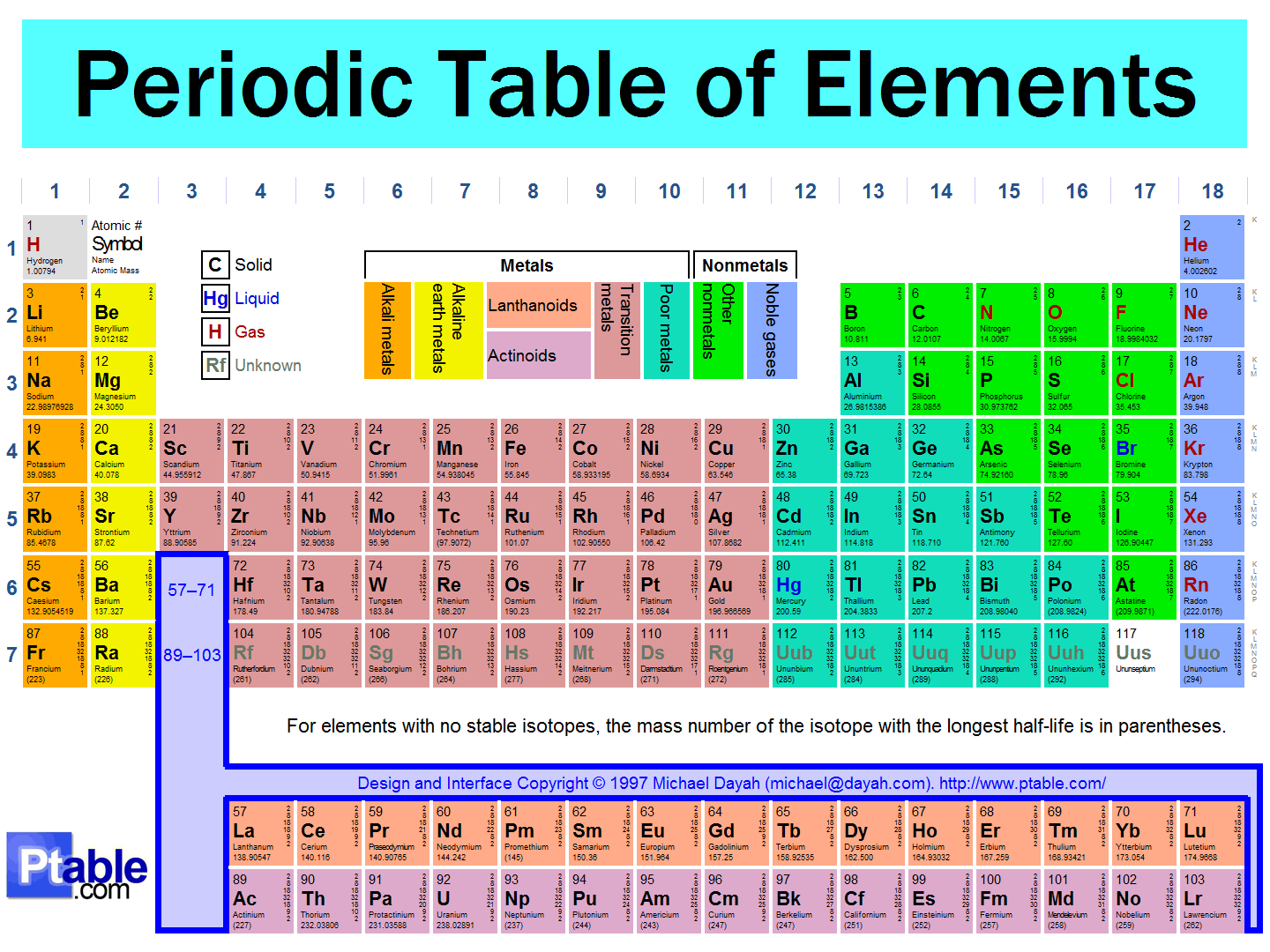


Which color on the image of the periodic table corresponds with the noble gases.
red
black
blue
orange
Which color on the image of the periodic table corresponds with the lanthanides.
red
black
blue
orange
Which color on the image of the periodic table corresponds with the transition metals.
red
black
blue
orange
Which color on the image of the periodic table corresponds with the metalloids.
bright yellow
gold
teal
light blue
What is the most reactive nonmetal?
Fluorine
Iodine
Chlorine
Bromine
Which family of elements does not combine with other elements unless under special conditions in a laboratory?
Noble gases
Halogens
Metalloids
Alkaline earth metals
Actinides
Which of the following is most reactive?
Lithium
Potassium
Sodium
Cesium
What is the general trend for density on the periodic table?
Moving outward and upward increases density
Moving inward and upward increases density
Moving inward and downward increases density
Moving inward and downward decreases density
What is the general trend for number of valence electrons on the periodic table?
Moving to the right and down increases valence electrons
Moving to the right increases valence electrons
Moving to the left increases valence electrons
Moving to the left and up increases valence electrons
What is the general trend for atomic size/radius on the periodic table?
Moving left and down increases atomic radius
Moving left and up increases atomic radius
Moving right and up increases atomic radius
Moving right and down increases atomic radius
What is the general trend for metal reactivity on the periodic table?
Moving up and left increases reactivity
Moving down and left increases reactivity
Moving up and right increases reactivity
Moving down and right increases reactivity
What is the general trend for nonmetal reactivity on the periodic table?
Moving up and left increases reactivity
Moving down and left increases reactivity
Moving up and right increases reactivity
Moving down and right increases reactivity
It is often the case that
periods share similar properties
groups share similar properties
Which of the following is a Halogen?
Bromine
Neon
Rubidium
Calcium
Which of the following is an alkali metal?
Bromine
Neon
Rubidium
Calcium
Which of the following is an alkaline earth metal?
Bromine
Neon
Rubidium
Calcium
Which of the following is a noble gas?
Bromine
Neon
Rubidium
Calcium
Groups 13 (3A) through 17 (7A) are easy to remember because
they are collectively called semimetals
they are collectively called transition metals
they are named for the element at the top
they are the friendliest atoms

