
 Worksheets
Atoms and the Periodic Table (Structure of Matter)
Total questions: 60
Worksheet time: 2hrs 0mins
Rows on the periodic table are called...
groups
periods
families
shells

Columns on the periodic table are called...
periods
groups or families
valence
energy levels
How is the modern periodic table organized?
Increasing by atomic number
By increasing atomic mass
By decreasing the number of alpha particles
By the number of neutrons
What is the maximum number of electrons in the outer level of an atom?
2
8
10
12
How do you find the number of protons or electrons in an atom?
atomic number
atomic mass
charge
atomic mass - atomic number
How do you find out the number of neutrons in an atom?
atomic number
atomic mass
atomic mass (rounded)
- atomic number
charge
A substance that is made up of one type of atom is called an:
atom
element
compound
mixture


How many electrons are in Carbon?
12
10
6
14

___________ proposed that matter is made of solid particles that can't be divided.
Dalton
JJ. Thomson
Rutherford
Bohr
________ proposed that electrons can only travel in fixed orbits (paths) that he called energy levels.
Dalton
Thompson
Rutherford
Bohr
_________ found out that atoms have negative charges called electrons and called his theory "plum pudding."
Dalton
Thomson
Rutherford
Bohr
_________ realized that the atom has a positive charge at the center (nucleus) of it and that an atom is mostly empty space.
Dalton
Thomson
Rutherford
Bohr
Who expressed the first idea that matter is made up of atoms even though he didn't see them?
Democritus
Rutherford
Thomson
Chadwick
Which is a finding attributed to Rutherford's Gold Foil Experiment?
atoms are indivisible and have a dense positive nucleus.
atoms are divisible and have multiple layers of electrons scattered uniformly about the atom.
atoms are like plum pudding with positive and negative charges uniformly scattered throughout the atom.
atoms are mostly empty space with a dense positive nucleus.
Who arranged the known elements into horizontal rows of increasing atomic mass leaving gaps for as yet undiscovered elements and gave it the name, "the Periodic Table of Elements."
Mendeleev
Meyer
Newlands
Moseley
the modern periodic table of elements are arranged by:
atomic mass
atomic number
valence electrons
number of isotopes


Number of protons
Number of electrons
Number of valence (outer) electrons
Number of shells
What particle in the atom has a positive charge?
proton
neutron
electron
quark
What is the particle in the atom that has no charge?
neutron
proton
electron
alpha particle
The particle in the atom that has a negative charge is called?
electron
proton
neutron
megatron
The area outside the nucleus where an electron moves around is called?
electron cloud
nucleus
electron space
orbital space
The number of electrons in the outer energy level is referred to as?
valence electrons
inner electrons
electron cloud
orbital shells
Why do sodium and potassium have similar properties?
They both have a full valence energy level.
They each have only one valence (outer) electron.
They both have few protons.
They are both non-metals.
Elements in the same ________ have similar chemical properties and the same number of outer (valence) electrons.
group
period
club
table
brittle
malleable
lustrous (shiny)
good conductors of heat and electricity

Group 1 on the periodic table is called _______.
alkali metals
alkaline earth metals
noble gases
noble gases
halogens

Group 18 on the periodic table is called ________.
alkali metals
alkaline earth metals
noble gases
transition metals

The period for Sodium (Na) is ___________.
3
2
4
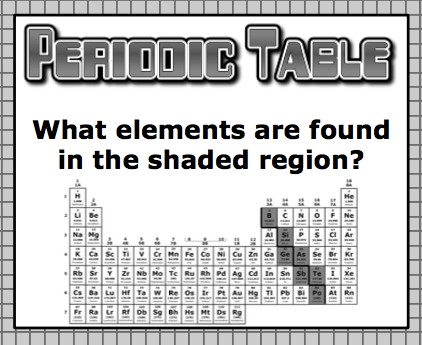
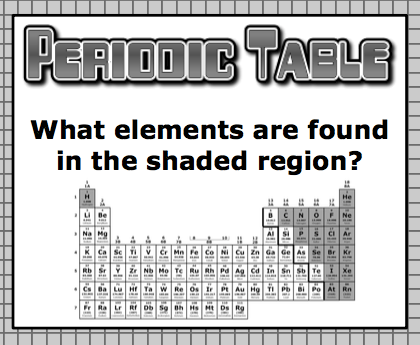
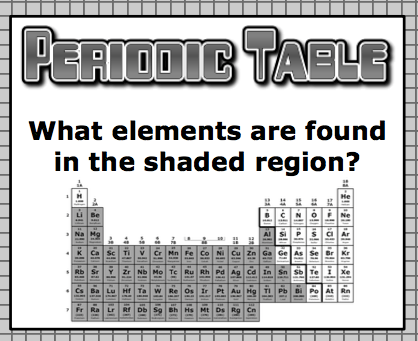
Metals
Nonmetals
Metalloids
Which is true of the noble gases?
They do not react with other elements (most stable).
They are solid at room temperature.
They are reactive.
They are all heavy.

Which element has the most in common with Helium (He)?
Boron (B)
Nitrogen (N)
Fluorine (F)
Argon (Ar)
Group 1 metals (Alkali) would most likely combine with which other group of elements to form salts?
Group 2 (Alkaline Earth Metals)
Transition Metals
Group 17 (Halogens)
Group 18 (Noble Gases)
Which of the following is not a pure substance?
Elements
Compounds
Mixtures
Oxygen
What is a substance that is chemically formed?
Mixtures
Compounds
Elements
Which best describes a mixture?
Chemically formed
definite ratio
physically formed
pure substance
Which of the following is NOT true about an element?
Made of 2 or more types of atoms
cannot be separated into something simpler
made of 1 type of atom
a pure substance
Which of these would NOT be combined in a definite ratio (compound)?
salt
salad
water
sugar
If something dissolves in water, it is _______.
a compound
flammable
soluble
dense
The _______ dissolves into the solvent.
solvent
solute
A solution won't dissolve any more so it is ________ and the crystals will settle to the bottom. (no heating and cooling involved)
unsaturated
saturated
supersaturated
When you can see the particles that make up a mixture, like seeing the individual ingredients that make up chex mix, you have what type of mixture?
homogeneous
heterogeneous
Water is the universal _________ because many substances dissolve in it.
solute
solvent
alloy
___________ have properties of both metals and nonmetals. For example, the substance can be shiny, but brittle.
Alloys
Noble Gases
Metalloids
An atom with the same number of protons but a different number of neutrons is called a(n) __________.
electron
atomic number
mass number
isotope
Which of the following statements is false?
Atoms are made of matter.
An atom is the smallest particle that an element can be divided and still be the same substance.
Atoms are mostly empty space.
Atoms of different elements are exactly the same.

