
 Worksheets
Honors: Math 2 Final Exam Review
Total questions: 170
Worksheet time: 8hrs 37mins


Solve for x.
21.2
81.7
5.9
5.7


To the nearest whole degree.
66°
24°
22°
37°

Solve the right triangle. Round measures of sides to the nearest hundredth and angles to the nearest degree.
<B = 39o, AB = 11.58, AC = 7.29
<B = 39o, AB = 7.29, AC = 11.58
<B = 129o, AB = 11.58, AC = 7.29
<B = 129o, AB = 7.29, AC = 11.58

Solve the right triangle.
<A = 33.7o, <C = 56.3o, AC = 5.59
<A = 56.3o, <C = 33.7o, AC = 5.59
<A = 33.7o, <C = 56.3o, AC = 9.01
<A = 56.3o, <C = 33.7o, AC = 9.01


In this 30-60-90 triangle, what is the length of the long leg?
6√2
3√3
12
6√3


AC ∥ ____
LK
LJ
JK
The segment is not parallel to any other segment in the diagram.
AB ∥ ____
LK
LJ
JK
The segment is not parallel to any other segment in the diagram.

If AB = 22, what is YZ?
22
11
44
Impossible to determine from the information given.

What is the value of x?
17
34
68
Impossible to determine from the information given.

What is the value of x?
1
2
4
Impossible to determine from the information given.

What is the value of x?
3
6
9
Impossible to determine from the information given.

What is the value of x?
-4
10
20
Impossible to determine from the information given.
m∠A = 52o , what is m∠BXY?
52
128
104
26
Which angle is congruent to ∠CYZ ?
∠B
∠A
∠ZYB
∠AXZ
Which is true about any midsegment in a triangle?
(Select all that apply).
The midsegment is parallel to its corresponding side.
The midsegment is perpendicular to its corresponding side.
The midsegment is half as long as its corresponding side.
The midsegment connects the midpoints of two sides of a triangle.
The midsegment is twice as long as its corresponding side.

Find the missing value of x.
HINT!!! (THE LENGTH OF THE PARALLLEL SIDE)=2(MIDSEGMENT)
x = 8
x = 11
x = 7
x = 9

UV is a midsegment of triangle FGH. What is the length of segment UV?
12
10
5
-12

Solve for the value of x.
8
24
6
10
f(x)
is the same thing as ______.
y
x
input
an equation
Translate the function notation into a coordinate point.
f(−1)=5
(−1,5)
(1,5)
(5,1)
(5,−1)
Translate the coordinate pair into function notation.
f(0)=8
f(0)=−8
f(8)=0
f(−8)=0
Given
g(x)=4x−2
Evaluate:
g(−7)g(−7)=−30
g(−7)=−26
g(−7)=−36
g(−7)=26
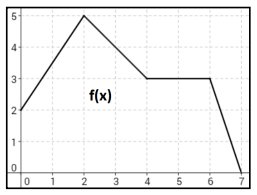
Given the graph,
find:
f(2)f(2)=5
f(2)=4
f(2)=3
f(2)=0
Given the graph,
find:
f(4)f(4)=3
f(4)=1
f(4)=2
f(4)=0
Given the graph,
find:
f(7)f(7)=3
f(7)=1
f(7)=2
f(7)=0
x(2) = ______

16
48
-28
4

-20
20
-24
24

1
-1
19
-19
If f(x) = x2 + 3, evaluate f(-2)
-1
1
7
-7
If h(x) = x2−5x + 8 , Evaluate h(−6)
h(-6) = 2
h(-6) = 36
h(-6) = 74
h(-6) = 14
When f(x) = x2 + 9 and g(x) = x - 9,
find f(x) - g(x).
x2 + x + 9
x2 - x + 9
x2 - x
x2 - x + 18
When f(x) = 9 - 3x and g(x) = 5x - 7
find f(x) + g(x).
14x - 10
-8x + 2
2x + 2
2x - 2

Which theorem proves these two triangles are similar?
ASA
SAS
SSS
AAS
HL

Which theorem proves these triangles are congruent?
ASA
SAS
SSS
AAS
HL

Which theorem proves these triangles are congruent?
ASA
SAS
SSS
AAS
HL

Which theorem proves these triangles are congruent?
ASA
SAS
SSS
AAS
HL

Which theorem proves these triangles are congruent?
ASA
SAS
SSS
AAS
HL

Which theorem proves these triangles are congruent?
ASA
SAS
SSS
AAS
HL

Which theorem proves these triangles are congruent?
ASA
SAS
SSS
AAS
HL


Solve for x.
8
9
13
15

Solve for x.
8
13
15
16


Which letter determines if a parabola opens up or down?
a
h
k

f(x) = x2- 8x + 15.
f(x) = -x2 - 4x + 12.
The equation for the axis of symmetry line is x = -b/(2a)
true
false
Identify a, b and c in the quadratic equation: 2x2−3x−5=0
a = 2 , b = 3, c = -5
a = 2, b = -3, c = 5
a = 2, b = -3, c = -5
a = -2, b = 3, c = 5
b2−4ac is called the . . .
Square root
Quadratic formula
X-intercepts
Discriminant
If there are no real solutions, the discriminant is
zero
a postive number
a negative number
a perfect square
If there is one solution, the discriminant is . . .
zero
a postive number
a negative number
a perfect square
What is the discriminant of x2+3x−4=0
25
0
-25
-13
Why are quadratic equations set equal to zero?
Because zero is an easy number to work with.
Because we are trying to find the x-intercepts and that happens when y=0.
Because setting it equal to zero helps us find the y-intercepts.
None of the above


x2 + 4x - 40 = -8
2x2=8x+3
Suzanne solved the equation using this process.
Did she make a mistake?
If yes, at which line did she make her first mistake?
(There are 5 steps in her process)
Suzanne made no errors.
Step 2
Step 3
Step 4
Step 5
Identify each variable & answer...
Layla throws a ball upwards so it goes 15ft per second. It leaves her hand 5ft above the ground. How long will it take for the ball to hit the ground?
1.2 seconds
15.73 seconds
0.26 seconds
14.27 seconds
Identify each variable & answer...
A rocket is launched from a 20ft tall stand going 210 ft per second. How long will it take for the rocket to hit the ground?
13.22 seconds
6.56 seconds
11.39 seconds
18.15 seconds
Identify each variable & answer...
Ben throws a ball upwards so it goes 35ft per second. It leaves his hand 6ft above the ground. How high is it above the ground after 1 second has passed?
it's 25ft above the ground
it's 16.5ft above the ground
it's 2.2 ft above the ground
it's 25.14ft above the ground
Identify each variable & answer...
A rocket is launched going 350ft per second from a 40ft tall base. How much TIME goes by when it reaches the maximum height?
about 10.9 seconds
about 14.6 seconds
about 12.2 seconds
about 8.3 seconds

What is the height of the object after 5 seconds?
Henry launched a model rocket from the ground with an initial speed of 88 feet per second. When will the rocket be 40 feet high?
0.5 sec, 5 seconds
0.5 seconds
5 seconds
never
Jason jumped off of a cliff into the ocean in Acapulco while vacationing with some friends. His height as a function of time could be modeled by the function h(t) = –16t2 + 16t + 480, where t is the time in seconds and h is the height in feet. How long does it take Jason to hit the water?
-16 seconds
-6 seconds
0 seconds
5 seconds
What is the height of the object after 5 seconds?
The quadratic function shown below is used to model vertical motion.
h(t)=−16t2+vot+ho
If a soccer ball is kicked from ground level with an initial velocity of 64 feet per second, how high will it go?
100 feet
64 feet
140 feet
88 feet
"Bill throws a rock off of a cliff. How high is the cliff from where he first throws the rock?"
10x2 + 15x-5
4b5+4b3+16b2
k2+7x+10
n2 + 16n + 63
k2 -2k - 24
3v2 - 4v - 7
3a2 + 4a + 1
2x2 - 13x - 70
Factor the Polynomial
12x3 - 9x2 + 4x - 3
(3x2 + 1) (4x - 3)
(3x2 - 1) (4x + 3)
(4x2 + 1) (3x - 3)
(4x2 - 1) (3x + 3)
Factor the Polynomial
2x3 + 5x2 + 6x + 15
(x2 + 3) (2x + 5)
(x2 - 3) (2x - 5)
(2x2 - 3) (x - 5)
(2x2 + 3) (x + 5)
Factor the Polynomial
5x3 - 10x2 + 3x - 6
(5x2 + 3) (x - 2)
(5x2 - 3) (x + 2)
(x2 + 3) (5x - 2)
(x2 - 3) (5x + 2)
Factor the Polynomial
8x3 - 64x2 + x - 8
(8x2 + 1) (x - 8)
(8x2 - 1) (x + 8)
(x2 + 1) (8x - 8)
(x2 - 1) (8x + 8)
Factor the Polynomial
63x3 + 54x2 - 105x - 90
3(3x2 - 5) (7x + 6)
3(3x2 + 5) (7x - 6)
5(3x2 - 5) (7x + 6)
5(3x2 + 5) (7x - 6)
Factor the Polynomial
96x3 - 84x2 + 112x - 98
2(6x2 + 7) (8x - 7)
2(6x2 - 7) (8x + 7)
4(6x2 + 7) (8x - 7)
4(6x2 - 7) (8x + 7)
Factor the Polynomial
5x2 + 45x
5x (x + 9)
x (5x + 9)
x (5x + 45)
9x (x + 5)
Factor the Polynomial
16x2 + 48x
16x (x + 3)
8x (2x + 6)
4x (4x + 12)
2x (8x + 24)

Identify the transformation from the graph of f(x)=x2 to the graph g(x)= -(x+5)2
shifted up five units
reflection in x-axis
shifted down five units
reflection in x-axis
shifted left 5 units
reflection x-axis
shifted right 5 units
reflection x-axis

Right 7
Left 7
Vertical stretch of 7
Horizontal stretch of 7
Left 3
Right 3
Left 3
Right 3
y = g(x) to y = - g(x + 6) - 10
Shifted down 10 units
Shifted left 6 units
Shifted up 10 units
Shifted left 6 units
Shifted up 10 units
Shifted right 6 units
Shifted down 10 units
Shifted left 6 units
f(x) = 1/3x2 + 2
Stretch of 1/3
Up 2
Shrink of 1/3
Up 2
Stretch of 1/3
Down 2
Shrink of 1/3
Down 2
y = 3g(x - 3) + 5
Shifted right 3 units
Stretched vertically by a factor of 3
Shifted left 3 units
Stretched vertically by a factor of 3
Shifted left 3 units
Stretched vertically by a factor of 3
Shifted left 3 units
Stretched vertically by a factor of 1/3
In the equation f(x)=5(x+3)2-10 what effect does the 5 do when compared to the parent function?
Vertical stretch by a factor of 5
Vertical compress by a factor of 5
Reflect over x-axis
Vertical shift up 5 units


Determine the image of C after it's first translated by the rule
(x, y) → (x − 2, y + 5)
and is then reflected over the y-axis.
(-1, 4)
(1, 4)
(6, -3)
(-3, 6)
Determine the image of C after it's first translated by the rule
(x, y) → (x − 3, y + 3)
and is then reflected over the y-axis.
(-2, 2)
(2, 2)
(4, -4)
(-4, 4)

What is the image of point E after a dilation with a scale factor of 1/3 ?
(5, 7)
(-3, 3)
(1, 1)
(1/9, 1/9)

Determine the image of B after it's first dilated by a scale factor of 1/2 and then translated by the rule
(x, y) → (x + 3, y − 1)
(5, -2)
(7, -3)
(2, -1)
(2, 1)
(-3, -1) -- Reflect across the line y=x and translate down 1.
(-1, -4)
(-1, -2)
(3, 0)
(-2, -3)

If you have the pre-image point A(-4, 1), what is the coordinates of point A'' after the composite transformation rotation 90 ccw about origin, then reflection over line y= -x?
A''(-1, -4)
A''(-4, -1)
A''(1, 4)
A''(4, 1)
√45
√200
√96


Simplify:
−325
(a)
Simplify: 216
(a)
*Use the "equal values method"*
y=x2+6x−9
(3,18)&(−3,−18)
(3,18)
(−3,−18)
No Solutions
Find ALL solutions to the system of non-linear equations:
*Use the "equal values method"*
y=−2x−5
y=x2+2x+5
No Solutions
(1,−7)
(2,−9)
(1,−7)&(2,−9)
Find ALL solutions to the system of non-linear equations:
*Use the "substitution" method*
x2+y=125
y=4x2
(5,100)&(−5,100)
(5,100)
(−5,100)
No Solutions
Find ALL solutions to the system of non-linear equations:
*Use the "elimination-multiplication" method*
x2+3y2=28
(4,±2)&(−4,±2)
(4,±2)
(−4,±2)
No Solutiions
Find ALL solutions to the system of non-linear equations:
*Use the "elimination-multiplication" method*
5x2−2y2=27
(5,±7)&(−5,±7)
(−5,±7)
(5,±7)
No Solutions
x + 2y = -3
x - y = -12
y = 4x+1
3x + 2y = 13

y2 = x + 4
x2 + y2 = 4
(0, 2), (0, -2)
(-1, √3), (-1, -√3)
(0, 2), (0, -2),
(-1, √3), (-1, -√3)
(2, 0), (0, -2),
(√3, 1),(√3, -1)
(11, −132) (1, −12)
(−11, −132) (−1, −12)
(11, 132) (1, 12)
(−11, 132) (−1, 12)

