
 Worksheets
Geo Test 5 Review - Advanced Triangle Theorems
Total questions: 171
Worksheet time: 7hrs 46mins

Name the segment/line/ray shown in the picture.
Perpendicular Bisector
Angle Bisector
Median
Altitude

Name the segment/line/ray shown in the picture.
Perpendicular Bisector
Angle Bisector
Median
Altitude

Name the segment/line/ray shown in the picture.
Perpendicular Bisector
Angle Bisector
Median
Altitude

Name the segment/line/ray shown in the picture.
Perpendicular Bisector
Angle Bisector
Median
Altitude
The three altitudes of a triangle intersect at the_______________.
circumcenter
incenter
centroid
orthocenter
The three medians of a triangle intersect at the_______________.
circumcenter
incenter
centroid
orthocenter
The three perpendicular bisectors of a triangle intersect at the_______________.
circumcenter
incenter
centroid
orthocenter
The three angle bisectors of a triangle intersect at the_______________.
circumcenter
incenter
centroid
orthocenter
It is equidistant from the three vertices of the triangle.
circumcenter
incenter
centroid
orthocenter
It is equidistant from the three sides of the triangle.
circumcenter
incenter
centroid
orthocenter
It divides each median into two sections at a 2:1 ratio.
circumcenter
incenter
centroid
orthocenter

Name the point of concurrency shown.
circumcenter
incenter
centroid
orthocenter

Name the point of concurrency shown.
circumcenter
incenter
centroid
orthocenter

Name the point of concurrency shown.
circumcenter
incenter
centroid
orthocenter

Name the point of concurrency shown.
circumcenter
incenter
centroid
orthocenter

Name the point of concurrency shown.
circumcenter
incenter
centroid
orthocenter

Name the point of concurrency shown.
circumcenter
incenter
centroid
orthocenter

Name the point of concurrency shown.
circumcenter
incenter
centroid
orthocenter

Name the point of concurrency shown.
circumcenter
incenter
centroid
orthocenter
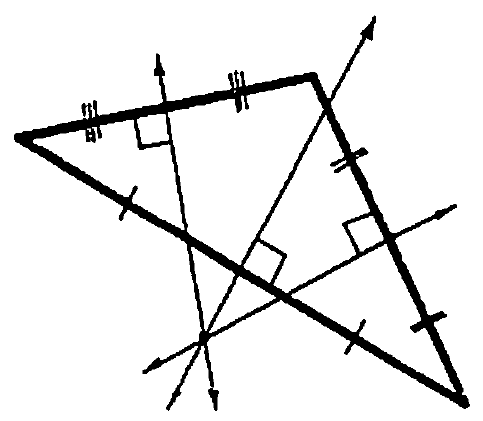
Name the point of concurrency shown.
circumcenter
incenter
centroid
orthocenter

Name the point of concurrency shown.
circumcenter
incenter
centroid
orthocenter

Name the point of concurrency shown.
circumcenter
incenter
centroid
orthocenter

Name the point of concurrency shown.
circumcenter
incenter
centroid
orthocenter

X is the centroid of the triangle. If CW = 30, find CX.
20
10
30
15
X is the centroid of the triangle. If BX = 8, find BY.
4
8
12
16
X is the centroid of the triangle. If ZX = 3, find AZ.
3
6
9
12

What type of segment is segment AH?
median
altitude
angle bisector
perpendicular bisector
What type of segment is segment CJ?
median
altitude
angle bisector
perpendicular bisector

X is the centroid of the triangle. If AZ = 24, find AX.
4
8
12
16

BD is a median of the triangle. Given DC=11, what is the length of AD?
11
22
5.5
3.67

If XP = 8, then PC = _______
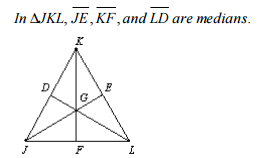
In ΔXYZ, YB, XC, and ZA are medians.
If YC= 10, then ZC = _______
15
5
20
10

What is the measure of ∠HKG?

Construction of Perpendicular Bisector

Construction of Angle Bisector

Construction of Median

Copy an Angle

Construction of Altitude

Given the diagram, complete the statement.
CD is the altitude from C to ___.
CD
AB
AC
KB

What point of concurrency is constructed here?
Incenter
Orthocenter
Circumcenter
Centroid

What point of concurrency is constructed here?
Incenter
Orthocenter
Circumcenter
Centroid

What point of concurrency is constructed here?
Incenter
Orthocenter
Circumcenter
Centroid

What point of concurrency is constructed here?
Incenter
Orthocenter
Circumcenter
Centroid
Slopes of parallel lines are...
opposite reciprocals.
opposites.
the same.
always 7.
These lines are...
y = 3x +2
y = 3x - 3
Parallel
Perpendicular
Neither
These lines are...
y=−32x+2
y=23x+9
Parallel
Perpendicular
Neither
Choose ALL the lines that are PARALLEL to:
y=92x−7
y=92x+8
y=29x−12
−2y=9x+8
9y=2x−18
What is the slope of this line?
-2
1/2
-1/2
2
m = 5/8
-5/8
5/8
-8/5
8/5
Write the equation of a line PERPENDICULAR to the line y = 3x + 2 that passes through the point (9, -2)
y=−31x−5
y = 3x-29
y=31x−5
y=−31x+1
Which is the equation of the line that is parallel to the graph of y = 5x + 7 and has a y-intercept at (0, -2)?
y = 5x - 2
y = -2x + 7
y = 5(x - 2)
y=−51x−2

Arrange the angles of the triangle in ascending order.
∠W, ∠U, ∠V
∠V, ∠U, ∠W
∠U, ∠W, ∠V
∠U, ∠V, ∠W

Arrange the angles of the triangle in descending order.
∠C, ∠A, ∠T
∠A, ∠T, ∠C
∠A, ∠C, ∠T
∠C, ∠T, ∠A
Given: ∆CAT, CA=7cm, CT=24cm and AT=25cm
Arrange the angles of the triangle in ascending order.
∠T, ∠A, ∠C
∠T, ∠C, ∠A
∠C, ∠T, ∠A
∠C, ∠A, ∠T
Given: ∆MEN, ME=0.15m, MN=0.11m and EN=0.10m
Arrange the angles of the triangle in descending order.
∠N, ∠M, ∠E
∠N, ∠E, ∠M
∠M, ∠E, ∠N
∠M, ∠N, ∠E
Given: ∆LOG, LO=0.55cm, LG=0.35cm and OG=0.4cm
Arrange the angles of the triangle in ascending order.
∠G, ∠O, ∠L
∠G, ∠L, ∠O
∠O, ∠G, ∠L
∠O, ∠L, ∠G

m∠O _______ m∠K
<
>
=
I don't know.
m∠T _____ m∠U
<
>
=
I don't know.
m∠KAU _____ m∠OAT
<
>
=
I don't know.
m∠KAU _____ m∠O
<
>
=
I don't know.
m∠U _____ m∠T
<
>
=
I don't know.


What is the smallest angle?
∠J
∠K
∠L

What is the largest angle?
∠K
∠L
∠M


and then back to its starting point in Barrow.
Which of the three legs of the trip is
the longest?

15, 12, 9

What is the correct order of angles?
m∡DFE > m∡FED > m∡EDF
m∡EDF > m∡FED > m∡DFE

Smallest angle to largest angle
∠R, ∠P, ∠Q
∠R, ∠Q, ∠P
∠Q, ∠R, ∠P
∠P, ∠R, ∠Q

From longest side to shortest side.
BC, AB, AC
BC, AC, AB
AB, AC, BC
AC, AB, BC
The sum of the lengths of any two sides of a triangle is _____ than the third side
less
greater
equal
Does the sides 8, 9, 10 make a triangle?
yes
no
Does the sides 1, 1, 2 make a triangle?
yes
no
Does the sides 6, 9, 8make a triangle?
yes
no
Does the side 3, 4, 9 make a triangle?
yes
no
Does the sides 12, 4, 17 make a triangle?
yes
no
Does the sides 8, 7, 2 make a triangle?
yes
no
Does the sides 14, 3, 9 make a triangle?
yes
no
Does the sides 12, 18, 2 make a triangle?
yes
no
Does the sides 3, 2, 1 make a triangle?
yes
no
The lengths of two sides are given (8, 5). What are the possible length of the third side? Between what two numbers
Between 5 and 8
Between 3 and 13
Between 3 and 5
Between 5 and 13
The lengths of two sides are given (9, 2). What are the possible length of the third side? Between what two numbers
Between 0 and 2
Between 2 and 9
Between 7 and 11
The lengths of two sides are given (10, 10). What are the possible length of the third side? Between what two numbers
Between 0 and 10
Between 0 and 20
Between 10 and 11
10
The lengths of two sides are given (4, 13). What are the possible length of the third side? Between what two numbers
Between 9 and 17
Between 0 and 13
Between 4 and 13
The lengths of two sides are given (27, 39). What are the possible length of the third side? Between what two numbers
Between 12 and 66
Between 27 and 39
Between 12 and 67
The lengths of two sides are given (6, 15). What are the possible length of the third side? Between what two numbers
Between 6 and 15
Between 9 and 21
Between 6 and 21
If a triangle has the following lengths XZ= 18, XY=4. What is the length of YZ?
12
4
14
21
Mrs. Barto has a pet rabbit and wants to build a pen for it. She has 3 pieces of lumber: 3ft, 7ft, and 8ft. Can she build a closed triangular pen with these three boards? (Will these three sides make a triangle?)
Yes
No
3, 5, 8

Will these three sides form a triangle?
yes
no

Will these line segments form a triangle?
yes
no

Will these side lengths form a triangle?
yes
no
15, 12, 9
It is called the HINGE theorem, because...
the vertex of the angle acts like a hinge to open the triangle.
it's named after Joseph Hinge, the man who discovered it.
"hinge" is the Spanish word for angle.
the triangle makes a hinge shape, like a tent.

Compare m∠ACD and m∠GDE
m∠ACB > m∠GDE
m∠ACD < m∠GDE
m∠ACB = m∠GDE
∠ACB ≅ ∠GDE

Compare QT and ST
QT < ST
QT > ST
QT = ST
QT ≅ ST

Find the range of possible values for x.
27<x<24
x<6
24<x
211<x<6

Find the range of possible values of x.
35<x<8
−23<x>8
332<x<27
27<x<37

Find the range of possible values for x.
2 <x<6
6<x<15 31
6<x<22
2<x<22

Find the range of possible values of x.
−20<x<21
8<x<37
34<x<37
8<x<24

Find the range of possible values for x
x>7
−317<x>7
−317<x<7
x<7

Which inequality relates ∠FBG and ∠BFA ?
m∠FBG <m∠BFA
m∠FBG >m∠BFA
m∠FBG ≥m∠BFA
m∠FBG ≤m∠BFA
Which inequality relates ∠GBC and ∠FBA ?
m∠GBC <m∠FBA
m∠GBC > m∠FBA
m∠GBC ≤ m∠FBA
m∠GBC ≥ m∠FBA

Four students are doing a scavenger hunt starting at the water fountain. They disagree one the directions and split up. Their paths are shown in the diagram. Which pair is closest to the fountain when they stop?
Luther and Stephanie
Mario and Lee


BC _____ EF
<
>
=
No conclusion can be made.

What are the possible values for x?
x < 16
4 < x < 16
x < 40
4 < x < 40
It is called the HINGE theorem, because...
the vertex of the angle acts like a hinge to open the triangle.
it's named after Joseph Hinge, the man who discovered it.
"hinge" is the Spanish word for angle.
the triangle makes a hinge shape, like a tent.
Compare m∠ACD and m∠GDE
m∠ACB > m∠GDE
m∠ACD < m∠GDE
m∠ACB = m∠GDE
∠ACB ≅ ∠GDE
Compare QT and ST
QT < ST
QT > ST
QT = ST
QT ≅ ST
Find the range of possible values for x.
27<x<24
x<6
24<x
211<x<6
Find the range of possible values of x.
35<x<8
−23<x>8
332<x<27
27<x<37
Find the range of possible values for x.
2 <x<6
6<x<15 31
6<x<22
2<x<22
Find the range of possible values of x.
−20<x<21
8<x<37
34<x<37
8<x<24
Find the range of possible values for x
x>7
−317<x>7
−317<x<7
x<7
Which inequality relates ∠FBG and ∠BFA ?
m∠FBG <m∠BFA
m∠FBG >m∠BFA
m∠FBG ≥m∠BFA
m∠FBG ≤m∠BFA
Which inequality relates ∠GBC and ∠FBA ?
m∠GBC <m∠FBA
m∠GBC > m∠FBA
m∠GBC ≤ m∠FBA
m∠GBC ≥ m∠FBA
Four students are doing a scavenger hunt starting at the water fountain. They disagree one the directions and split up. Their paths are shown in the diagram. Which pair is closest to the fountain when they stop?
Luther and Stephanie
Mario and Lee
BC _____ EF
<
>
=
No conclusion can be made.
What are the possible values for x?
x < 16
4 < x < 16
x < 40
4 < x < 40
Which one of these represent SAS?


Which one of these represent SSS?

Order the sides of the triangle from shortest to longest.
UV, UT, VT
UV, VT, UT
VT, UT, UV
VT, UV, UT

Order the sides of the triangle from longest to shortest.
KL, ML, KM
KL, KM, ML
KM, ML, KL
KM, KL, ML

Order the angles from smallest to largest.
∠D, ∠E, ∠C
∠D, ∠C, ∠E
∠C, ∠E, ∠D
∠C, ∠D, ∠E

Order the angles from largest to smallest
∠S, ∠R, ∠T
∠S, ∠T, ∠R
∠T, ∠R, ∠S
∠T, ∠S, ∠R
Can a triangle be formed with line segments that have lengths 2, 8 and 14 units?
No, because these line segments wouldn't satisfy the triangle inequality theorem
No, because there are only two sides to a triangle
Yes, because these line segments satisfy the triangle inequality theorem
Yes, because 8< 14
4 cm, 7 cm, 2 cm


≅ Thrm
≅ Thrm
≅ Thrm


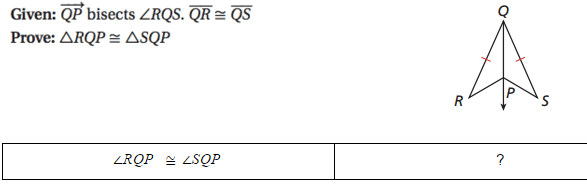
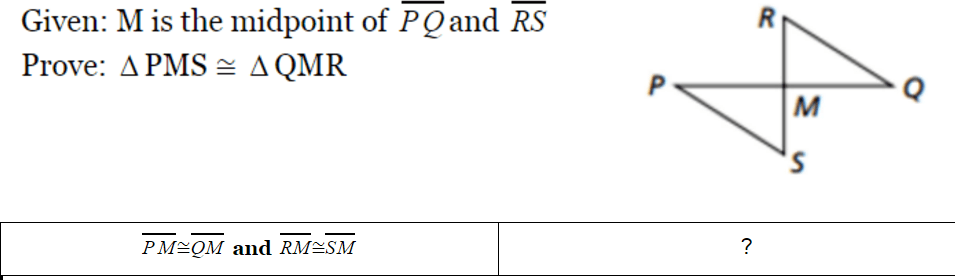

∡B≅∡G

What is the difference between a theorem and a postulate?
A postulate is a statement that is assumed true without proof while a theorem is a true statement that can be proven.
A theorem is a statement that is assumed true without proof while a postulate is a true statement that can be proven.
Why are proofs useful?
They use logical deductions to prove a statement true.
They list given statements.
They show statements.

