
 Worksheets
Periodic Law
Total questions: 70
Worksheet time: 1hrs 21mins
Who discovered a way to measure atomic number?
John Newland
Johann Dobereiner
Henry Moseley
Antoine Lavoisier
How many periods does the Periodic Table have?
18
10
7
8

Which accurately describes nonmetals?
Poor conductors of electricity
Often used in computer parts
Both malleable and ductile
Both dull and brittle

Name group 18 on the periodic table.
An element that has the electron [Ne]3s23p5 is in Period
2
3
5
7
An element that has the electron configuration [Ne]3s23p5 is in Group
2
5
7
17
Elements in the s and p blocks of the periodic table are called
alloys
main-group elements
metals
transition metals
Elements in Group 18 have
very low reactivity
good conductivity
very high reactivity
metallic character.
The outer-level electron configuration of a neutral alkaline-earth metal atom consists of
one electron is the s orbital
two electrons in the s orbital
one electron in the p orbital
two electrons in the p orbital
In nature the alkali metals are found only in compounds because they
have small atoms.
are very reactive elements.
are rare elements.
each have a stable octet.
An element found in groups 3-12 of the periodic table is classified as a(n)
alkali metal
alloy
transition metal
actinide
What block is Sulfur in?
s
p
d
f
Potassium has how many electrons in it's outermost s orbital?
0
1
2
3
The noble gases (except for He) has a valence electron configuration of:
s2p4
s2p5
s2p6
s2p7
The lanthanides and actinides belong to the:
p block
d block
f block
s block
Which of the following is the electron configuration for calcium?
1s22s22p63s2
1s22s22p63s23p64s2
1s22s22p6
1s22s22p63s23p4
Which of the following is an electron configuration for a lithium atom?
1s22s1
1s12s21s12s2
2s11s2
None of the above
How many valence electrons do alkali metals have?
2
4
1
3
Element A is an alkaline earth metal. If element A loses two electrons to gain a complete octet, it has the same number of electrons as a(n)
Halogen
Alkali metal
Transition metal
Noble gas
Alkaline earth metal
if "n" stands for a given principal energy level, what is the outer electron configuration of the alkaline earth metals?
ns1
ns2np1
ns2np5
ns2
Which statement correctly describes the reactivity of the alkaline earth metals compared to alkali metals?
They are more reactive than the alkali metals
They are less reactive, so they can be found in nature as pure elements.
The reactivity is about the same.
They are less reactive, but still are found in nature only as compounds.
Elements in group 1 all have an electron configuration that end in
s1
s2
s3
p6
Elements in group 3 all have an electron configuration that end in
s1
d1
d2
p1
In general, the electron configuration of the atom's highest occupied energy level governs the atoms's chemical properties.
true
false

The electron configuration for group 17 elements always ends in
p4
p5
p6
none of these

The distance from the nucleus of an atom to the valence electrons is the __________
Atomic Radius
Ionization Energy
Electronegativity
Electrostatic
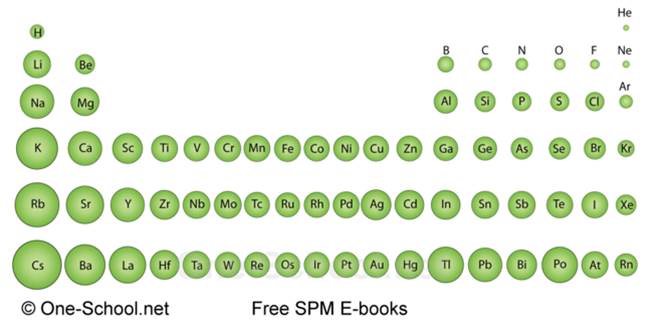
As you move across a row (period) on the periodic table, the atomic radius ______________________
Increases
Decreases
Stays the same
Explodes
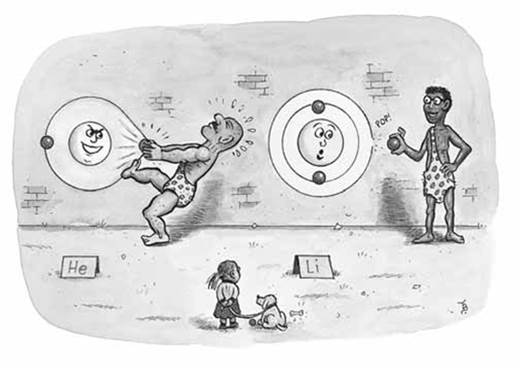
Ionization energy is the energy needed to _________ an electron.
Fission
Explode
Remove
Add
The reason the atomic radius increases down a group is due to
Greater attraction by protons
More energy levels (rings)
As you move across a row on the periodic table, ionization energy ______________________
Decreases
Increases
Stays the same
Which element has the highest electronegativity?
F
Na
K
Li
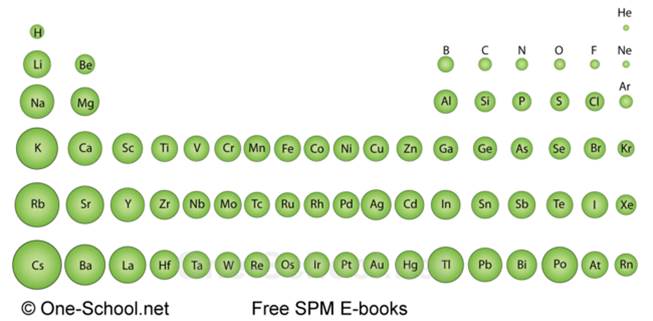
Which group of elements has the lowest ionization energy?
Group 1
Group 2
Group 3
Group 4
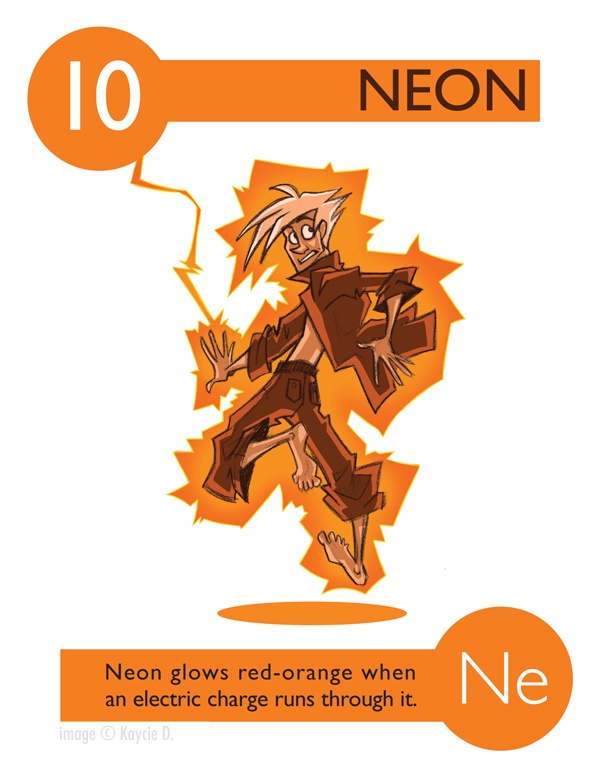
Which element would have the smallest atomic radius?
Li
Be
C
Ne

Which element would have the largest atomic radius?
Cs
K
Na
H
N or C?
Which of the period 3 elements has the largest electronegativity
Ar
Na
F
Cl
The element with the lowest electron affinity in Period 3 is
Sodium
Chlorine
Potassium
Argon
As you move from left to right across a period, the number of valence electrons
increase
stays the same
increases then decreases
decreases
How many electrons would a Nitrogen ion gain/lose?
lose 5
gain 5
lose 3
gain 3
How many electrons would a Calcium ion gain/lose?
lose 1
gain 1
lose 2
gain 2
If an atom loses electrons, the charge will be positive.
true
false
A Bromine ion gains 1 electron, which of the following is the correct symbol for a Bromine ion?
Br-1
Br+1
Br+7
Br-7
Which substance is larger
Ca
Ca+2
Which substance is larger
Br
Br-1
What happens to the radius of an atom when it becomes an anion?
It increases
It decreases
Chlorine is much more apt to exist as an anion than sodium. This is because...
Chlorine has a greater ionization energy than sodium does
Chlorine is bigger than sodium
Chlorine is more metallic than sodium
Chlorine has a greater electron affinity than sodium does
Which ion below has the greatest radius?
Li+
Cl-
K+
I-
Potassium is much more apt to exist as a cation than bromine. This is because...
Bromine has a greater electron affinity than potassium does
Bromine has a greater ionization energy than potassium does
Bromine is bigger than potassium
Bromine is more metallic than potassium
Which gives the correct order for atomic radius for Be, Li, N, C, and Ne?
Be < Li < N < C < Ne
C < N < Ne < Li < Be
Ne < N < C < Be < Li
Li < Be < C < N < Ne
Which gives the correct order for first ionization energies?
Ga > Ge > Se > Br > Kr
Se > Ge > Br > Ga > Kr
Kr > Br > Se > Ge > Ga
Br > Se > Ga > Kr > Ge

Which is easiest to remove an electron from?
sodium (Na)
magnesium (Mg)
aluminum (Al)
silicon (Si)
Which has the highest ionization energy?
sodium (Na)
magnesium (Mg)
aluminum (Al)
silicon (Si)
Which has the highest ionization energy?
chlorine (Cl)
bromine (Br)
iodine (I)
astatine (At)

Which of the following is most electronegative?
Oxygen (O)
Nitrogen (N)
Sulfur (S)
Phosphorus (P)

Which of the following has the highest electronegativity?
argon (Ar)
chlorine (Cl)
krypton (Kr)
bromine (Br)
Which of the following has the lowest electronegativity?
sulfur (S)
chlorine (Cl)
selenium (Se)
bromine (Br)
Which element is the widest (biggest radius)?
sulfur (S)
chlorine (Cl)
selenium (Se)
bromine (Br)
Identify the period and group of the element that has the electron configuration [Ne] 3s2 3p3.
Period 2 group 2A
Period 3 group 1A
Period 3 group 3A
Period 3 group 5A

In what group AND period can you find this element?
4th period Group 8A
5th period Group 2A
3rd period Group 3A
4th period Group 4A
How many electrons does an atom generally need in its outer level to be the most stable?
4
8
10
12
Statement that when the elements are arranged by increasing atomic number, there is a periodic repetition of their chemical and physical properties
Atomic theory
Newton's 3 laws of motion
Periodic Law
Octet rule

