
 Worksheets
3rd 6 weeks Test Review
Total questions: 32
Worksheet time: 43mins
What does the Law of Conservation of Mass tell us about the reactants and products in a chemical reaction?
Mass is consumed during a chemical reaction
Mass is never created or destroyed during a chemical reaction.
Sometimes mass is created during a chemical reaction.
Sometimes mass is destroyed in a chemical reaction.
What can you increase to make most substances more soluble?
Particle Size
Density
Temperature
Polarity
A form of an element with the same number of protons, but a different number of neutrons:
Ionic
Noble Gas
Alkali Metal
Isotope
The amount of time it takes for half of the nuclei of a radioactive substance to decay
Isotopic Harmonic
Full Term Nuclear Radiation
Radiaoactive Half Life
Half Term Nuclear Radiation
In a solution of salt water, the salt is the (a) .
In a solution of salt water, the water is the (a) .
A Supersaturated Solution is:
A solution with exactly the right amount of solute in the solvent.
A solution with more than the maximum amount of solute in the solvent at a given temperature.
A solution with less than the maximum amount of solute in the solvent at a given temperature.
A solution with more than the maximum amount of solvent in the solution at a given temperature.
What is the biggest problem with nuclear energy?
Exposure to radiation.
Danger of nuclear accidents.
Expense of mining Uranium.
Storage of the waste.
Holds the protons and neutrons together in the nucleus of an atom.
Strong Force
Electromagnetic Force
Gravity Force
Weak Force
Causes protons to repel eachother.
Strong Force
Electromagnetic Force
Gravity Force
Weak Force
Which subatomic particles are found in the nucleus?
Protons and Neutrons
Electrons and Protons
Only Protons
Electrons only.
What can you decrease to make most substances more soluble?
Pressure
Temperature
Particle size
Surface area
The process of nuclear decay is:
Isotope
Half Life
Radiation
Synthesis
What happens during a chemical reaction?
Atoms are rearranged.
The nucleus falls apart.
Protons are lost.
Atoms are destroyed.
The electric force in a small atom is _______ a large atom.
larger than in
smaller than in a
the same as in
not important as in
Carbon-14 has a half-life of _____ years.
8000
2
5730
26
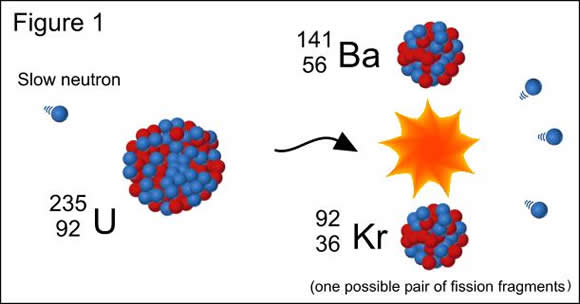
The splitting of a nucleus into smaller nuclei is
gamma radiation
fusion
fission
Which type of compound is formed when a base neutralizes an acid?
Carbohydrate
Nonpolar
Salt
Covalent

Al + O2 --> Al2O3
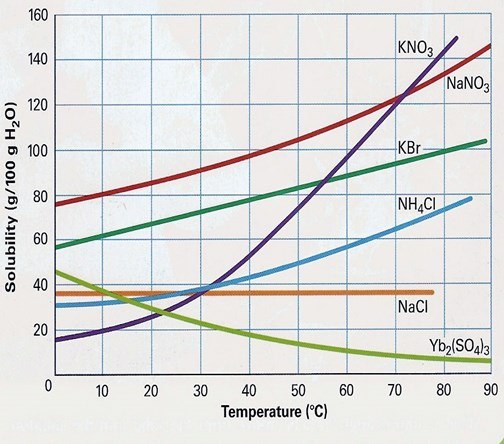
At 30'C, which substance has the lowest solubility?
KNO3
KBr
NaCl
Yb2(SO4)3
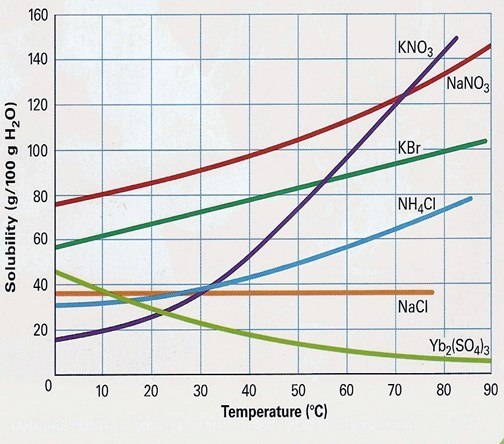
The solubility of Yb2(SO4)3 ________________ with added temperature.
increases
decreases
remains the same
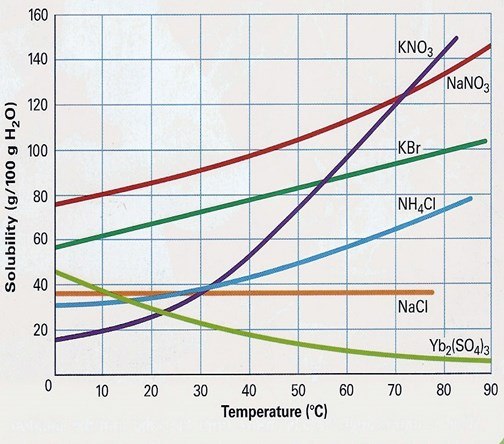
Identify if the following solution would be saturated, unsaturated, or supersaturated: 103 g KBr at 70'C.
Unsaturated
Saturated
Supersaturated
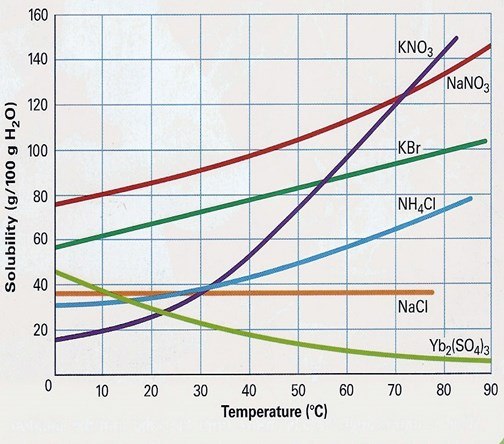
At 80'C, KBr's solubility is:
100
90
80
0

