
 Worksheets
Econ Final
Total questions: 52
Worksheet time: 2hrs 44mins

Which of these is a progressive tax?
airport tax
income tax
property tax
sales tax
What is gross income?
The amount of money you get in your bank account
The amount of money you earn
Your taxable wages
The total amount of money you have
Why does the US government enforce antitrust laws?
To ensure the development of public goods and services
To create incentives for research and development
To develop large-scale efficient industries
To ensure competition in the marketplace

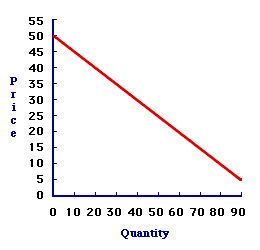
Mr. Sherman goes to the ticket booth to buy tickets for a Lakers game. Mr. Sherman is told that the game is sold out and no tickets are available. Which best explains why there are no basketball tickets available?
A new type of television set uses 3-D images. many stores will have large quantities of the older style televisions. What will happen to the price of these older televisions?


What is the purpose of a free-market system?
to protect the conditions that enable specialization
to stimulate the growth of the gross domestic product
to raise the standard of living for everyone in the country
to allow consumers and producers to make their own decisions
When demand changes a lot with the price of a good that is
Elastic
Inelastic
Which of the following describes the relative elasticity in demand for toothpaste?
Demand is inelastic because it is a luxury item
Demand is elastic because there are no substitutes
Demand is inelastic because it makes up a large share of most people’s budget
Demand is inelastic because it is a low-cost necessity
GDP per capita is found by dividing a country's GDP by it's
population.
average birth rates.
number of households.
Wants
Necessary items for life that are paid monthly/yearly such as food, housing, transportation, utilities, insurances
Expenses that equal all the fixed and variable expenses added together
Things or tems that a person would like to own or purchase that is not necessary for life; Ex. entertainment, video games, etc.
Income from all possible sources
Budget
Anything that you might incur an expense for
Is a spending plan for managing your money that includes income and expenses
All expenses deducted from income before net pay can result.
Income after all deductions have been paid.
Total monthly income
Income from only one source
Total income of your parents and siblings added to your income.
Income from all possible sources.
A spending plan of expenses
Needs
Necessary items that are paid monthly./yearly such as food, housing, transportation, utilities, & Insurance
Things you would like to have but are not necessary for life.
Income from all sources that are spent for necessary items
Anything that you might incur an expense for.
Total Expenses
Is a spending lan for managing your money that includes income and expenses.
All expenses deducted from income before net pay can result
Expenses tat remain the same month after month such as mortgages, rent, car payments & insurances
Expenses that equal all the fixed expenses and variable expenses
Pay Stub
Expenses that increase/decrease monthly or yearly EX: TV provider, internet, food, entertainment, utilities
Hard or electronic copy of earnings that show all deductions and results in net pay
Federal or State tax on your gross income
Income left over after paying all expenses for the month or year.
Fixed expenses
Is a spending plan for managing your money
Income from all possible sources
Expenses that equal all the fixed & variable expenses.
Expenses that remain the ssame month after month EX: mortgages, rent, car payments insurances
Variable expenses
Necessary things or items that are paid monthly
Expenses that increase/decrease monthly/yearly EX: Utilities, food, entertainment, internet, TV provider
Is a spending plan for managing your money that includes income and expenses.
Expenses that remain the same over a period of time.
Income tax
Federal, state, and local taxes taken out as deductions from a person or business revenue source
An occupation that allows for advancement opportunities
Anything you might incur an expense for.
Income after tax
Gross Income
Hard copy of revenue
Income from all sources before deductions such as retirement, health insurance, federal, state, and local taxes, etc
all expenses for the month
income left over after taxes
Net pay
Revenue before deductions
State and local taxes
Income after all deductions have been paid
I don't know i just want pizza and wings
Emma makes $300 each paycheck and is paid twice a month. Can she afford to pay for an apartment that charges $700 rent?
yes
no
David pays $500 a month in rent, $200 for groceries, and $300 for his car payment. How much are his expenses?
$1,010
$900
$1,100
$1,000
You want to be spending ____ than what you are making.
more
less
If you earn $900 a month and spend $500 on rent, $200 on groceries, and $75 on utilities, do you have enough money to pay $50 a month for TV?
yes
no
Sam earns $1,000 a month and pays $600 in rent, $300 on groceries, $250 for his car, and $30 for streaming subscriptions. Is this a smart budget?
yes
no
Which of the following is a benefit of using a budget?
Helps to keep track of the money you receive
Helps to prioritize your spending
Helps reach short- and long-term financial goals
All of the above
Your employer sends you a _______ form that tells you how much you've made and how much you've paid in
taxes in the last year.
1040
W-2
W-4
W-9
Dayanara's gross income was $550. What was her net income if her deductions were $110 for payroll taxes and $22.50 for health insurance?
$132.50
$417.50
$440.00
$638.50
Healthcare, paid time off, disability insurance, and matching contributions to a retirement account are all types of _________ available from your employer.
benefits
pensions
allowances
deductions
When considering a job offer, you should consider how much you're being paid and any other employee benefits before you accept the offer.
TRUE
FALSE
What do taxes pay for?
Operation of financial institutions
Schools, government departments, roads, and emergency services
Privately-owned businesses
None of the above

